Food Traceability
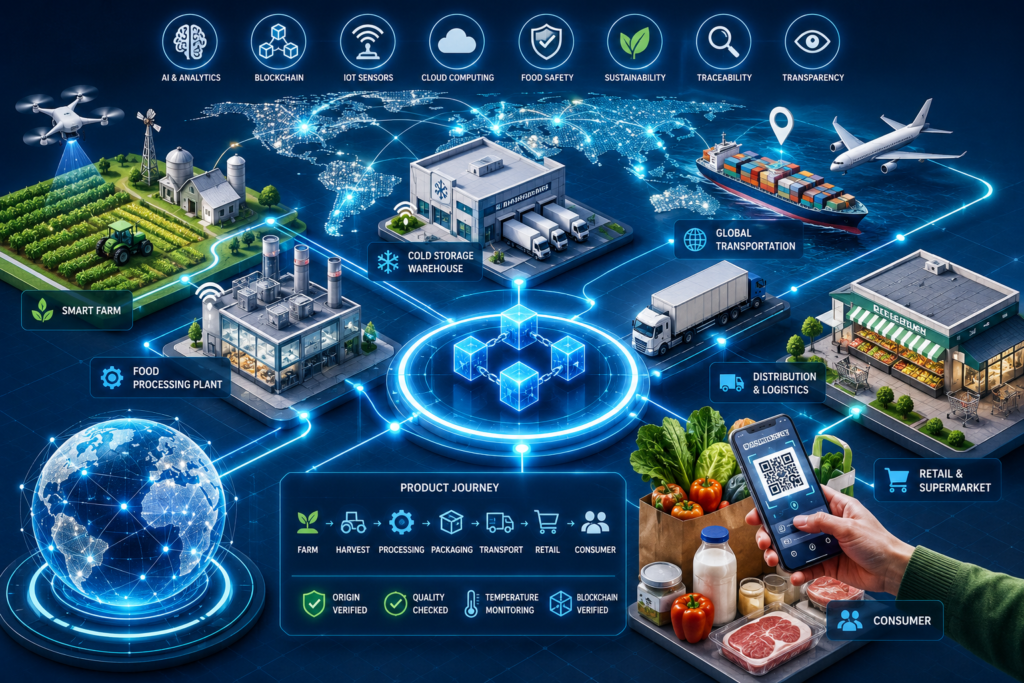
Imagine standing in a supermarket aisle, reaching for a carton of milk or a package of fresh strawberries. Before placing it in your shopping basket, you scan a QR code on the packaging with your smartphone. Instantly, a detailed history appears on your screen. You can see where the product was grown, the date it was harvested, how it was transported, the temperatures it experienced during shipping, the quality inspections it passed, and even the sustainability certifications it earned before arriving at the store.
Only a few years ago, this level of transparency felt futuristic. Today, it is becoming the new standard across the global food industry.
Consumers have become more informed than ever. They are no longer satisfied with attractive packaging or bold marketing claims. Instead, they want evidence. They want reassurance that the food they buy is safe, ethically sourced, environmentally responsible, and authentic. Whether purchasing organic vegetables, premium seafood, dairy products, or packaged snacks, today’s buyers expect brands to prove their claims with verifiable data rather than promises.
This growing demand has made Food Traceability one of the most important investments food businesses can make in 2026.
At the same time, governments around the world are introducing stricter food safety regulations. Retailers are tightening supplier requirements. Investors are evaluating environmental, social, and governance (ESG) performance before funding food companies. Together, these forces are pushing businesses toward smarter, more transparent supply chains.
Fortunately, advances in Food Technology are making this transformation possible.
Artificial Intelligence (AI), blockchain, cloud computing, Internet of Things (IoT) sensors, and advanced analytics are revolutionizing the way food moves from farms to consumers. These technologies no longer serve only multinational corporations. Today, businesses of all sizes—from family-owned farms to global food manufacturers—can implement digital systems that improve efficiency, strengthen compliance, reduce waste, and build stronger customer relationships.
Among these innovations, AI and blockchain food traceability solutions are emerging as the most influential technologies reshaping the industry.
Artificial intelligence analyzes enormous amounts of supply chain data, identifies risks before they become costly problems, predicts disruptions, and helps companies make faster decisions. Blockchain, on the other hand, creates permanent, tamper-resistant digital records that improve accountability and trust among everyone involved in the supply chain.
When these technologies work together, they create an ecosystem where information flows securely from producers to processors, distributors, retailers, regulators, and consumers.
This transformation is changing more than operational efficiency.
It is fundamentally changing how consumers perceive food brands.
Today’s customers are willing to reward businesses that demonstrate honesty and transparency. Numerous market studies consistently show that consumers are more likely to remain loyal to brands they trust. Transparency has evolved from being a marketing advantage into a critical factor influencing purchasing decisions.
This explains why leading food companies are investing millions in digital traceability platforms rather than viewing them merely as compliance tools.
Businesses increasingly recognize that transparency directly contributes to:
- Higher customer confidence
- Stronger brand reputation
- Faster food recall management
- Reduced food fraud
- Better supplier accountability
- Increased operational efficiency
- Long-term customer loyalty
These benefits extend well beyond food safety.
They also improve profitability.
Every supply chain disruption carries financial consequences. A delayed shipment, inaccurate inventory record, contaminated ingredient, or counterfeit product can damage consumer confidence almost overnight. In today’s connected world, negative news spreads across social media within minutes, making recovery both expensive and time-consuming.
Food traceability provides businesses with the ability to identify problems quickly, isolate affected products, and protect unaffected inventory before reputational damage escalates.
Consumers notice this responsiveness.
Rather than seeing occasional recalls as evidence of failure, they increasingly judge companies by how transparently and efficiently they respond when issues arise.
This shift represents one of the biggest changes in modern consumer behavior.
People no longer expect perfection.
They expect accountability.
That is precisely why Food Traceability has become one of the fastest-growing areas of investment across agriculture, manufacturing, logistics, and retail.
Beyond food safety, traceability also supports broader sustainability initiatives. Consumers are asking difficult questions:
- Was this coffee ethically sourced?
- Is this seafood legally harvested?
- Were pesticides used responsibly?
- Does this product contribute to deforestation?
- Were workers treated fairly throughout production?
Answering these questions requires reliable, accessible data—not assumptions. Modern traceability systems provide that evidence, allowing companies to verify sustainability claims while reducing the risk of greenwashing accusations.
The business case is equally compelling.
Companies implementing advanced traceability systems often experience improvements in inventory management, supplier collaboration, demand forecasting, and regulatory compliance. Digital records reduce paperwork, automate audits, simplify reporting, and improve decision-making throughout the organization.
In competitive markets, these operational advantages can significantly improve profitability while simultaneously enhancing customer satisfaction.
As global food supply chains become increasingly interconnected, the importance of transparency will only continue to grow.
Businesses that embrace digital traceability today are positioning themselves ahead of competitors who continue relying on outdated manual processes.
Throughout this comprehensive guide, we’ll explore three powerful ways Food Traceability is transforming the food industry in 2026. You’ll discover how artificial intelligence and blockchain are improving Supply Chain Transparency, why transparency has become one of the strongest drivers of brand loyalty, and how businesses can leverage modern Food Technology to gain a sustainable competitive advantage.
Whether you’re a food entrepreneur, investor, manufacturer, retailer, distributor, farmer, or simply a curious consumer, understanding these innovations will provide valuable insight into where the future of food is heading—and why transparency is rapidly becoming the industry’s most valuable currency.
As food safety regulations continue to evolve, businesses should stay informed about the Food and Agriculture Organization (FAO), which outlines modern recordkeeping requirements designed to improve supply chain visibility and accelerate food recalls.FAO Official Website

Food Traceability: Understanding the Foundation of Modern Food Technology
What Is Food Traceability?
At its core, Food Traceability is the ability to monitor and document every stage of a food product’s journey—from the origin of raw ingredients to the moment the finished product reaches the consumer.
Rather than relying on fragmented records or manual documentation, modern traceability systems create a continuous digital record of every significant event within the supply chain.
These events typically include:
- Farm production
- Harvest dates
- Processing activities
- Packaging operations
- Storage conditions
- Transportation routes
- Warehouse management
- Retail distribution
- Final point of sale
Every participant contributes information that creates a complete history of the product.
When integrated with modern Food Technology, this information becomes available almost instantly through cloud platforms, QR codes, RFID tags, IoT sensors, and blockchain networks.
This level of visibility allows businesses to answer critical questions such as:
- Where did this product originate?
- Which supplier provided the ingredients?
- What temperatures were maintained during transportation?
- Has the product exceeded recommended storage conditions?
- Which batches may be affected during a recall?
- Can sustainability claims be verified?
- Is the product authentic?
Years ago, gathering this information could take days—or even weeks. Today, advanced digital systems can provide answers within seconds.
This dramatic improvement is why Food Traceability has become a strategic business investment rather than simply a regulatory requirement.
Food Traceability in 2026: Why Transparency Has Become a Competitive Business Advantage
Over the past decade, food companies competed primarily on three factors:
- Price
- Quality
- Convenience
In 2026, a fourth factor has become equally important:
Transparency.
Consumers increasingly associate transparent brands with higher quality, greater safety, stronger ethics, and better sustainability practices.
This change has fundamentally altered purchasing behavior.
Modern consumers are far more likely to support companies that openly share information about sourcing, production, and environmental responsibility. Businesses that embrace Food Traceability are therefore gaining more than operational improvements—they are earning something far more valuable: trust.
In today’s digital economy, trust directly influences repeat purchases, positive reviews, customer advocacy, and long-term brand loyalty. It transforms one-time buyers into loyal customers who actively recommend a brand to friends, family, and online communities.
For food businesses, this shift presents a powerful opportunity. By investing in Food traceability technology for supply chain transparency, companies can strengthen consumer confidence while improving efficiency, reducing risk, and positioning themselves for sustainable growth in an increasingly competitive marketplace.
Food Traceability: Powerful Way #1 — How AI and Blockchain Build Trusted Supply Chain Transparency
If there is one reason Food Traceability has become a strategic investment rather than just a compliance requirement, it is the remarkable combination of Artificial Intelligence (AI) and Blockchain Food technology.
Individually, these technologies are impressive. Together, they are transforming the global food industry by creating supply chains that are smarter, faster, more transparent, and significantly more trustworthy.
In previous decades, tracing the source of contaminated food or verifying the authenticity of imported products could take several days—or even weeks. During that time, retailers often removed entire product categories from shelves because they couldn’t accurately identify which batches were affected.
Today, businesses equipped with AI and blockchain food traceability solutions can pinpoint affected products in minutes instead of days.
That difference saves millions of dollars while protecting consumers and preserving brand reputation.
More importantly, it gives customers confidence that the companies they support value honesty over secrecy.
Food Traceability and Artificial Intelligence: Creating Smarter Supply Chains
Artificial Intelligence is changing nearly every industry, and the food sector is no exception.
Within Food Technology, AI serves as the intelligent brain behind modern traceability systems.
Instead of simply collecting information, AI analyzes enormous volumes of data in real time, helping businesses predict problems before they become expensive crises.
Think about the amount of information generated throughout a food product’s journey.
Every shipment creates records about:
- Temperature
- Humidity
- Vehicle location
- Warehouse conditions
- Delivery schedules
- Production speed
- Inventory levels
- Supplier performance
- Customer demand
- Quality inspections
Without AI, much of this information remains underused.
Artificial intelligence processes millions of data points simultaneously, identifying hidden patterns that humans would likely miss.
For example, AI can detect that a refrigeration unit is slowly failing long before temperatures reach dangerous levels.
Instead of discovering spoiled products after delivery, businesses receive an early warning, allowing maintenance teams to intervene before food quality is compromised.
This predictive capability reduces waste, improves food safety, and protects profits.
Food Traceability Benefits from AI Predictive Analytics
One of the greatest advantages of AI is predictive analytics.
Rather than reacting to problems, companies begin preventing them.
AI can accurately forecast:
- Supply shortages
- Transportation delays
- Seasonal demand
- Product spoilage
- Equipment failures
- Inventory shortages
- Supplier risks
- Quality inconsistencies
Imagine a fruit exporter preparing thousands of shipments.
Weather forecasts predict unusually high temperatures across several transport routes.
Instead of waiting for products to spoil, AI recommends alternative shipping schedules, optimized delivery routes, and improved cold-chain monitoring.
The result is fresher produce, lower waste, happier retailers, and more satisfied consumers.
This proactive approach is becoming one of the strongest competitive advantages in modern Food Technology.
How AI Improves Food Safety
Food safety has always depended on rapid decision-making.
Artificial intelligence accelerates those decisions dramatically.
AI systems continuously monitor:
- Cold storage temperatures
- Food processing equipment
- Packaging quality
- Transportation conditions
- Production line efficiency
- Supplier compliance
- Shelf-life predictions
When abnormal patterns appear, alerts are generated immediately.
Instead of discovering contamination during routine inspections, businesses can intervene before unsafe products leave the facility.
Consumers may never notice these behind-the-scenes improvements.
But they certainly notice the outcome:
Safer food.
That quiet reliability strengthens trust over time.
Food Traceability and Blockchain Food Technology
While AI analyzes information, blockchain protects it.
Blockchain functions as a decentralized digital ledger where every transaction is permanently recorded.
Unlike traditional databases, blockchain records cannot easily be altered, deleted, or manipulated.
Every participant in the supply chain contributes verified information.
This creates a permanent history that everyone can trust.
For food businesses, this means every important event becomes securely documented.
Examples include:
- Farm origin
- Harvest date
- Processing facility
- Transportation records
- Storage temperatures
- Quality inspections
- Laboratory testing
- Distribution centers
- Retail delivery
Once recorded, these details remain available throughout the product’s lifecycle.
Consumers scanning a QR code can verify the information themselves.
That transparency dramatically increases confidence.
Why Blockchain Food Is Becoming Essential
Counterfeit food products represent a growing global challenge.
Premium products are especially vulnerable.
Examples include:
- Olive oil
- Honey
- Organic vegetables
- Coffee
- Chocolate
- Wine
- Seafood
- Premium beef
Unscrupulous suppliers sometimes mislabel cheaper products as premium alternatives.
Without reliable verification, consumers unknowingly pay higher prices for inferior products.
Blockchain changes that.
Every stage of production becomes permanently documented.
Authenticity becomes much easier to verify.
Businesses that invest in Blockchain Food systems therefore gain two major advantages:
- Protection against fraud
- Stronger consumer confidence
Food Traceability Makes Food Recalls Faster
Food recalls are expensive.
More importantly, they can permanently damage public trust.
Traditional recalls often involve uncertainty.
Companies may know contamination exists but struggle to identify exactly which products are affected.
To remain safe, they recall everything.
This approach wastes enormous quantities of food.
Modern Food Traceability changes the equation.
Using blockchain records, businesses can quickly determine:
- Which farm supplied the ingredients
- Which production batch was affected
- Which warehouses received shipments
- Which retailers stocked the products
- Which consumers may be impacted
Instead of recalling millions of products unnecessarily, businesses isolate only the affected batches.
The result includes:
- Reduced financial losses
- Less food waste
- Faster public communication
- Higher consumer confidence
Food Traceability Technology for Supply Chain Transparency
One of the biggest weaknesses in traditional supply chains has always been information gaps.
Every participant often maintains separate records.
Farmers record harvests.
Processors maintain production logs.
Distributors manage transportation records.
Retailers track inventory.
Unfortunately, these systems rarely communicate effectively.
Information becomes fragmented.
Errors accumulate.
Accountability weakens.
Modern Food traceability technology for supply chain transparency eliminates these disconnected systems.
Instead, every authorized participant shares secure, synchronized information across one integrated ecosystem.
This dramatically improves visibility.
Comparison Table: Traditional Supply Chains vs AI-Powered Food Traceability
| Feature | Traditional Supply Chain | AI & Blockchain Food Traceability |
|---|---|---|
| Product visibility | Limited | End-to-end visibility |
| Recall speed | Several days or weeks | Minutes or hours |
| Fraud detection | Difficult | Real-time verification |
| Consumer transparency | Very limited | QR code access to verified information |
| Data accuracy | Manual entry | Automated digital records |
| Inventory management | Reactive | Predictive AI optimization |
| Compliance reporting | Paper-intensive | Automated documentation |
| Supplier accountability | Limited | Full lifecycle verification |
| Brand reputation | Vulnerable | Strengthened through transparency |
| Customer trust | Marketing-based | Evidence-based trust |
The contrast is striking.
Companies no longer need to rely solely on promises.
Instead, they provide verifiable evidence.
That evidence has become one of the most valuable business assets in today’s marketplace.

Food Traceability Creates Competitive Advantage
Businesses adopting traceability early gain advantages beyond compliance.
They become more attractive to:
- Investors
- Retail partners
- International buyers
- Government regulators
- Environmentally conscious consumers
These advantages accumulate over time.
Companies known for transparency often enjoy:
- Higher customer retention
- Stronger online reviews
- Greater media credibility
- Improved retailer relationships
- Easier international expansion
- Better crisis management
- Increased market valuation
Trust has become a measurable business asset.
Food Traceability Is Reshaping the Future of Food Technology
The food industry is entering a new era.
Instead of asking whether transparency is necessary, businesses are asking how quickly they can implement it.
Consumers expect instant access to information.
Governments demand stronger accountability.
Retailers require higher supplier standards.
Investors increasingly evaluate operational resilience before funding food businesses.
Together, these forces are accelerating adoption of AI and blockchain food traceability solutions across agriculture, manufacturing, logistics, and retail.
The companies investing today are not simply responding to regulations—they are building a foundation for long-term resilience, profitability, and consumer trust.
Food Traceability: Powerful Way #2 — How Food Traceability Builds Consumer Trust in 2026
Trust has always been one of the most valuable assets a food business can earn. In the past, companies built trust primarily through advertising, consistent product quality, and word-of-mouth recommendations. While those factors still matter, today’s consumers expect something more: proof.
People no longer want to rely solely on attractive packaging or marketing slogans. They want evidence that the food they buy is safe, ethically sourced, environmentally responsible, and exactly what it claims to be. This shift in consumer expectations has made Food Traceability a defining feature of successful food brands in 2026.
Modern shoppers have access to more information than ever before. With just a smartphone, they can compare products, read reviews, research ingredients, and even verify where food was grown or processed. As a result, transparency has become one of the strongest drivers of purchasing decisions.
Businesses that openly share information about their supply chains are earning higher levels of customer confidence, while companies that remain secretive often struggle to maintain credibility in an increasingly competitive marketplace.
Why Consumer Trust Matters More Than Ever
Consumer trust directly influences long-term business success.
When people trust a brand, they are more likely to:
- Buy repeatedly instead of switching to competitors.
- Recommend the brand to friends and family.
- Leave positive online reviews.
- Pay premium prices for products they believe are authentic.
- Forgive occasional mistakes when companies respond transparently.
- Become loyal advocates who strengthen the brand’s reputation.
Conversely, once trust is lost, rebuilding it can take years. A single food safety incident or misleading labeling claim can spread across social media within hours, damaging even well-established brands.
This is why Food Traceability has become more than a compliance tool—it is now a reputation management strategy.
How Food Traceability Builds Consumer Trust in 2026
Consumers today are not simply buying food; they are buying confidence.
They want reassurance that:
- The product is authentic.
- Ingredients are safe.
- Ethical sourcing claims are genuine.
- Sustainability promises are supported by evidence.
- Food has been handled properly throughout the supply chain.
Modern Food traceability technology for supply chain transparency provides this reassurance by making supply chain information accessible and verifiable.
For example, a consumer purchasing organic coffee can scan a QR code and discover:
- The farm where the coffee beans were grown.
- Harvest dates.
- Sustainability certifications.
- Processing facilities.
- Shipping history.
- Roasting information.
- Distribution details.
Instead of asking consumers to “trust us,” businesses now allow them to verify the information independently.
That shift fundamentally changes the relationship between brands and customers.
Why Younger Consumers Expect Food Traceability
Millennials and Generation Z have significantly influenced the rise of transparent supply chains.
These generations are:
- Digitally connected.
- Environmentally conscious.
- Health-focused.
- Socially responsible.
- Comfortable researching products before purchasing.
They expect businesses to answer questions such as:
- Where was this food produced?
- Is it sustainably sourced?
- Were workers treated fairly?
- Does the company support ethical farming?
- Is the packaging environmentally friendly?
Companies unable to answer these questions risk losing younger customers to more transparent competitors.
Food Traceability provides those answers.
Blockchain Food Creates Confidence Through Verification
One reason Blockchain Food technology has become increasingly valuable is its ability to prevent data manipulation.
Traditional records can sometimes be altered or lost.
Blockchain creates permanent digital records.
Every transaction is timestamped.
Every update is verified.
Every participant shares the same trusted information.
Consumers appreciate this because it removes much of the uncertainty surrounding food claims.
Rather than depending solely on marketing language, they can verify:
- Product origin.
- Processing history.
- Transportation records.
- Certifications.
- Inspection reports.
Verification is replacing assumption.
Food Traceability Reduces Consumer Anxiety
Food purchasing decisions often involve uncertainty.
Consumers worry about:
- Foodborne illnesses.
- Counterfeit products.
- Misleading labels.
- Hidden allergens.
- Chemical contamination.
- Unsustainable farming.
- Animal welfare.
Modern traceability systems address these concerns by providing reliable information before purchase.
This reduces anxiety and increases purchasing confidence.
Customers feel empowered because they have access to facts rather than assumptions.
Real-World Applications Across the Food Industry
Food Traceability is transforming virtually every food sector.
Fresh Produce
Consumers verify:
- Farm location.
- Harvest dates.
- Pesticide compliance.
- Transportation conditions.
Fresh fruits and vegetables benefit enormously from transparency because freshness directly affects purchasing decisions.
Seafood
Seafood fraud remains a global concern.
Traceability helps verify:
- Catch location.
- Fishing methods.
- Sustainability certifications.
- Processing history.
Consumers gain confidence that premium seafood products are genuine.
Dairy Products
Milk, cheese, and yogurt require careful temperature management.
Digital traceability allows businesses to monitor cold-chain conditions throughout transportation.
Consumers benefit from improved safety and freshness.
Meat Products
Traceability documents:
- Animal origin.
- Veterinary records.
- Feed information.
- Processing facilities.
- Inspection results.
This information reassures consumers concerned about food safety and ethical farming.
Organic Foods
Organic products often command premium prices.
Consumers expect proof that organic standards have been followed.
Traceability provides documentation supporting certification claims.
Food Technology Is Making Transparency Affordable
Several years ago, advanced traceability systems were primarily available to multinational corporations.
Today, cloud-based Food Technology platforms have dramatically lowered implementation costs.
Small and medium-sized businesses now have access to:
- QR code systems.
- Cloud databases.
- Mobile applications.
- AI-powered analytics.
- Blockchain verification.
- Digital compliance reporting.
This democratization of technology is accelerating adoption across the entire food industry.
further, these authoritative resources provide valuable information:
GS1 Global Traceability Standards

Conclusion
The food industry is undergoing one of the most significant transformations in its history. Advances in Food Technology have changed how products are grown, processed, transported, and purchased, while consumer expectations have redefined what it means to be a trusted food brand.
Throughout this guide, we explored three powerful ways Food Traceability is reshaping the industry. First, we examined how Artificial Intelligence and Blockchain Food technologies are creating smarter, faster, and more transparent supply chains. Together, these innovations enable businesses to monitor products in real time, predict potential disruptions, improve recall efficiency, and verify product authenticity with unprecedented accuracy.
Next, we explored how Food Traceability builds consumer trust in 2026. Modern shoppers expect more than marketing claims—they expect evidence. By giving customers access to verified information about sourcing, production, transportation, and sustainability, businesses can transform transparency into a lasting competitive advantage. Trust, once earned, encourages repeat purchases, strengthens brand loyalty, and turns satisfied customers into enthusiastic advocates.
Finally, we examined why investing in Food traceability technology for supply chain transparency is a smart business decision. Digital traceability reduces waste, improves compliance, enhances supplier accountability, and supports better operational decisions. It also positions companies to meet evolving regulatory requirements and rising consumer expectations while creating long-term value for investors and stakeholders.
Looking ahead, the future of Food Traceability will be shaped by continued innovation in AI, blockchain, IoT, and cloud technologies. Businesses that embrace these advancements today will be better equipped to navigate increasingly complex supply chains, respond to emerging risks, and build stronger relationships with customers.
In a marketplace where transparency has become a defining measure of quality, Food Traceability is no longer optional—it is a strategic investment in resilience, reputation, and sustainable growth. Companies that lead with openness and verifiable information will be best positioned to earn consumer confidence and thrive well beyond 2027.
About The Author