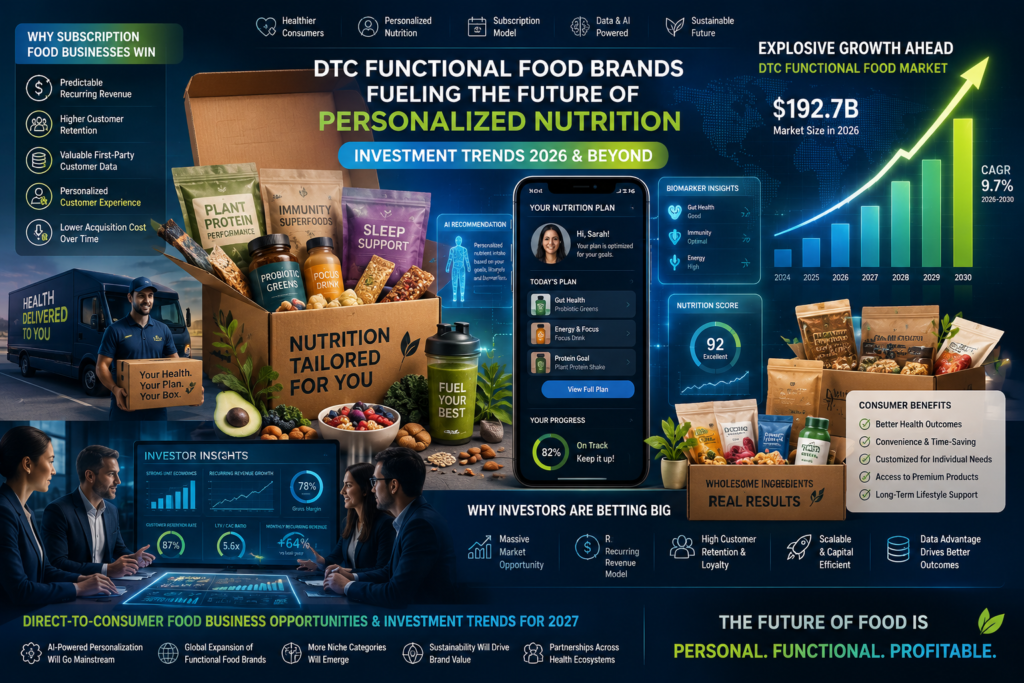
Functional Food Brands
The food industry is undergoing one of the most significant transformations in decades. For generations, food companies competed primarily on taste, convenience, and price. Today, however, consumers expect much more from the products they consume. They want food that supports their health goals, aligns with their lifestyles, and delivers measurable benefits beyond basic nutrition.
This shift has created a booming market for Functional Food Brands, a rapidly expanding segment that combines nutrition, science, technology, and direct consumer engagement.
At the center of this revolution lies Personalized Nutrition, an approach that recognizes that every individual has unique dietary needs, health goals, and biological characteristics. Instead of offering generic solutions, modern food companies are leveraging data, artificial intelligence, health tracking, and consumer insights to create tailored nutritional experiences.
Investors have taken notice.
Venture capital firms, private equity groups, and institutional investors are increasingly directing capital toward innovative food businesses that blend wellness with technology. The appeal is obvious: recurring revenue, strong customer loyalty, valuable consumer data, and enormous market growth potential.
Meanwhile, the rise of the Food Subscription Business model has given these companies a predictable and scalable path to revenue growth. Rather than relying on occasional purchases, many modern brands establish recurring relationships with customers through monthly subscription programs.
The result is a perfect storm of opportunity.
As we move through 2026, DTC Food Brands are becoming some of the most closely watched businesses in both the food and technology sectors.
In this article, we’ll explore:
- Why Functional Food Brands are attracting investor attention
- How Personalized Nutrition is reshaping consumer behavior
- Why subscription models are outperforming traditional food retail
- The biggest direct-to-consumer food business opportunities emerging through 2027
- Four major investment trends fueling industry growth

Why Functional Food Brands Are Becoming an Investment Hotspot
Traditional food companies have historically operated on volume.
Their success depended on selling as many products as possible through supermarkets, wholesalers, and distributors. While this model still works, it comes with limitations:
- Thin profit margins
- Limited consumer data
- Dependence on retailers
- High competition
- Difficulty building direct customer relationships
Functional Food Brands have introduced a fundamentally different approach.
These businesses create products designed to deliver specific health benefits, such as:
- Improved gut health
- Enhanced immunity
- Better sleep quality
- Increased energy
- Cognitive performance support
- Weight management
- Athletic recovery
Examples include:
- Probiotic beverages
- Adaptogenic drinks
- Protein-rich meal replacements
- Functional snacks
- Vitamin-enhanced foods
- Personalized supplement programs
Consumers increasingly view these products as investments in their long-term health rather than discretionary purchases.
This creates stronger purchasing habits and higher customer retention rates.
For investors, that translates into:
- Consistent demand
- Premium pricing power
- Brand loyalty
- Long-term scalability
According to market research from Grand View Research, the global functional foods market continues to expand at a significant pace as consumers prioritize preventative health and wellness.https://www.grandviewresearch.com
The Rise of Personalized Nutrition: A Fundamental Shift in Consumer Behavior
The concept of Personalized Nutrition has existed for years.
However, advances in technology have made it more accessible and practical than ever before.
Consumers now have access to:
- Wearable fitness trackers
- Health monitoring apps
- DNA testing kits
- Continuous glucose monitors
- AI-powered wellness platforms
These technologies generate valuable data that can be used to create highly customized nutritional recommendations.
Instead of following generalized dietary advice, consumers can receive recommendations based on:
- Age
- Activity level
- Metabolism
- Health conditions
- Fitness goals
- Genetic markers
This personalized approach creates a significantly stronger value proposition.
People are more likely to remain loyal to products that appear specifically designed for their needs.
As a result, Personalized Nutrition businesses often achieve:
- Higher retention rates
- Greater customer satisfaction
- Stronger recurring revenue
- Better customer lifetime value
Investors understand that these metrics are powerful indicators of long-term business success.
How Personalized Nutrition Startups Attract Investors in 2026
Understanding how personalized nutrition startups attract investors in 2026 requires examining what modern investors prioritize.
Today’s investors look beyond revenue.
They evaluate:
1. Proprietary Data
Data has become one of the most valuable assets in business.
Personalized nutrition companies collect insights about:
- Consumer preferences
- Health objectives
- Purchasing habits
- Product effectiveness
This information helps companies continuously improve their offerings.
2. Subscription Revenue
Investors love predictable cash flow.
Recurring monthly subscriptions provide:
- Stable revenue forecasts
- Improved valuation metrics
- Reduced customer acquisition pressure
3. Technology Integration
Companies combining food science with AI often command higher valuations.
Technology creates barriers to entry and competitive advantages.
4. Consumer Loyalty
Customers who receive personalized recommendations tend to remain engaged longer.
This lowers churn rates and improves profitability.
5. Scalability
The best personalized nutrition startups can expand globally without dramatically increasing operational complexity.
This scalability makes them attractive acquisition targets.
Functional Food Brands vs Traditional Food Companies
The differences between these business models explain why investors increasingly favor DTC food businesses.
| Factor | Functional Food Brands | Traditional Food Companies |
|---|---|---|
| Customer Relationship | Direct | Retailer-controlled |
| Data Collection | Extensive | Limited |
| Subscription Potential | High | Low |
| Product Personalization | High | Minimal |
| Profit Margins | Often Higher | Typically Lower |
| Brand Loyalty | Strong | Moderate |
| Growth Potential | Rapid | Mature |
| Investor Interest | Very High | Moderate |
This comparison highlights why capital continues flowing toward modern nutrition-focused businesses.
Functional Food Brands: 4 Proven and Inspiring Investment Trends Fueling the Explosive Growth of Personalized Nutrition in 2026
Investment Trend #1: Functional Food Brands Are Becoming Wellness Ecosystems
One of the biggest changes in 2026 is that Functional Food Brands are no longer selling individual products.
Instead, they are building complete wellness ecosystems.
Successful companies now offer:
- Personalized meal plans
- Nutrition coaching
- Health tracking tools
- Mobile applications
- Supplement subscriptions
- Community memberships
This ecosystem approach creates multiple revenue streams while strengthening customer engagement.
The more integrated the experience becomes, the harder it is for customers to switch to competitors.
For investors, this means:
- Higher customer lifetime value
- Lower churn
- Increased profitability
- Stronger competitive positioning
This trend is expected to accelerate significantly through 2027.
Investment Trend #2: Why Food Subscription Business Models Are Outperforming Traditional Retail
One of the most important developments behind the success of Functional Food Brands is the rise of the Food Subscription Business model.
Not long ago, food companies relied heavily on grocery stores, supermarkets, and wholesalers to reach consumers. While this distribution model still dominates much of the food industry, it comes with significant challenges:
- Retail shelf competition
- High distribution costs
- Limited customer insights
- Dependence on retailer relationships
- Constant pricing pressure
Subscription-based food companies have disrupted this traditional system.
Instead of competing for shelf space, they deliver products directly to consumers on a recurring basis.
Examples include:
- Personalized nutrition packages
- Healthy snack boxes
- Functional beverage subscriptions
- Protein meal plans
- Vitamin-enhanced food kits
- Wellness-focused food memberships
The appeal for consumers is straightforward:
Convenience
Customers no longer need to remember to reorder products.
Their preferred products arrive automatically.
Personalization
Subscriptions can be adjusted based on:
- Health goals
- Dietary preferences
- Allergies
- Fitness objectives
- Lifestyle changes
Consistency
Consumers often achieve better results when nutritional products become part of a routine.
Subscription models encourage habit formation.
Exclusive Benefits
Many brands offer:
- Loyalty rewards
- Educational content
- Expert consultations
- Community access
These additional benefits strengthen customer retention.
Why Subscription Food Businesses Are Growing Faster Than Traditional Food Brands
A major reason investors are excited about direct-to-consumer nutrition businesses is their recurring revenue structure.
Consider the difference.
Traditional Food Brand
A customer buys a product once.
The company must repeatedly spend money on advertising to encourage another purchase.
Subscription Food Business
The customer signs up once.
Revenue continues monthly until the customer cancels.
This creates:
- Predictable cash flow
- Better revenue forecasting
- Higher customer lifetime value
- Improved business stability
Investors place significant value on recurring revenue because it reduces uncertainty.
Businesses with predictable revenue streams often receive higher valuations than companies that depend entirely on one-time purchases.
Another important factor is customer engagement.
Subscription companies communicate with customers regularly through:
- Email marketing
- Mobile apps
- Nutrition updates
- Product recommendations
- Health insights
These touchpoints create stronger relationships and increase retention.
As a result, many subscription-based food companies experience faster growth than traditional packaged food brands.
The Economics Investors Love
Let’s examine why the subscription model attracts investor attention.
| Metric | Traditional Food Brand | Food Subscription Business |
|---|---|---|
| Revenue Predictability | Low | High |
| Customer Data Access | Limited | Extensive |
| Repeat Purchases | Uncertain | Automated |
| Customer Loyalty | Moderate | Strong |
| Lifetime Value | Lower | Higher |
| Investor Appeal | Moderate | High |
| Scalability | Moderate | High |
The numbers often tell a compelling story.
When investors evaluate opportunities, recurring revenue businesses consistently rank among the most attractive investments.
This is one reason DTC Food Brands continue attracting capital across venture capital and private equity markets.

Investment Trend #3: AI-Powered Personalized Nutrition Is Creating a New Category of Functional Food Brands
Artificial intelligence is transforming nearly every industry.
The food and nutrition sector is no exception.
Many experts believe the next phase of growth for Personalized Nutrition will be driven by AI.
Modern nutrition platforms can now analyze:
- Dietary habits
- Health records
- Activity levels
- Sleep patterns
- Biomarker data
- Consumer preferences
Using these insights, AI systems generate personalized recommendations tailored to individual needs.
For example:
A consumer seeking improved energy levels may receive:
- Customized meal plans
- Functional beverage recommendations
- Supplement suggestions
- Weekly dietary adjustments
As more data becomes available, recommendations become increasingly accurate.
This creates a powerful feedback loop.
The longer customers remain engaged, the more effective the personalization becomes.
How AI Strengthens the Value of Personalized Nutrition
Artificial intelligence creates benefits for both consumers and businesses.
Consumer Benefits
- More accurate recommendations
- Faster goal achievement
- Improved health outcomes
- Better user experiences
Business Benefits
- Increased customer retention
- Higher engagement rates
- Enhanced product recommendations
- Stronger customer relationships
For investors, AI-powered nutrition platforms represent a rare combination:
- Technology company
- Wellness company
- Data company
- Food company
Businesses operating at the intersection of multiple high-growth sectors often command premium valuations.
This explains why venture capital investment in personalized nutrition continues to increase.
How Personalized Nutrition Startups Attract Investors in 2026 Through Technology
The most successful startups are not merely selling food products.
They are building data-driven nutrition platforms.
Investors look for companies that possess:
Proprietary Algorithms
Unique recommendation systems can create sustainable competitive advantages.
Consumer Data Assets
First-party customer data becomes more valuable over time.
High Retention Rates
The better the personalization, the longer customers stay subscribed.
Scalable Infrastructure
Technology allows rapid expansion without proportionally increasing costs.
Global Market Potential
Health-conscious consumers exist worldwide.
This creates opportunities far beyond domestic markets.
These factors help explain how personalized nutrition startups attract investors in 2026.
Investment Trend #4: DTC Food Brands Are Winning the Data Advantage
One of the most overlooked reasons investors favor DTC Food Brands is data ownership.
Traditional food companies often know very little about the end consumer.
When products are sold through retailers, valuable customer information remains with the retailer.
Direct-to-consumer businesses operate differently.
They collect data directly from customers through:
- Online purchases
- Subscription programs
- Mobile apps
- Surveys
- Wellness assessments
- Customer support interactions
This information enables companies to make smarter decisions.
For example:
Brands can identify:
- Which products customers prefer
- Which ingredients drive repeat purchases
- Which demographics have the highest retention rates
- Which subscription plans perform best
These insights improve marketing efficiency and profitability.
Investors recognize the value of first-party data because it strengthens long-term competitiveness.
Best DTC Functional Food Brands for Investment in 2026
When evaluating the Best DTC functional food brands for investment in 2026, investors typically focus on several key characteristics rather than specific product categories.
Successful companies often demonstrate:
Strong Subscription Revenue
Recurring income improves financial predictability.
Personalized Experiences
Customization increases customer loyalty.
High Customer Retention
Retention often matters more than rapid acquisition.
Technology Integration
AI and health analytics create differentiation.
Brand Authority
Trust is critical in nutrition-related markets.
Community Building
Consumers increasingly seek brands that align with their lifestyles and values.
The strongest opportunities often emerge from businesses that combine all of these elements.
Emerging Categories Investors Are Watching Closely
Several segments are expected to dominate investment conversations through 2027.
Gut Health Products
Interest in digestive wellness continues to grow rapidly.
Examples include:
- Probiotics
- Prebiotics
- Fermented foods
- Functional beverages
Cognitive Nutrition
Products targeting focus, productivity, and mental performance are gaining traction.
Sports Nutrition
Athletes and fitness enthusiasts remain strong consumers of functional foods.
Women’s Health Nutrition
Personalized solutions addressing hormonal health are attracting increasing demand.
Healthy Aging
Products supporting longevity and healthy aging are becoming major investment targets.
Metabolic Health
As consumers become more health-conscious, products focused on blood sugar management and metabolic wellness continue expanding.
Direct-to-Consumer Food Business Opportunities and Investment Trends for 2027
Looking ahead, several trends are likely to shape the next phase of growth.
Greater Personalization
Consumers increasingly expect customized experiences.
Generic nutrition advice will continue losing relevance.
AI Integration
Artificial intelligence will become standard across nutrition platforms.
Subscription Expansion
More food categories will adopt recurring revenue models.
Preventive Health Focus
Consumers are investing in long-term wellness rather than reactive healthcare.
Premium Functional Products
People are increasingly willing to pay more for products with measurable benefits.
Global Expansion
Successful DTC food businesses will expand into international markets.
Data-Driven Product Development
Consumer insights will influence product creation more than ever before.
These developments create significant opportunities for entrepreneurs, investors, and established food companies alike.
How Functional Food Brands Are Transforming Consumer Health and Wellness in 2026
Functional Food Brands are redefining how consumers approach health and nutrition in 2026. Rather than focusing solely on taste and convenience, today’s consumers seek foods that deliver measurable health benefits, such as improved gut health, enhanced immunity, increased energy, and better mental performance. This shift has accelerated the growth of Personalized Nutrition, where products are tailored to individual health goals and lifestyles. Many brands now combine nutritional science, technology, and consumer data to create highly targeted solutions. As awareness of preventive healthcare continues to rise, functional foods are becoming a mainstream choice for health-conscious consumers worldwide. Learn more about consumer wellness trends from McKinsey & Company and industry market insights from Grand View Research.https://www.mckinsey.com
Why Subscription Food Businesses Are Becoming the Preferred Revenue Model for Investors
The Food Subscription Business model is rapidly gaining popularity because it offers predictable recurring revenue, stronger customer loyalty, and valuable consumer data. Unlike traditional food brands that rely on one-time purchases, subscription-based companies build long-term relationships with customers through personalized deliveries and ongoing engagement. This consistency makes revenue more stable and scalable, which is highly attractive to investors looking for sustainable growth opportunities in the evolving DTC Food Brands market.

Final Thoughts: Why Functional Food Brands Are Becoming One of the Most Exciting Investment Stories of the Decade
The explosive growth of Functional Food Brands is not simply a temporary trend.
It reflects a deeper transformation in how consumers think about health, wellness, and nutrition.
People increasingly want products that:
- Deliver measurable benefits
- Align with personal goals
- Fit seamlessly into daily routines
- Provide customized experiences
At the same time, investors are searching for businesses that offer:
- Recurring revenue
- Strong customer retention
- Valuable data assets
- Scalable growth opportunities
The convergence of Personalized Nutrition, Food Subscription Business models, and DTC Food Brands has created exactly that opportunity.
The four investment trends explored in this article—wellness ecosystems, subscription commerce, AI-powered personalization, and first-party data ownership—are fundamentally reshaping the food industry.
For entrepreneurs, these trends represent a blueprint for building the next generation of food businesses.
For consumers, they promise healthier and more personalized experiences.
And for investors, they may represent one of the most compelling long-term opportunities in the evolving world of food, health, and technology.
As we move toward 2027, one thing is becoming increasingly clear: the future of food will be more personalized, more data-driven, and more direct-to-consumer than ever before.
About The Author