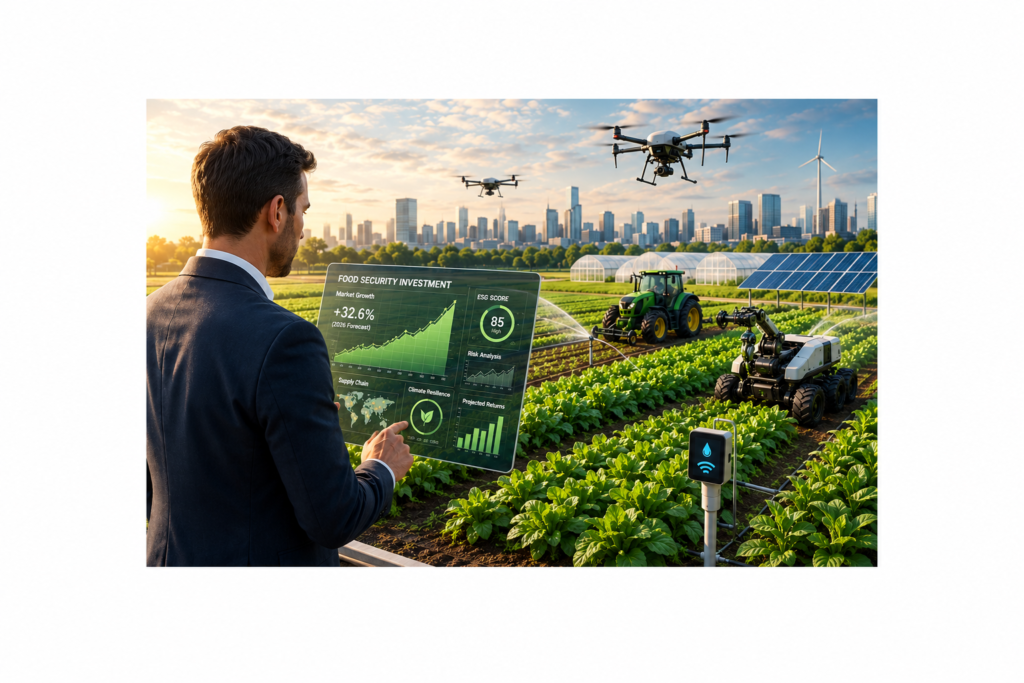
Food Security Investment
Food Security Investment is quickly becoming one of the most talked-about opportunities in the global investment landscape—and for good reason. Climate change is disrupting traditional agriculture at an unprecedented pace, bringing longer droughts, extreme floods, rising temperatures, and volatile food prices. At the same time, the world’s population continues to grow, increasing the demand for reliable, sustainable food production. This combination of challenges is transforming the way governments, businesses, and investors think about the future of food.
While these climate-driven disruptions pose significant risks to global food systems, they are also creating a wave of profitable opportunities for investors who can identify the industries driving innovation. From artificial intelligence-powered farming and precision agriculture to vertical farming, climate-resilient crops, sustainable aquaculture, and food supply chain technology, companies are developing groundbreaking solutions that not only address food insecurity but also offer strong long-term growth potential.
The shift toward climate-resilient agriculture is no longer a niche trend—it is a global investment movement. Governments are introducing supportive policies, financial institutions are increasing funding for sustainable agriculture, and private investors are actively seeking businesses that can thrive in a changing climate. As a result, Food Security Investment has evolved from a socially responsible concept into a strategic asset class with the potential to generate both meaningful impact and attractive financial returns.
In this comprehensive guide, you’ll discover 12 powerful and profitable climate-resilient investment opportunities that are reshaping the future of agriculture and global food systems. Whether you’re a seasoned investor looking to diversify your portfolio or a beginner exploring emerging markets, this article will help you understand where the smartest investment opportunities lie, what trends are driving the industry, and how you can position yourself to benefit from one of the fastest-growing sectors of the decade.
Climate change is no longer just an environmental concern—it has become one of the biggest forces shaping global investment decisions. From prolonged droughts and unpredictable rainfall to rising food prices and disrupted supply chains, the world’s food system is under increasing pressure. Yet, where many people see uncertainty, forward-thinking investors see opportunity.
Food Security Investment has rapidly emerged as one of the most promising long-term investment themes of 2026. Governments, private equity firms, venture capitalists, institutional investors, and even individual investors are pouring billions into businesses that can help feed a growing global population despite changing climate conditions.
Whether you’re looking to diversify your portfolio, invest in sustainable industries, or capitalize on emerging agricultural technologies, climate-resilient food investments offer a unique combination of financial potential and positive global impact.
In this guide, you’ll discover 12 powerful investment opportunities created by climate change, understand why food security has become one of the hottest investment trends, and learn practical strategies for building a resilient investment portfolio.

Why Food Security Investment Is Becoming a Global Priority
Food security means ensuring that people have reliable access to sufficient, safe, nutritious, and affordable food. Unfortunately, climate change is making this increasingly difficult.
Extreme weather events have become more frequent, reducing crop yields and disrupting transportation networks. Heatwaves damage livestock productivity, while flooding destroys farmland and infrastructure. At the same time, the global population continues to grow, placing even greater demand on agricultural production.
Food and Agriculture Organization of the United Nations (FAO)
These challenges are accelerating investments in technologies and businesses capable of producing more food using fewer resources.
For investors, this creates an opportunity to participate in industries expected to experience sustained growth for decades rather than just a few years.
Why Climate Change Is Creating New Investment Opportunities
Climate change isn’t only creating risks—it is reshaping entire industries.
Businesses are now developing innovative solutions to address problems such as:
- Water scarcity
- Soil degradation
- Food waste
- Crop diseases
- Rising food prices
- Supply chain disruptions
- Sustainable farming
- Carbon emissions in agriculture
Every one of these challenges creates new markets, new technologies, and new companies seeking investment.
That is why many analysts now consider agriculture and food technology among the most resilient sectors for long-term investing.
Food Security Investment Opportunities at a Glance
| Investment Opportunity | How It Supports Food Security | Climate Resilience Benefit | Growth Potential (2026–2027) | Risk Level |
|---|---|---|---|---|
| Precision Agriculture | Optimizes crop production using AI, drones, and IoT | Reduces water, fertilizer, and pesticide use | Very High | Medium |
| Vertical Farming | Produces crops indoors all year | Eliminates dependence on unpredictable weather | High | Medium |
| Sustainable Irrigation Systems | Improves water efficiency | Protects crops during droughts and water shortages | High | Low |
| Climate-Resilient Seed Companies | Develops heat-, drought-, and pest-resistant crops | Improves harvest reliability under extreme weather | Very High | Medium |
| Regenerative Agriculture | Restores soil health and biodiversity | Increases long-term farm productivity and carbon storage | High | Low |
| Alternative Protein Companies | Expands sustainable food sources | Reduces environmental impact compared to livestock | Very High | High |
| Agricultural Robotics | Automates farming operations | Solves labor shortages and improves efficiency | High | Medium |
| Food Waste Reduction Technologies | Reduces post-harvest and retail food losses | Improves food availability and supply chain efficiency | High | Low |
| Controlled Environment Agriculture (CEA) | Produces food in climate-controlled facilities | Minimizes weather-related production risks | High | Medium |
| Sustainable Aquaculture | Produces seafood with lower environmental impact | Reduces pressure on wild fish populations | High | Medium |
| Food Supply Chain Technology | Improves logistics, storage, and traceability | Strengthens resilience against climate disruptions | Very High | Low |
| Agricultural Biotechnology | Develops innovative crops and biological solutions | Enhances resistance to climate stress and disease | Very High | High |
12 Powerful Climate-Resilient Food Security Investment Opportunities
1. Precision Agriculture Technologies
Modern farms increasingly rely on artificial intelligence, GPS mapping, drones, robotics, and satellite imaging.
Precision agriculture allows farmers to:
- Reduce fertilizer use
- Save water
- Increase crop yields
- Lower operating costs
Companies developing smart farming software and autonomous equipment continue attracting strong investor interest because they improve efficiency while reducing environmental impact.
2. Vertical Farming
Traditional farming depends heavily on weather conditions.
Vertical farms grow crops indoors using LED lighting, hydroponics, and climate-controlled environments.
Benefits include:
- Year-round production
- Reduced land usage
- Minimal water consumption
- Fewer pesticides
- Shorter transportation distances
As urban populations expand, vertical farming continues becoming a major investment opportunity.
3. Sustainable Irrigation Systems
Water scarcity affects nearly every agricultural region.
Innovative irrigation technologies such as:
- Smart drip irrigation
- Soil moisture sensors
- Automated watering systems
help farmers produce more food while conserving precious water resources.
Demand for water-efficient farming solutions is expected to continue growing.
4. Climate-Resilient Seed Companies
Scientists are developing seeds capable of surviving:
- Heat
- Floods
- Salinity
- Drought
- New plant diseases
Seed innovation has become one of agriculture’s fastest-growing sectors because resilient crops reduce production risks for farmers worldwide.
5. Regenerative Agriculture
Instead of exhausting farmland, regenerative agriculture restores it.
Popular practices include:
- Cover cropping
- Crop rotation
- Compost application
- Reduced tillage
- Agroforestry
Healthy soils improve productivity while storing more carbon, creating potential revenue streams through carbon credit programs.
6. Alternative Protein Companies
Global demand for protein continues rising.
Meanwhile, livestock production contributes significantly to greenhouse gas emissions.
Investors are increasingly supporting businesses producing:
- Plant-based meat
- Precision fermentation proteins
- Cultivated meat
- Sustainable seafood alternatives
These sectors continue expanding as consumers seek environmentally friendly food options.
7. Agricultural Robotics
Labor shortages remain a major challenge for farmers.
Agricultural robots now perform tasks such as:
- Harvesting
- Weeding
- Spraying
- Fruit picking
- Crop monitoring
Automation improves productivity while reducing long-term labor costs.
8. Food Waste Reduction Technologies
Roughly one-third of food produced globally never reaches consumers.
Companies developing solutions such as:
- Smart storage systems
- AI inventory management
- Cold-chain logistics
- Food preservation technologies
are helping reduce waste while improving food availability.
This creates both environmental and financial benefits.
9. Controlled Environment Agriculture (CEA)
CEA combines technology with agriculture to produce food inside greenhouses and controlled facilities.
Advantages include:
- Stable production
- Better pest control
- Reduced climate risks
- Higher crop quality
Many investors consider controlled environment farming one of agriculture’s fastest-growing segments.
10. Sustainable Aquaculture
Wild fish populations continue declining.
Sustainable fish farming offers an alternative capable of meeting growing seafood demand while reducing pressure on oceans.
Innovations include:
- Recirculating aquaculture systems
- Smart fish monitoring
- Automated feeding technologies
11. Food Supply Chain Technology
Climate-related disruptions have exposed weaknesses throughout global food supply chains.
Technology companies now help improve:
- Supply chain visibility
- Inventory management
- Transportation optimization
- Blockchain traceability
- Food safety monitoring
Efficient logistics reduce costs while strengthening food security.
12. Agricultural Biotechnology
Biotechnology is transforming agriculture.
Researchers continue developing:
- Disease-resistant crops
- Pest-resistant plants
- Faster breeding techniques
- Gene-editing technologies
- Biological fertilizers
Although regulations vary across countries, biotechnology remains one of agriculture’s most innovative investment areas.

How to Build a Climate-Resilient Food Investment Portfolio
Investing wisely means balancing opportunity with risk.
Consider diversifying across multiple sectors instead of relying on a single investment.
A balanced portfolio may include:
- Agricultural technology
- Water management companies
- Sustainable food producers
- Seed innovation firms
- Greenhouse agriculture
- Alternative protein businesses
- Food logistics companies
Diversification helps reduce exposure to market fluctuations while capturing growth across different parts of the food system.
Why Food Security Investment Is One of the Fastest-Growing Trends in 2026
Food Security Investment has evolved from a niche investment theme into one of the most attractive long-term opportunities in the global financial market. As climate change continues to disrupt agricultural production, food supply chains, and commodity prices, investors are increasingly recognizing that Food Security Investment is not only about supporting sustainable development—it is also about capturing growth in an industry that is essential to every economy.
Unlike many sectors that fluctuate with changing consumer preferences, food remains a basic human necessity. Regardless of economic conditions, people need consistent access to safe, affordable, and nutritious food. This makes Food Security Investment particularly resilient, especially during periods of inflation, geopolitical uncertainty, and climate-related disruptions.
Climate Change Is Accelerating Food Security Investment
Climate change is placing unprecedented pressure on global agriculture. More frequent droughts, floods, hurricanes, wildfires, and rising temperatures are reducing crop yields and increasing food production costs. Farmers are being forced to adopt smarter technologies and climate-resilient farming practices to remain productive.
This growing demand for innovation has fueled Food Security Investment across multiple industries, including:
- Precision agriculture
- Smart irrigation systems
- Agricultural robotics
- Climate-resilient seed technology
- Vertical farming
- Regenerative agriculture
- Sustainable aquaculture
- Food logistics and supply chain technology
For investors, these sectors represent some of the most promising Climate-Resilient Investments available today because they address critical global challenges while creating long-term business value.
Rising Global Population Is Driving Agriculture Investment
The world’s population continues to grow, placing increasing pressure on food production systems. At the same time, urbanization is reducing available farmland, making it more important than ever to produce more food with fewer resources.
This is why Agriculture Investment is receiving unprecedented attention from governments, multinational corporations, institutional investors, and venture capital firms. Companies that improve crop productivity, conserve water, reduce food waste, and strengthen supply chains are attracting significant capital because they play a vital role in future food security.
As global demand for food increases, Food Security Investment is expected to remain a key driver of innovation and economic growth well beyond 2026.
Governments and Financial Institutions Are Increasing Support
Public and private investment in sustainable agriculture has expanded rapidly over the past few years. Governments around the world are introducing policies that encourage climate-smart farming, renewable energy adoption in agriculture, and investments in resilient food systems.
Meanwhile, banks, development organizations, and investment funds are directing billions of dollars toward Climate-Resilient Investments that improve agricultural productivity and reduce environmental risks. This influx of capital is creating new opportunities for businesses involved in AgriTech, biotechnology, food processing, and sustainable infrastructure.
For individual investors, this means Food Security Investment is benefiting from strong institutional backing, making it a sector with significant long-term potential.
Sustainable Food Investing Is Becoming Mainstream
Consumer preferences are changing just as quickly as agricultural technologies. More people are choosing sustainably produced food, environmentally responsible brands, and businesses that prioritize ethical sourcing. As a result, Sustainable Food Investing has become an important strategy for investors seeking both financial returns and positive environmental impact.
Companies focused on plant-based proteins, regenerative farming, carbon-smart agriculture, and eco-friendly food production continue to attract increasing investment because they align with global sustainability goals while addressing food security challenges.
This shift has transformed Sustainable Food Investing from a niche market into a rapidly growing investment category with strong prospects through 2027 and beyond.
Technology Is Transforming Food Security Investment
Technology is one of the biggest reasons Food Security Investment continues to gain momentum. Artificial intelligence, machine learning, drones, satellite imaging, Internet of Things (IoT) sensors, blockchain, and agricultural robotics are revolutionizing the way food is produced, transported, and distributed.
Modern farming is becoming more data-driven and efficient, enabling farmers to increase yields while reducing water use, fertilizer application, and operational costs. These innovations are creating attractive opportunities for investors seeking exposure to Climate-Resilient Investments and Agriculture Investment trends with long-term growth potential.
Food Inflation Is Creating New Investment Opportunities
Food prices have become increasingly volatile due to climate events, geopolitical conflicts, supply chain disruptions, and rising production costs. While food inflation presents challenges for consumers, it is also encouraging investment in businesses that can improve efficiency, stabilize production, and strengthen food distribution networks.
Companies developing innovative farming solutions, storage technologies, precision agriculture systems, and resilient food supply chains are well positioned to benefit from this structural shift. As a result, Food Security Investment is becoming a strategic choice for investors looking to hedge against long-term inflation while supporting industries that are critical to global economic stability.
Why Smart Investors Are Paying Attention
Experienced investors understand that some of the strongest opportunities arise from solving major global challenges. Food Security Investment sits at the intersection of climate resilience, technological innovation, sustainability, and rising global demand for food.
Whether through Agriculture Investment, Climate-Resilient Investments, or Sustainable Food Investing, investors are gaining exposure to sectors expected to experience sustained growth over the next decade. Businesses that help farmers adapt to climate change, reduce food waste, improve productivity, and strengthen supply chains are likely to remain essential as governments and consumers continue prioritizing resilient food systems.
For anyone seeking long-term portfolio growth, diversification, and exposure to one of the world’s most important industries, Food Security Investment represents more than a trend—it is a strategic investment theme with the potential to deliver lasting value well beyond 2026.
How Climate Change Is Reshaping Global Food Investment Strategies
Climate change is no longer a distant environmental issue—it is a major economic force influencing where capital flows and how investors evaluate long-term opportunities. Rising temperatures, shifting weather patterns, water shortages, and more frequent natural disasters are disrupting food production across the globe. As these challenges intensify, investors are moving away from traditional agricultural investments and focusing on businesses capable of thriving in a changing climate.
This shift has transformed Food Security Investment into one of the most attractive sectors for long-term investors. Instead of investing solely in farmland or conventional food production, many investors are now targeting innovative technologies, resilient infrastructure, and sustainable business models that can withstand climate-related risks while meeting the growing global demand for food.
The Growing Financial Impact of Climate Change on Agriculture
Agriculture is one of the industries most exposed to climate-related risks. A single drought, flood, or severe storm can reduce harvests, increase production costs, and disrupt food supplies across entire regions. These events often lead to food shortages, price volatility, and lower profitability for businesses that rely on traditional farming methods.
Some of the biggest climate-related challenges affecting global agriculture include:
- Longer and more severe droughts
- Extreme heat reducing crop yields
- Flooding that damages farmland and infrastructure
- Increased outbreaks of crop pests and diseases
- Declining soil fertility
- Water scarcity for irrigation
- Rising transportation and storage costs due to supply chain disruptions
Because these risks directly affect profitability, investors are increasingly prioritizing businesses that offer practical solutions rather than those dependent on outdated production systems.
Investors Are Prioritizing Climate-Resilient Businesses
One of the biggest changes in global investment strategies is the growing focus on climate resilience. Investors want companies that can continue operating successfully despite environmental challenges.
Businesses attracting the most attention include those involved in:
- Precision agriculture powered by artificial intelligence
- Smart irrigation and water conservation technologies
- Climate-resilient seed development
- Agricultural biotechnology
- Vertical and indoor farming
- Regenerative agriculture
- Sustainable aquaculture
- Food supply chain technology
These industries help reduce climate-related risks while improving efficiency, making them attractive options for investors seeking stable, long-term returns.
Technology Is Becoming the Foundation of Modern Agriculture
Technology is transforming the way food is produced, managed, and distributed. Rather than relying solely on experience and seasonal weather patterns, farmers now use advanced digital tools to make more informed decisions.
For example, artificial intelligence can analyze weather forecasts, monitor crop health, and recommend the best times for planting or harvesting. Drones and satellite imaging help farmers identify pest outbreaks before they spread, while soil sensors measure moisture levels to optimize irrigation and reduce water waste.
These innovations increase productivity, lower operating costs, and improve resilience against climate-related disruptions. As a result, technology-driven agriculture has become a key focus for investors looking to capitalize on the future of food production.
Food Supply Chains Are Becoming a Major Investment Opportunity
Climate change has exposed weaknesses in global food supply chains. Extreme weather events, transportation delays, and geopolitical tensions have shown how quickly food distribution can be disrupted.
In response, investors are funding companies that improve supply chain resilience through innovations such as:
- Cold-chain logistics
- Blockchain-based food traceability
- AI-powered inventory management
- Smart warehousing
- Real-time transportation monitoring
- Predictive demand forecasting
Businesses that strengthen food supply chains not only reduce waste but also improve food availability and enhance overall food security.
Water Management Is Driving New Investment Decisions
Water has become one of the most valuable resources in agriculture. With droughts becoming more common in many parts of the world, efficient water management is now essential for maintaining food production.
This has created growing demand for businesses specializing in:
- Drip irrigation systems
- Smart irrigation controllers
- Rainwater harvesting technologies
- Water recycling systems
- Soil moisture monitoring
- Precision water management software
Companies providing these solutions are well positioned for long-term growth as governments and farmers invest in sustainable water use.
ESG Investing Is Accelerating Capital Into Sustainable Agriculture
Environmental, Social, and Governance (ESG) investing has become an important factor influencing investment decisions. Many institutional investors now evaluate companies based not only on financial performance but also on their environmental impact and long-term sustainability.
Businesses involved in regenerative agriculture, carbon farming, renewable energy integration, and responsible food production are increasingly attracting investment because they align with global sustainability goals while offering competitive financial returns.
This trend is encouraging more capital to flow into companies that support resilient food systems and climate adaptation.
Climate Change Is Fueling Innovation Across the Food Industry
Some of the most exciting investment opportunities are emerging from companies developing entirely new ways to produce food. Innovations that were once considered experimental are becoming commercially viable, including:
- Plant-based protein products
- Cultivated meat technologies
- Precision fermentation
- Indoor farming systems
- Autonomous farming equipment
- Climate-smart greenhouses
- Biological crop protection solutions
These businesses are helping reduce agriculture’s environmental footprint while creating new markets with strong growth potential.
What This Means for Smart Investors
Climate change is reshaping investment strategies by shifting attention toward industries that can adapt to environmental challenges. Investors who recognize these changes early have the opportunity to build diversified portfolios focused on innovation, resilience, and long-term demand.
Rather than viewing climate change solely as a source of risk, many experienced investors see it as a catalyst for economic transformation. Companies developing solutions to strengthen global food systems are likely to play an increasingly important role in the future economy.
Key Takeaway
The future of Food Security Investment lies in resilience, innovation, and sustainability. As climate change continues to influence agricultural production and global food markets, investment strategies are evolving to prioritize businesses that can produce more food with fewer resources while adapting to changing environmental conditions.
For investors seeking opportunities that combine long-term growth potential with real-world impact, climate-resilient food investments represent one of the most promising sectors of the decade. By focusing on innovative technologies, sustainable farming practices, and resilient supply chains, investors can position themselves at the forefront of a rapidly evolving global market. World Bank – Agriculture and Food
https://www.worldbank.org/en/topic/agriculture
Risks Every Investor Should Understand
No investment is risk-free.
Food security investments may face:
- Regulatory changes
- Commodity price volatility
- Extreme weather events
- Technology adoption delays
- Supply chain disruptions
- Market competition
Understanding these risks helps investors make informed decisions rather than emotional ones.
Practical Tips for New Food Security Investors
If you’re just getting started, these strategies can help:
Start Small
Begin with manageable investments while learning about the industry.
Diversify
Avoid concentrating your portfolio in one company or one agricultural niche.
Think Long Term
Food security is a multi-decade trend, not a short-term market fad.
Follow Innovation
Stay informed about developments in AI, biotechnology, robotics, and sustainable farming.
Monitor Global Policies
Government incentives, climate policies, and agricultural subsidies can significantly influence industry growth.

Frequently Asked Questions
Is Food Security Investment profitable?
It can be. While returns vary depending on the investment, sectors such as agricultural technology, precision farming, sustainable irrigation, and alternative proteins have shown strong long-term growth potential due to increasing global demand.
Why is climate change increasing investment opportunities?
Climate change is forcing governments and businesses to develop innovative ways to produce food more efficiently. This drives investment into technologies and companies that improve resilience, productivity, and sustainability.
Can beginners invest in food security?
Yes. Beginners can gain exposure through diversified exchange-traded funds (ETFs), agriculture-focused mutual funds, publicly traded companies, or carefully researched individual stocks, depending on their financial goals and risk tolerance.
Is sustainable food investing only about environmental impact?
No. Sustainable food investing also focuses on improving profitability, strengthening supply chains, increasing food production, enhancing resource efficiency, and meeting growing consumer demand for responsibly produced food.
Final Thoughts
Climate change is transforming agriculture, food production, and global investment markets. While the challenges are significant, they are also driving unprecedented innovation. Companies developing smarter farming technologies, resilient crops, efficient supply chains, and sustainable food systems are positioned to play a vital role in the future of global food production.
For investors willing to think beyond traditional sectors, Food Security Investment represents more than a financial opportunity—it is a chance to support solutions that address one of humanity’s most pressing challenges. By focusing on diversified, climate-resilient investments and maintaining a long-term perspective, you can position your portfolio to benefit from a trend that is likely to remain relevant well beyond 2026 and into the coming decade.
The future of investing isn’t just about generating returns. It’s about backing industries that can adapt, innovate, and help feed a changing world. If you’re looking for a sector with enduring demand, meaningful impact, and strong growth potential, food security deserves a place on your investment watchlist.
About The Author