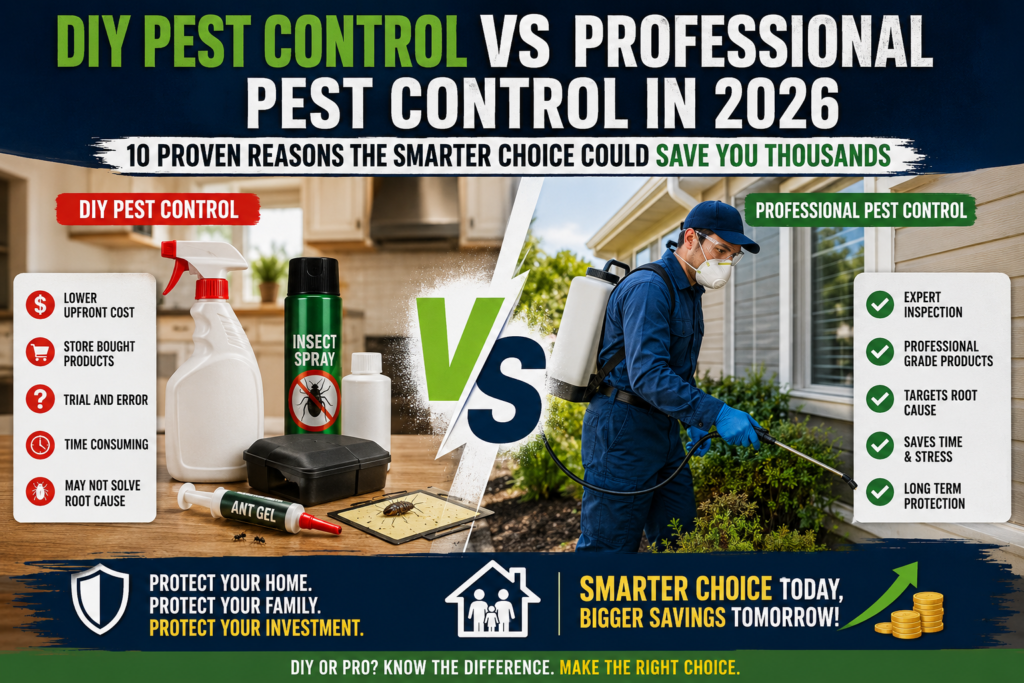
DIY Pest Control vs Professional Pest Control
Imagine walking into your kitchen one morning only to discover a line of ants marching across your countertop. Or perhaps you’ve heard scratching sounds coming from inside your walls at night. Maybe you’ve spotted a cockroach disappearing beneath the refrigerator just as you turned on the lights.
Your first instinct is probably the same as millions of homeowners around the world:
“Can I handle this myself, or do I need to call a professional?”
It’s a question that has become even more relevant in 2026.
With inflation affecting household budgets, many people are looking for ways to cut expenses. Hardware stores, online marketplaces, and home improvement retailers now offer hundreds of DIY pest control products promising professional-level results at a fraction of the cost.
At first glance, the choice seems obvious.
Spend $25 on sprays and traps…
…or pay hundreds of dollars for professional exterminator services.
But is that really the smarter financial decision?
Not always.
In fact, many homeowners end up spending far more by repeatedly buying ineffective DIY products before eventually hiring a professional anyway. Others waste valuable time while an infestation quietly spreads behind walls, under floors, or inside attics.
On the other hand, calling a pest control company for every tiny insect you encounter isn’t necessarily the most cost-effective solution either.
The smartest homeowners understand one important truth:
Successful pest control isn’t about choosing the cheapest option—it’s about choosing the right solution for the right problem.
Throughout this guide, we’ll compare DIY pest control vs professional pest control in 2026, examine real costs, reveal situations where DIY truly works, and uncover the warning signs that indicate it’s time to call experienced exterminator services before the damage becomes far more expensive.
Why Pest Control Matters More Than Ever in 2026
The pest control industry continues to grow because pests remain a year-round concern for homeowners, businesses, and property managers. Warmer temperatures in many regions, expanding urban areas, and increased awareness of preventive home maintenance have contributed to sustained demand for pest management services. (FindTrustedHelp.com)
Today’s homeowners face challenges from:
- Ant infestations
- Cockroaches
- Rats and mice
- Bed bugs
- Mosquitoes
- Fleas
- Spiders
- Wasps
- Termites
Each pest behaves differently.
Each requires different treatment methods.
And unfortunately…
No single spray solves every pest problem.
This is exactly why understanding the strengths—and limitations—of DIY pest control can save you significant money over time.
DIY Pest Control vs Professional Pest Control in 2026: A Quick Comparison
| Feature | DIY Pest Control | Professional Pest Control |
|---|---|---|
| Initial Cost | Low | Higher |
| Long-Term Cost | Can increase with repeat treatments | Often lower for severe infestations |
| Skill Required | Moderate | Minimal homeowner effort |
| Equipment | Consumer-grade | Commercial-grade |
| Pest Identification | Homeowner responsibility | Expert inspection |
| Treatment Accuracy | Varies | Highly targeted |
| Severe Infestations | Often ineffective | Highly effective |
| Safety | Depends on proper product use | Licensed application and safety protocols |
| Follow-up Support | None | Usually included |
| Prevention Advice | Limited | Comprehensive prevention plans |
The table above highlights an important reality.
While DIY pest control often wins on upfront affordability, professional pest control frequently delivers better long-term value for moderate to severe infestations through accurate identification, targeted treatments, and follow-up support. (FindTrustedHelp.com)
Reason #1 — DIY Pest Control Costs Less Upfront
One reason homeowners naturally gravitate toward DIY solutions is the price.
Walk into any home improvement store and you’ll find:
- Ant bait stations
- Cockroach gels
- Mouse traps
- Rat bait
- Sticky traps
- Insect sprays
- Mosquito repellents
Many of these products cost between $10 and $50, making them appear to be incredible bargains compared with professional visits that may range from around $100 to several hundred dollars, depending on the pest and treatment required. Costs vary by location and infestation severity. (Unanswered)
For small and newly discovered infestations, DIY can indeed be the most economical option.
Examples include:
- A few ants entering through a doorway
- One or two spiders indoors
- Occasional flies
- A single mouse sighting
- Minor pantry moth issues
If you identify the pest correctly and use the appropriate product according to its label, there’s a good chance you’ll resolve the issue without needing professional assistance. (Pest Control Review)
However, the initial purchase price tells only part of the story.
Many homeowners underestimate:
- Repeat applications
- Replacement traps
- Time spent monitoring
- Failed treatments
- Additional cleaning
- Property damage caused while the infestation continues
These hidden costs often transform what seemed like a cheap solution into a surprisingly expensive one.
Reason #2 — Professional Pest Control Solves the Root Cause
Here’s something many homeowners overlook.
Pests are rarely the actual problem.
They’re a symptom.
If ants keep returning every week…
If cockroaches continue appearing despite repeated spraying…
If rodents keep finding their way indoors…
Then something is attracting them.
Professional pest control companies don’t simply kill visible pests.
They investigate:
- Entry points
- Moisture issues
- Food sources
- Nesting locations
- Structural vulnerabilities
- Seasonal risk factors
Instead of treating symptoms alone, they aim to eliminate the conditions that allow pests to thrive. This broader approach is one reason professional treatments often produce longer-lasting results, especially for recurring infestations. (Pest Control Insider)
For example:
A homeowner may spray cockroaches every week for months.
A professional may identify a hidden nesting site behind kitchen cabinets and apply targeted bait where it will reach the colony, reducing the infestation at its source.
That’s a completely different strategy.
Reason #3 — Severe Infestations Rarely Respond to DIY Methods
One of the most searched questions online today is:
Does DIY Pest Control Really Work for Severe Infestations?
The honest answer is:
Sometimes—but usually not.
DIY methods are most successful when:
- The infestation is caught early.
- The pest population is small.
- The species is easy to identify.
- The treatment reaches the source.
Unfortunately, severe infestations often involve pests hiding in wall voids, attics, crawl spaces, or other inaccessible areas.
Examples include:
- Large rodent populations
- Bed bugs
- Established cockroach colonies
- Active termite infestations
- Large wasp nests
In these situations, over-the-counter products may kill only the pests you can see while leaving the colony untouched. Delaying effective treatment allows the infestation to grow, increasing both the difficulty and eventual cost of elimination. (Pest Control Review)
The result?
You may spend weeks—or even months—trying different products, only to discover the infestation has become larger and more expensive to resolve.
Reason #4 — Professional Pest Control Cost vs DIY Pest Control Savings
One of the biggest misconceptions surrounding professional pest control is that it is always the more expensive option. While the upfront bill may be higher than buying a can of insect spray or a few bait stations, the total cost over time often tells a very different story.
This is where many homeowners unknowingly fall into what experts call the “DIY cost trap.”
Imagine this scenario:
You notice a few ants in your kitchen and purchase a spray for $20. The ants disappear for a few days, only to return. You then buy bait stations for another $25. When that doesn’t solve the problem, you purchase a stronger insecticide for $35.
After several weeks, you’ve spent close to $100, devoted hours to treating the problem yourself, and the infestation is still active because the colony remains untouched.
Eventually, you hire a professional pest control company anyway.
Now you’ve paid for both the DIY products and the professional treatment.
This situation is more common than many people realize.
Why Professional Pest Control Often Saves More Money
Professional technicians don’t rely on guesswork. They follow a systematic process that includes:
- Thorough inspection of the property
- Accurate pest identification
- Determining the severity of the infestation
- Locating entry points
- Applying targeted treatment
- Scheduling follow-up visits when necessary
- Providing long-term prevention strategies
Because the problem is addressed correctly the first time, homeowners often avoid repeated spending on ineffective DIY products.
Comparing the Long-Term Costs
| Expense Category | DIY Pest Control | Professional Pest Control |
|---|---|---|
| Initial treatment | Low | Medium to High |
| Repeat product purchases | High | Usually included in treatment plan |
| Property damage risk | Higher | Much lower |
| Time investment | Significant | Minimal |
| Success rate for severe infestations | Low | High |
| Long-term savings | Unpredictable | More predictable |
The key takeaway isn’t that professional services are always cheaper. Rather, they often provide better value when the full cost of recurring infestations, damaged property, and repeated DIY purchases is considered.
Reason #5 — Knowing When to Call a Professional Exterminator for Pests Can Save Thousands
A question many homeowners ask is:
When Should I Call a Professional Exterminator for Pests?
The answer is simple.
The earlier you recognize that the infestation is beyond your control, the more money you are likely to save.
Ignoring the warning signs often allows pests to multiply rapidly, turning a manageable issue into a costly repair project.
10 Signs It’s Time to Call Professional Exterminator Services
1. You Keep Seeing Pests After Multiple DIY Treatments
If you’ve tried different sprays, traps, or bait products without success, it’s a clear indication that the underlying problem hasn’t been solved.
Recurring pests almost always point to hidden nests or breeding sites.
2. You Notice Structural Damage
Termites, carpenter ants, and rodents can silently destroy:
- Wooden beams
- Flooring
- Furniture
- Drywall
- Electrical wiring
Structural repairs can cost thousands of dollars, making early professional intervention a worthwhile investment.
3. The Infestation Is Growing Rapidly
Pests reproduce quickly.
For example:
- Rodents can produce multiple litters each year.
- Cockroaches multiply rapidly under favorable conditions.
- Bed bugs spread from room to room if left untreated.
A problem that starts with a few pests can escalate dramatically in a short period.
4. You Don’t Know What Pest You’re Dealing With
Misidentifying a pest often leads to using the wrong treatment.
Professional technicians are trained to distinguish between similar-looking species and select the most effective treatment method.
5. You Discover a Nest
Finding a nest usually means you’ve only seen a small portion of the actual pest population.
Common examples include:
- Wasp nests
- Rodent nests
- Ant colonies
- Termite colonies
Removing visible pests without addressing the nest rarely solves the problem.
6. Family Members Have Allergies or Asthma
Certain pests can worsen indoor air quality.
Examples include:
- Cockroach allergens
- Rodent droppings
- Dust mites
- Fleas
Professional treatment can help reduce these health risks more effectively than repeated DIY attempts.
7. Children or Pets Live in the Home
Many over-the-counter pesticides require careful handling and storage.
Professional pest control companies are trained to apply treatments responsibly and provide guidance on when treated areas can be safely used again.
8. You’re Preparing to Sell or Rent Your Property
Visible pest problems can reduce buyer confidence and property value.
Many home inspections identify evidence of:
- Termites
- Rodents
- Active infestations
Resolving these issues before listing your property can help avoid delays and negotiations.
9. You Hear Strange Noises Inside Walls
Scratching, chewing, or movement inside walls often indicates rodents or other wildlife.
Ignoring these sounds can lead to:
- Damaged insulation
- Chewed electrical wires
- Fire hazards
- Extensive cleanup costs
10. The Infestation Keeps Returning Every Season
Seasonal recurrence usually indicates that pests have established a reliable entry point or nesting location.
Professionals don’t just eliminate current pests—they also identify and recommend ways to reduce future infestations.
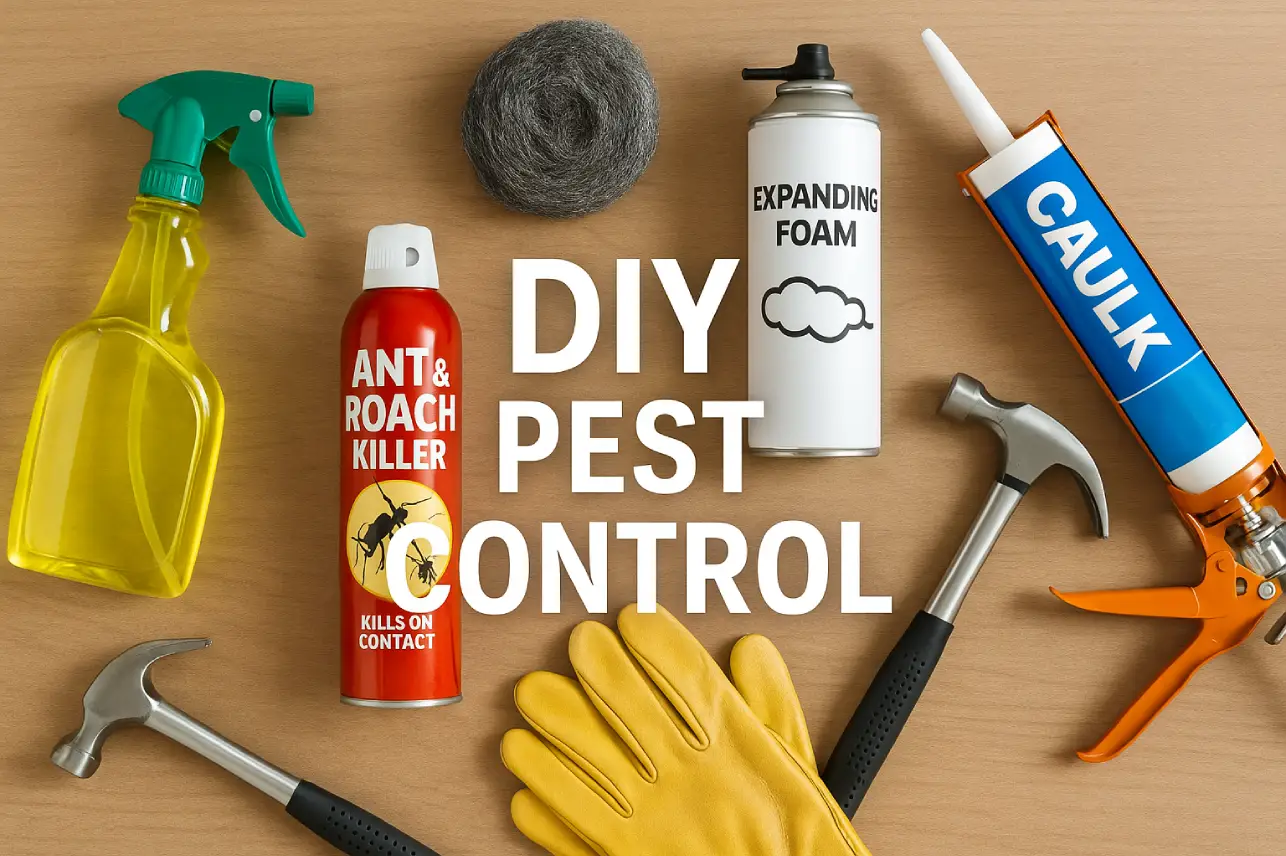
Reason #6 — Hidden Costs Most Homeowners Never Consider
Many people compare only the price tag of a DIY product with the cost of hiring a professional.
Unfortunately, that comparison overlooks several hidden expenses.
Hidden Cost #1: Your Time
Researching products.
Watching tutorials.
Setting traps.
Checking bait stations.
Cleaning dead insects.
Repeating treatments.
These tasks consume valuable hours that many homeowners don’t factor into the overall cost.
Hidden Cost #2: Property Damage
The longer pests remain untreated, the more damage they can cause.
Examples include:
- Termites weakening structural wood
- Rodents chewing electrical wiring
- Cockroaches contaminating food storage areas
- Carpenter ants damaging wooden structures
Repair costs often exceed the price of early professional treatment.
Hidden Cost #3: Product Waste
Many homeowners buy multiple products hoping one will work.
This can include:
- Sprays
- Foggers
- Baits
- Traps
- Powders
- Granules
- Repellents
Buying several ineffective products can quickly exceed the cost of a professional inspection.
Hidden Cost #4: Health Risks
Incorrect pesticide application may expose people and pets to unnecessary chemicals or fail to control the infestation.
Following product labels carefully is essential, but even then, some situations require specialized equipment and expertise.
Hidden Cost #5: Emotional Stress
Living with persistent pests affects more than your home.
Many homeowners experience:
- Poor sleep
- Anxiety
- Embarrassment when guests visit
- Constant worry about contamination
- Reduced comfort in their own living space
Peace of mind is difficult to assign a dollar value, but it’s an important benefit of effective pest management.
Reason #7 — Safety Should Always Come Before Savings
Saving money is important.
Protecting your family is even more important.
Many DIY pest control products are safe when used exactly as directed, but problems can arise when products are mixed, over-applied, or used in ways not intended by the manufacturer.
Common mistakes include:
- Applying too much pesticide
- Treating food preparation areas improperly
- Using outdoor products indoors
- Mixing different chemical products
- Failing to wear protective equipment
- Storing pesticides where children or pets can access them
Professional pest control technicians receive training on product selection, application methods, and safety precautions, helping reduce unnecessary exposure while targeting pests effectively.
Safe DIY Pest Control Practices
If you decide to handle minor pest problems yourself, follow these best practices:
- Read every label before use.
- Wear recommended protective gear.
- Keep children and pets away from treated areas until it’s safe to return.
- Store pesticides in their original containers.
- Never mix products unless the label specifically permits it.
- Dispose of unused products according to local regulations.
- Focus on prevention by sealing cracks, fixing leaks, and removing food sources.
Remember, successful pest control is about more than eliminating insects or rodents—it also means protecting the health of everyone in your home.
Reason #8 — Prevention Is the Most Affordable Pest Control Strategy
If there’s one lesson every homeowner eventually learns, it’s this:
The cheapest pest infestation is the one that never happens.
Many people think pest control begins after they discover ants in the kitchen or hear rodents scratching inside the walls. In reality, the best pest control starts long before pests make themselves at home.
Think about your house like a castle.
Even the strongest castle becomes vulnerable if you leave the gate open.
The same principle applies to your home.
Tiny cracks around doors, leaking pipes, overflowing trash bins, standing water, cluttered storage areas, and uncovered food all create invitations for pests.
Professional pest control companies spend just as much time educating homeowners on prevention as they do eliminating active infestations.
Prevention Tips That Actually Work
One of the biggest advantages of prevention is that it works against almost every common household pest.
Keep Your Home Clean
Pests are constantly searching for three things:
- Food
- Water
- Shelter
Simple habits dramatically reduce your risk.
These include:
- Wiping kitchen counters daily
- Vacuuming regularly
- Storing food in airtight containers
- Cleaning up crumbs immediately
- Taking out garbage frequently
Seal Entry Points
Many insects only need a tiny opening to enter your home.
Inspect around:
- Windows
- Doors
- Plumbing pipes
- Utility lines
- Roof vents
- Foundation cracks
A small amount spent on caulk or weather stripping today can prevent hundreds or even thousands of dollars in future extermination costs.
Eliminate Moisture
Many pests thrive in damp environments.
Pay special attention to:
- Bathrooms
- Basements
- Crawl spaces
- Under sinks
- Around air conditioning units
Repair leaks promptly.
Use dehumidifiers where necessary.
Good ventilation alone can discourage several moisture-loving pests.
Keep Landscaping Under Control
Your yard is the first line of defense.
Trim:
- Bushes touching the house
- Tree branches over the roof
- Tall grass
- Overgrown shrubs
Also remove:
- Wood piles near the house
- Standing water
- Leaf piles
- Unused containers
A clean outdoor environment makes your property less attractive to rodents and insects.
Schedule Routine Inspections
Even if you don’t currently have a pest problem, occasional inspections can identify issues before they become expensive.
This is particularly valuable for homeowners living in areas where termites, carpenter ants, rodents, or mosquitoes are common.
Preventive inspections often cost far less than repairing structural damage caused by long-term infestations.
Reason #9 — Some Pests Are Suitable for DIY, Others Require Professionals
One of the biggest mistakes homeowners make is assuming every pest requires the same treatment.
The truth is that some infestations respond well to DIY methods, while others almost always require professional pest control.
Pests That DIY Can Often Handle Successfully
If discovered early, these pests can often be managed with consumer products and good sanitation.
Examples include:
- Small ant trails
- Houseflies
- Fruit flies
- Occasional spiders
- Pantry moths
- Silverfish
Success depends on:
- Correct identification
- Proper product selection
- Following label instructions
- Eliminating food sources
Pests That Usually Require Professional Exterminator Services
Certain pests are far more difficult to eliminate because they hide well, reproduce rapidly, or cause extensive damage before homeowners even realize they’re present.
Examples include:
Termites
Termites often remain hidden for months or years.
By the time visible damage appears, colonies may already be extensive.
Professional treatment is usually the safest and most effective solution.
Bed Bugs
Bed bugs are among the most challenging household pests.
They hide inside:
- Mattresses
- Furniture
- Electrical outlets
- Wall cracks
- Carpets
Missing even a few insects can allow the infestation to rebound.
Large Rodent Infestations
One mouse is rarely just one mouse.
Rodents reproduce quickly and can spread disease, contaminate food, and damage electrical wiring.
Professionals can locate nesting sites and entry points that homeowners often overlook.
Wasp Colonies
Removing an active wasp nest without proper equipment can be dangerous.
Large nests should almost always be handled by experienced professionals.
Cockroach Colonies
Seeing one cockroach during the day often suggests a larger hidden population.
Professional baiting systems target entire colonies rather than only visible insects.
Reason #10 — Professional Pest Control Delivers Long-Term Peace of Mind
At first glance, DIY pest control appears to save money.
But homeowners should ask a more important question:
What am I actually paying for?
Professional services provide far more than pesticide application.
You’re investing in:
- Expert inspections
- Accurate pest identification
- Customized treatment plans
- Access to professional-grade products
- Follow-up monitoring
- Prevention recommendations
- Ongoing support if pests return
That peace of mind has real value.
Instead of wondering whether you’ve purchased the right spray or whether pests are hiding behind the walls, you have trained professionals monitoring the situation.
For busy families, landlords, property managers, and homeowners protecting a significant investment, this reassurance is often worth every dollar.
Ultimately, the best choice depends on the severity of the infestation, the type of pest involved, and your confidence in handling the problem safely.
Frequently Asked Questions (FAQs)
Does DIY pest control really work for severe infestations?
In most cases, DIY pest control is effective only for small, newly discovered infestations. Severe infestations involving termites, bed bugs, large rodent populations, or extensive cockroach colonies typically require professional treatment because the source of the infestation is often hidden.
When should I call a professional exterminator for pests?
You should consider calling a professional if:
- DIY treatments have failed.
- The infestation keeps returning.
- You discover structural damage.
- You find nests.
- You hear rodents inside walls.
- Family members have health concerns related to pests.
- You suspect termites or bed bugs.
The earlier professional intervention occurs, the easier and less expensive treatment often becomes.
Is professional pest control worth the money?
For minor pest issues, DIY may be sufficient.
For recurring or severe infestations, professional services often reduce long-term costs by preventing repeated product purchases, structural damage, and ongoing infestations.
Is DIY pest control safe?
Yes—provided products are used exactly according to the manufacturer’s instructions.
Always read labels carefully, wear recommended protective equipment, keep children and pets away from treated areas until it is safe, and never mix pesticides.
Which pests are easiest to eliminate yourself?
Generally, homeowners can often manage:
- Ants (small infestations)
- Flies
- Pantry pests
- Silverfish
- Occasional spiders
However, success depends on proper identification and addressing the source of the problem.

Final Verdict: DIY Pest Control vs Professional Pest Control in 2026
So, which option wins?
The answer isn’t as simple as declaring one universally better than the other.
Instead, the smarter choice depends on your situation.
Choose DIY pest control if:
- The infestation is small.
- The pest is easy to identify.
- You enjoy handling home maintenance.
- You’re comfortable following product instructions carefully.
- The problem is isolated and recently discovered.
Choose professional pest control if:
- DIY treatments have failed.
- The infestation is growing.
- Property damage is occurring.
- You’re dealing with termites, bed bugs, rodents, or large cockroach infestations.
- You want a long-term solution rather than temporary relief.
The biggest mistake homeowners make isn’t choosing DIY.
It’s waiting too long before realizing professional help is needed.
Fast action almost always saves money.
Conclusion
When comparing DIY Pest Control vs Professional Pest Control in 2026, the real question isn’t simply which option costs less today.
It’s which option protects your home, your family, and your finances over the long run.
DIY methods certainly have their place. They can be affordable, convenient, and highly effective for small, isolated pest problems. For many homeowners, learning basic preventive measures and handling minor infestations independently is both practical and rewarding.
However, not every pest problem should become a weekend project.
Persistent infestations, structural pests like termites, hidden rodent colonies, and rapidly spreading insects require more than over-the-counter products. In these cases, delaying professional intervention often increases both the complexity of the problem and the final repair bill.
The smartest homeowners know when to take action themselves—and when to trust experienced professionals.
By combining preventive habits with timely decisions, you can enjoy a healthier, safer, and pest-free home while avoiding unnecessary expenses.
In the end, the goal isn’t simply to eliminate pests.
It’s to protect one of your biggest investments—your home—for years to come.
About The Author