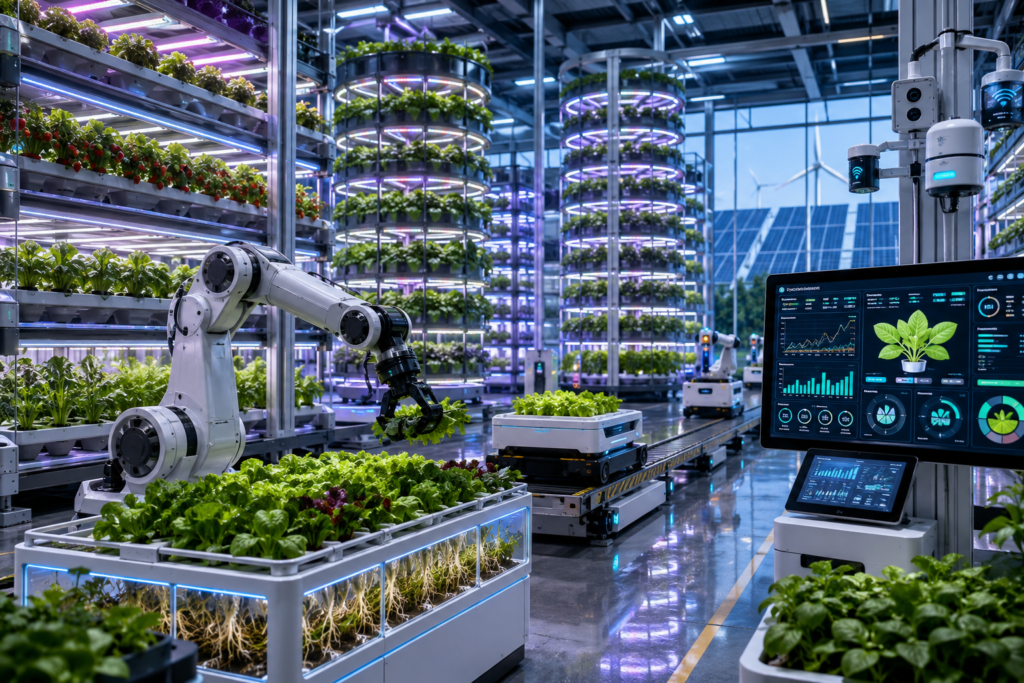
Vertical Farming
Not long ago, the idea of producing thousands of kilograms of fresh vegetables inside a warehouse sounded like science fiction. Today, that vision is rapidly becoming reality. Around the world, Vertical Farming is changing the way food is grown, distributed, and consumed. Instead of relying solely on vast stretches of farmland, farmers and technology companies are stacking crops vertically in climate-controlled environments where every aspect of plant growth can be monitored and optimized.
This transformation has been driven by growing concerns over food security, climate change, urbanization, and shrinking agricultural land. Traditional farming continues to face increasing pressure from unpredictable weather patterns, water scarcity, pest outbreaks, and declining soil fertility. Meanwhile, consumers expect fresh produce year-round regardless of season or geography.
These challenges have created the perfect environment for Indoor Farming to flourish.
The future of vertical farming in 2026 is no longer centered solely on hydroponics or LED lighting. Today’s systems incorporate Artificial Intelligence, robotics, machine learning, Internet of Things (IoT) sensors, predictive analytics, and autonomous monitoring systems capable of making thousands of decisions every hour. This evolution has given rise to what experts now describe as AI-powered vertical farming technology, where computers continuously optimize crop growth with remarkable precision.
The result is an agricultural model capable of producing more food while using fewer natural resources. Water consumption can be dramatically reduced through recirculating systems. Crop losses caused by extreme weather are virtually eliminated because plants grow inside carefully managed environments. Since crops are often cultivated close to consumers in urban centers, transportation distances shrink, reducing carbon emissions while improving freshness.
Another reason Smart Farming continues to attract global attention is its ability to collect and analyze enormous amounts of agricultural data. Every light adjustment, nutrient change, humidity fluctuation, and growth stage is measured. Farmers can identify problems long before they become visible to the human eye, leading to healthier crops and significantly higher yields.
Governments, investors, universities, and technology companies are increasingly viewing AI Agriculture as one of the most promising solutions to feeding a growing global population sustainably. Billions of dollars are flowing into agricultural technology startups focused on automation, robotics, sensor networks, and sustainable crop production.
This article explores six groundbreaking innovations that are redefining Vertical Farming in 2026. Along the way, we’ll examine the technologies driving this revolution, compare indoor farming with conventional agriculture, discuss opportunities and challenges, and explore why many experts believe the next decade will fundamentally reshape global food production.
Whether you are a farmer, entrepreneur, investor, student, or simply curious about the future of food, understanding these developments offers valuable insight into one of the fastest-evolving sectors in modern agriculture.

What Is Vertical Farming?
Vertical Farming is an advanced agricultural practice in which crops are cultivated in vertically stacked layers rather than across expansive horizontal fields. These farms are typically housed inside warehouses, greenhouses, shipping containers, or purpose-built facilities where environmental conditions are carefully controlled.
Unlike conventional agriculture, vertical farms do not depend on seasonal rainfall, fertile soil, or favorable weather conditions. Instead, growers create ideal environments using sophisticated lighting systems, automated irrigation, nutrient delivery systems, climate control, and intelligent monitoring software.
Several cultivation methods are commonly used in indoor farming facilities:
Hydroponics
Plants grow without soil while their roots receive carefully balanced nutrient-rich water solutions.
Advantages include:
- Faster plant growth
- Significant water savings
- Reduced soil-borne diseases
- Greater nutrient efficiency
- Higher crop consistency
Hydroponics remains the most widely adopted growing system in commercial vertical farms because of its reliability and scalability.
Aeroponics
Aeroponic systems suspend plant roots in the air while periodically spraying them with nutrient-rich mist.
This method offers several important benefits:
- Exceptional oxygen availability
- Faster root development
- Reduced water consumption
- Higher nutrient absorption
- Improved crop quality
Because less water is required compared to hydroponics, aeroponic systems continue gaining popularity among sustainability-focused growers.
Aquaponics
Aquaponics combines fish farming with hydroponic crop production.
Fish naturally produce waste that beneficial bacteria convert into nutrients for plants. Plants then filter the water before it returns to the fish tanks, creating a self-sustaining ecosystem.
This integrated approach reduces waste while supporting environmentally friendly food production.
Core Technologies Behind Modern Vertical Farming
Today’s indoor farms rely on several advanced technologies working together.
These include:
- Artificial Intelligence
- Machine Learning
- IoT Sensors
- Robotics
- Computer Vision
- LED Lighting Systems
- Automated Climate Control
- Data Analytics
- Cloud Computing
- Predictive Algorithms
Together, these technologies enable growers to achieve remarkable efficiency while maintaining ideal growing conditions around the clock.
Why Vertical Farming Is Growing Rapidly in 2026
The rapid expansion of Vertical Farming is not driven by a single factor. Instead, several global trends have converged, making indoor agriculture one of the most exciting innovations in food production.
1. Growing Global Population
The world’s population continues to increase, placing unprecedented pressure on food production systems.
As urban populations expand, cities require fresh produce that can be grown closer to consumers. Vertical farms offer an attractive solution by transforming underutilized buildings into productive agricultural facilities.
2. Climate Change
Extreme weather events have become increasingly common.
Floods, droughts, hurricanes, heatwaves, and changing rainfall patterns continue disrupting conventional farming operations.
Indoor agriculture provides protection from these environmental uncertainties by creating controlled growing environments that remain stable throughout the year.
3. Water Conservation
Freshwater scarcity has become one of agriculture’s greatest challenges.
Many Indoor Farming systems recycle up to 90–95% of their irrigation water through closed-loop systems.
This dramatically reduces water usage while maintaining excellent crop quality.
4. Urban Food Production
Transporting vegetables across continents increases costs and carbon emissions.
Urban vertical farms shorten supply chains by producing food closer to consumers.
Benefits include:
- Fresher produce
- Lower transportation costs
- Reduced greenhouse gas emissions
- Less food waste
- Greater food security
5. AI Agriculture Is Becoming More Affordable
One of the biggest developments in recent years has been the declining cost of Artificial Intelligence technologies.
Advanced sensors, cloud computing, machine learning software, and automation systems that once required massive investments have become increasingly accessible.
This affordability is accelerating adoption among both commercial producers and emerging agricultural startups.
Vertical Farming vs Traditional Farming
| Feature | Vertical Farming | Traditional Farming |
|---|---|---|
| Land Usage | Extremely Efficient | Requires Large Areas |
| Water Consumption | Very Low | High |
| Climate Dependence | Independent | Highly Dependent |
| Crop Protection | Highly Controlled | Weather and Pest Exposure |
| Growing Seasons | Year-Round | Seasonal |
| Technology Integration | Very High | Moderate |
| Labor Requirements | Automated | Labor Intensive |
| Initial Investment | High | Moderate |
| Yield Per Square Meter | Significantly Higher | Lower |
| Sustainability | Excellent | Variable |
The comparison clearly illustrates why many experts believe Smart Farming will become an increasingly important component of global agriculture over the coming decades. While traditional farming remains essential for staple crops such as wheat, rice, and maize, vertical farming offers distinct advantages for leafy greens, herbs, strawberries, tomatoes, and other high-value produce.
6 Powerful Innovations Changing Vertical Farming
The future of indoor agriculture is being shaped by a new generation of technologies that extend far beyond basic hydroponic systems. These innovations are making farms more intelligent, productive, and sustainable than ever before.
The six most influential innovations include:
- AI-Powered Vertical Farming Technology
- Agricultural Robotics and Automation
- Advanced LED Lighting Systems
- Internet of Things (IoT) Smart Sensors
- Digital Twins and Predictive Analytics
- Renewable Energy Integration
Each of these breakthroughs addresses critical challenges while improving efficiency, reducing operational costs, and supporting sustainable food production.
Innovation #1: AI-Powered Vertical Farming Technology Is Revolutionizing Indoor Agriculture
Artificial Intelligence has become the driving force behind modern Vertical Farming. Rather than relying solely on human observation, advanced AI systems continuously monitor every aspect of crop development, making real-time adjustments that optimize plant health and productivity.
This marks a significant shift from traditional farming practices, where many decisions depend on experience and manual inspection. In today’s AI Agriculture systems, thousands of data points are collected every minute from sensors distributed throughout the growing environment.
These sensors measure variables such as:
- Temperature
- Humidity
- Carbon dioxide levels
- Light intensity
- Nutrient concentrations
- Water quality
- Air circulation
- Plant growth rates
Artificial Intelligence processes this information almost instantly, identifying subtle patterns that would be impossible for humans to detect consistently. If environmental conditions drift away from the ideal range, automated systems can adjust lighting schedules, nutrient delivery, irrigation cycles, or ventilation before crops experience stress.
This proactive approach helps reduce waste, improve crop uniformity, and maximize yields while lowering resource consumption.
In addition, AI-powered image recognition systems can scan thousands of plants daily, identifying early signs of nutrient deficiencies, disease, or pest activity. Detecting issues at such an early stage allows growers to intervene quickly, preventing larger outbreaks and reducing the need for chemical treatments.
As a result, AI-powered vertical farming technology is not simply making farming more efficient—it is fundamentally changing how food is grown, managed, and delivered to consumers.
Innovation #2: Agricultural Robotics and Automation Are Transforming Vertical Farming
The second major breakthrough shaping Vertical Farming is the rapid adoption of agricultural robotics and automation. As indoor farms continue to scale, relying entirely on manual labor becomes increasingly expensive and inefficient. Automation is solving this challenge by handling repetitive tasks with remarkable speed, consistency, and precision.
Unlike conventional farms, where weather conditions often dictate when work can be done, indoor farms operate continuously. Crops require monitoring 24 hours a day, nutrient levels must remain stable, and harvesting schedules need to be carefully coordinated. Robotics allows these operations to continue around the clock without fatigue or interruptions.
This is one of the clearest examples of How AI is transforming indoor agriculture. Intelligent robots no longer perform simple repetitive movements alone—they can analyze plant conditions, identify ripe produce, and make real-time decisions based on sensor data.
How Robotics Is Used in Vertical Farming
Modern robotic systems perform a wide range of farming activities, including:
- Automated seeding
- Precision transplanting
- Crop monitoring
- Nutrient dispensing
- Water management
- Robotic harvesting
- Packaging and sorting
- Inventory tracking
- Facility cleaning and sanitation
These machines work with incredible consistency, reducing errors that naturally occur with manual labor.
For example, robotic harvesting systems equipped with AI-powered cameras can distinguish mature lettuce from younger plants, harvesting only crops that meet quality standards. This reduces waste while ensuring consistent product quality.
Benefits of Agricultural Robotics
The adoption of automation offers significant advantages for commercial growers.
Increased Productivity
Robots never tire or require breaks. They can operate continuously, allowing farms to increase production without dramatically increasing labor costs.
Improved Crop Quality
Automated systems handle delicate vegetables with precision, reducing bruising and damage during harvesting.
Labor Cost Reduction
Many agricultural regions face labor shortages. Robotics helps bridge this gap while allowing workers to focus on higher-value tasks such as system management and quality control.
Greater Food Safety
Since robots minimize direct human contact with crops, the risk of contamination decreases significantly.
Data Collection
Every movement made by robotic systems generates valuable operational data that can be analyzed to improve future production.
Why Automation Is Essential for Smart Farming
Smart Farming is more than simply using machines. It is the integration of automation, Artificial Intelligence, cloud computing, and advanced analytics into one intelligent agricultural ecosystem.
Instead of reacting to problems after they occur, automated farms anticipate issues before they become serious.
For example:
- AI predicts equipment failures.
- Robots inspect crops automatically.
- Irrigation adjusts itself.
- Lighting changes according to plant growth.
- Climate systems respond instantly to sensor readings.
This level of coordination would be nearly impossible through manual management alone.
Innovation #3: Advanced LED Lighting Is Making Indoor Farming More Efficient
Lighting has always been one of the biggest operational expenses in Indoor Farming. Plants rely on light to perform photosynthesis, but traditional lighting systems consume enormous amounts of electricity while generating excess heat.
Today’s advanced LED technology has completely changed this equation.
Modern LEDs consume far less energy while delivering highly targeted light wavelengths that encourage faster growth and healthier plants.
This represents one of the most significant Emerging technologies in vertical farming.
Instead of simply illuminating crops, smart LED systems actively support plant development by providing customized lighting recipes.
Why Different Light Colors Matter
Plants respond differently to various wavelengths.
For example:
Blue Light
Supports:
- Leaf growth
- Strong stems
- Root development
- Compact plant structure
Red Light
Encourages:
- Flowering
- Fruit production
- Biomass accumulation
- Faster maturity
Far-Red Light
Helps regulate:
- Plant height
- Seed germination
- Flower timing
White Light
Improves:
- Human visibility
- Overall plant balance
- Inspection accuracy
By combining these wavelengths intelligently, growers can optimize production for different crop varieties.
AI Controls Modern Lighting Systems
The latest AI-powered vertical farming technology allows lighting schedules to change automatically.
Artificial Intelligence analyzes:
- Plant age
- Growth stage
- Temperature
- Humidity
- Nutrient levels
- Historical performance
Based on this information, AI determines exactly how much light each crop requires.
Rather than operating lights continuously, intelligent systems adjust brightness and timing throughout the day.
Benefits include:
- Lower electricity bills
- Faster crop growth
- Better crop quality
- Reduced heat generation
- Longer equipment lifespan
Vertical Farming Lighting Comparison
| Traditional Greenhouse | AI-Controlled Vertical Farm |
|---|---|
| Depends on sunlight | Fully controlled lighting |
| Seasonal production | Year-round production |
| Limited daily control | Real-time AI adjustments |
| Higher weather risk | Weather independent |
| Less efficient energy use | Optimized LED efficiency |
This level of environmental control helps explain why commercial investors continue expanding indoor farming operations worldwide.

Innovation #4: Internet of Things (IoT) Sensors Create Truly Smart Farming Systems
One of the most exciting Emerging technologies in vertical farming is the Internet of Things (IoT).
IoT refers to thousands of interconnected sensors placed throughout a farming facility.
Each sensor continuously measures environmental conditions.
Examples include:
- Air temperature
- Root temperature
- Water pH
- Electrical conductivity
- Humidity
- Carbon dioxide
- Airflow
- Water levels
- Light intensity
- Equipment performance
Rather than checking these measurements manually once or twice per day, growers receive updates every few seconds.
This continuous monitoring dramatically improves decision-making.
How AI Agriculture Uses IoT Data
Collecting data alone is not enough.
The real value comes from analyzing it.
Artificial Intelligence processes enormous volumes of sensor data to detect trends that humans would likely overlook.
For example:
If humidity begins increasing unusually during the night, AI may predict fungal disease before symptoms appear.
Instead of waiting until crops become infected, automated ventilation systems activate immediately.
This proactive management reduces losses while protecting crop quality.
Predictive Farming
One of the biggest advances in AI Agriculture is predictive farming.
Rather than asking:
“What is happening now?”
AI asks:
“What will happen tomorrow?”
Using historical data alongside current sensor readings, AI predicts:
- Equipment failures
- Nutrient shortages
- Water demand
- Crop maturity
- Disease outbreaks
- Harvest schedules
This predictive capability significantly improves planning while reducing unnecessary costs.
Cloud-Based Smart Farming
Today’s Smart Farming operations rarely store data on individual computers.
Instead, cloud platforms centralize information from every sensor, camera, robot, and production system.
Benefits include:
- Remote monitoring
- Automatic software updates
- Multi-location management
- Improved cybersecurity
- Data backup
- AI model improvements
Farm managers can review entire facilities using smartphones or tablets from virtually anywhere.
This flexibility becomes especially valuable for companies operating multiple indoor farms across different cities or countries.
Practical Example of AI and IoT Working Together
Imagine a commercial lettuce farm.
Thousands of sensors continuously monitor environmental conditions.
At 2:15 AM:
- Humidity rises.
- Temperature increases slightly.
- Carbon dioxide drops.
- Root oxygen decreases.
Rather than waiting for employees to arrive in the morning, AI immediately analyzes the situation.
The system automatically:
- Activates additional ventilation.
- Adjusts cooling.
- Increases air circulation.
- Modifies irrigation timing.
- Sends a notification to the farm manager.
By sunrise, the issue has already been corrected.
Without AI, this same problem could have resulted in reduced growth or disease development.
Why These Innovations Matter for the Future of Vertical Farming in 2026
The Future of vertical farming in 2026 depends on far more than simply growing crops indoors.
Success increasingly relies on integrating intelligent technologies into one connected production system.
These innovations are helping growers achieve several important objectives:
- Produce more food using less land.
- Reduce water consumption dramatically.
- Improve crop consistency.
- Lower operational costs over time.
- Strengthen food security in urban areas.
- Minimize pesticide use.
- Reduce transportation emissions.
- Increase year-round production.
- Improve resilience against climate change.
As technology continues advancing, the distinction between agriculture and digital technology becomes increasingly blurred.
Tomorrow’s farms will not simply be places where food is grown—they will operate as intelligent ecosystems powered by data, automation, and continuous optimization.
The rapid progress seen in robotics, AI, LED lighting, and IoT sensors demonstrates that Vertical Farming is evolving into one of the most innovative sectors within modern agriculture. These technologies are laying the groundwork for highly efficient food production systems capable of meeting the demands of growing urban populations while conserving precious natural resources.
Innovation #5: Digital Twins and Predictive Analytics Are Shaping the Future of Vertical Farming in 2026
As Vertical Farming continues to evolve, growers are looking beyond automation toward technologies that can predict outcomes before they happen. One of the most exciting developments is the use of digital twins combined with predictive analytics. These innovations are transforming indoor agriculture from reactive management into proactive decision-making.
A digital twin is a virtual replica of a physical farm. It mirrors everything happening inside the facility—from crop growth and nutrient levels to energy consumption and climate conditions—in real time. By continuously receiving data from sensors and connected devices, the digital twin allows growers to simulate different scenarios without risking actual crops.
For example, a farm manager can test what happens if humidity is increased by 5%, if nutrient concentrations are adjusted, or if lighting schedules are changed. The system predicts the likely outcome before any physical changes are made.
This technology has become an important component of AI-powered vertical farming technology, helping farmers make better decisions while minimizing costly mistakes.
How Predictive Analytics Works in AI Agriculture
Predictive analytics combines historical farming data with Artificial Intelligence to forecast future events. Instead of simply reporting current conditions, AI analyzes patterns and predicts what is likely to happen next.
Examples include:
- Forecasting crop growth rates.
- Predicting harvest dates.
- Estimating energy consumption.
- Identifying equipment likely to fail.
- Detecting nutrient deficiencies before symptoms appear.
- Forecasting disease risks.
- Optimizing production schedules.
This shift from reactive farming to predictive farming allows growers to maximize efficiency while reducing waste.
Benefits of Digital Twins in Indoor Farming
The use of digital twins offers numerous advantages:
- Faster decision-making.
- Reduced operational risks.
- Improved crop consistency.
- Lower maintenance costs.
- Better resource allocation.
- Higher profitability.
- More accurate production forecasting.
- Improved sustainability.
For commercial producers operating multiple facilities, digital twins provide a centralized overview of every farm, allowing managers to compare performance across different locations.
Innovation #6: Renewable Energy Integration Is Making Vertical Farming More Sustainable
Although Indoor Farming offers many environmental benefits, energy consumption has historically been one of its greatest challenges. Lighting, climate control, water circulation, and automation systems require significant electricity.
To address this issue, many modern vertical farms are integrating renewable energy sources directly into their operations.
Renewable energy not only reduces operating costs over time but also helps lower greenhouse gas emissions, making indoor agriculture more environmentally sustainable.
Common Renewable Energy Sources Used in Vertical Farming
Today’s commercial facilities increasingly rely on:
- Solar power
- Wind energy
- Hydroelectric power
- Battery storage systems
- Smart energy management software
Some farms even combine multiple renewable energy sources to ensure a stable power supply throughout the year.
AI Optimizes Energy Consumption
Artificial Intelligence plays a critical role in managing energy usage.
Rather than operating every system at full capacity continuously, AI determines when electricity demand is highest and adjusts operations accordingly.
For example, AI can:
- Schedule lighting during off-peak energy periods.
- Optimize HVAC performance.
- Reduce unnecessary equipment operation.
- Coordinate battery charging.
- Improve renewable energy utilization.
These intelligent adjustments significantly reduce operational expenses while improving sustainability.
Opportunities Created by Vertical Farming
The rapid advancement of Vertical Farming presents opportunities that extend far beyond food production. Governments, businesses, entrepreneurs, researchers, and investors all recognize its potential to reshape agriculture and strengthen food systems.
1. Improved Food Security
Producing food closer to urban populations reduces dependence on long-distance transportation and international supply chains. Local production also increases resilience during extreme weather events and global disruptions.
2. Urban Agriculture Expansion
Unused warehouses, office buildings, and industrial facilities can be converted into productive farms, creating fresh food sources within cities.
3. New Employment Opportunities
Although automation reduces repetitive manual labor, it creates demand for highly skilled professionals such as:
- Agricultural engineers
- Data analysts
- AI specialists
- Robotics technicians
- Environmental scientists
- Software developers
- Plant scientists
4. Reduced Environmental Impact
Vertical farms use significantly less water and land than many traditional farming systems while minimizing pesticide use and reducing transportation emissions.
5. Increased Investment
The global interest in AI Agriculture continues to attract venture capital, institutional investment, and government support aimed at improving food security and climate resilience. (World Bank)
Challenges Facing the Future of Vertical Farming in 2026
Despite its remarkable potential, Vertical Farming is not without obstacles.
High Initial Investment
Constructing modern indoor farming facilities requires substantial investment in:
- Buildings
- LED lighting
- Climate control systems
- Robotics
- AI software
- Sensor networks
- Automation infrastructure
These costs can be challenging for smaller businesses.
Energy Requirements
Although renewable energy integration is improving, electricity remains one of the largest operational expenses for many facilities.
Limited Crop Variety
Most commercial vertical farms currently focus on leafy greens, herbs, and a limited number of fruits. Large staple crops such as wheat, rice, and maize remain more economically viable in conventional agriculture.
Technical Expertise
Operating AI-driven farming systems requires expertise in both agriculture and technology. Businesses must invest in workforce training to maximize system performance.
Consumer Awareness
Many consumers still know little about how indoor agriculture works. Increasing public understanding and trust remains an important task for the industry.
The Future of Vertical Farming Beyond 2026
The Future of vertical farming in 2026 is only the beginning of a much larger transformation.
Experts expect continued advancements in:
- Artificial Intelligence
- Robotics
- Machine learning
- Computer vision
- Renewable energy
- Precision nutrient delivery
- Autonomous harvesting
- Smart greenhouses
- Climate-resilient agriculture
Organizations such as the Food and Agriculture Organization (FAO) and the World Bank emphasize that responsible digital technologies and AI can strengthen food security, improve resource efficiency, and build more resilient agricultural systems. (FAOHome)
Rather than replacing conventional farming, vertical farming is likely to complement it. Traditional farms will continue producing staple crops, while indoor farms specialize in high-value produce that benefits from controlled environments.

Conclusion
The remarkable growth of Vertical Farming reflects a broader transformation in how the world approaches food production. Faced with climate change, urbanization, limited natural resources, and increasing demand for fresh produce, agriculture is entering a new era where technology and sustainability work hand in hand.
The six innovations explored in this article—AI-powered farming systems, robotics, advanced LED lighting, IoT sensors, digital twins, and renewable energy integration—demonstrate how AI Agriculture and Smart Farming are redefining what is possible. These technologies are making Indoor Farming more productive, efficient, and resilient while helping growers conserve water, optimize energy use, and produce high-quality crops year-round.
Challenges remain, particularly around energy costs, startup investment, and technical expertise. Yet ongoing innovation, improved economics, and stronger collaboration between governments, researchers, and the private sector continue to accelerate progress. As responsible AI and digital agriculture mature, vertical farming is poised to become an increasingly important complement to conventional agriculture, especially in urban regions where land and water are scarce. (World Economic Forum)
Ultimately, the future of agriculture will not be defined by choosing between traditional fields and indoor farms. Instead, it will be shaped by combining the strengths of both approaches to create a food system that is more sustainable, resilient, and capable of feeding a growing global population.
About The Author