Soil Microbiome
When people think about eating healthier, they often picture colorful salads, fresh fruits, whole grains, and balanced meals. Rarely do they think about the ground beneath their feet. Yet beneath every thriving crop lies an extraordinary world filled with billions of microscopic organisms working around the clock. This hidden ecosystem, known as the Soil Microbiome, could be one of the most important factors influencing the nutritional quality of our food—and ultimately, our Gut Health.
For decades, conversations about nutrition focused almost exclusively on vitamins, minerals, proteins, carbohydrates, and fats. While these nutrients remain essential, modern research is shifting attention toward where these nutrients originate. Increasingly, scientists are discovering that the health of our soil directly influences the health of our food, and the health of our food shapes the health of our bodies.
This idea isn’t merely a passing trend. Around the world, researchers, nutritionists, farmers, and environmental scientists are uncovering evidence that the Connection Between Soil Health and Nutrient-Rich Food is stronger than previously believed. Healthy soils produce crops containing more beneficial compounds, improved mineral profiles, and greater biological diversity. Those foods, in turn, nourish the trillions of microorganisms living inside the human digestive system.
It is becoming increasingly difficult to separate agriculture from medicine. Every meal begins long before food reaches a grocery store or kitchen—it begins with soil.
The significance of this discovery couldn’t arrive at a better time.
Consumers today face numerous nutritional challenges:
- Declining nutrient density in some conventionally grown crops
- Increasing digestive disorders
- Greater awareness of gut microbiome health
- Rising demand for organic and regenerative farming
- Concerns about environmental sustainability
These issues have inspired scientists to ask an important question:
Can improving soil health also improve human health?
The evidence increasingly suggests the answer is yes.
Healthy soils are living ecosystems. A single teaspoon of fertile soil contains billions of bacteria, miles of fungal networks, protozoa, nematodes, beneficial insects, and countless microorganisms interacting in remarkable harmony. Together they recycle nutrients, protect plants against disease, improve water retention, increase carbon storage, and help crops absorb essential minerals from the earth.
Without this living community, plants may still grow—but they often fail to reach their full nutritional potential.
This explains why many experts now believe that Healthy Soil Creates Nutrient-Dense Foods Naturally, reducing the need for excessive synthetic inputs while producing crops that better support human wellness.
Another fascinating discovery involves our own digestive system.
Inside every person lives a unique community of bacteria known as the gut microbiome. These microbes help digest food, manufacture vitamins, regulate immune function, influence mental health, and protect against harmful pathogens.
Interestingly, the gut microbiome functions much like the soil microbiome.
Both depend on biodiversity.
Both require balance.
Both flourish when nourished naturally.
This remarkable parallel has inspired scientists to study How Soil Microbiome Improves Human Gut Health through the foods we consume every day.
As regenerative agriculture continues gaining momentum worldwide, farmers are increasingly focusing on rebuilding living soils instead of simply maximizing yields. Their goal isn’t just producing larger harvests—it is growing healthier food capable of supporting healthier people.
That shift may define the future of nutrition throughout 2026 and beyond.
In this comprehensive guide, we’ll explore the fascinating science connecting soil microbes, plant nutrition, regenerative agriculture, and human digestive health. You’ll discover why the smallest organisms beneath our feet may hold the key to stronger immune systems, healthier diets, and more sustainable food production.

What Is the Soil Microbiome?
Before understanding why soil influences human health, it’s important to understand what the Soil Microbiome actually is.
Contrary to appearances, soil isn’t simply dirt.
Healthy soil is a living ecosystem comparable to a bustling underground city.
Within just one teaspoon of fertile soil live billions of microorganisms representing thousands of different species. These organisms interact continuously, forming complex relationships that sustain plant life.
The soil microbiome consists primarily of:
- Beneficial bacteria
- Mycorrhizal fungi
- Actinomycetes
- Protozoa
- Algae
- Beneficial nematodes
- Earthworms and larger soil organisms
Each organism performs a specialized role.
Some decompose dead plant material into usable nutrients.
Others fix atmospheric nitrogen, making it available for crops.
Certain fungi create extensive underground networks that transport water and minerals directly into plant roots.
Predatory microorganisms help control harmful pathogens naturally.
Together, these organisms create one of Earth’s most productive biological systems.
Rather than acting independently, they function as a highly coordinated community.
Scientists often compare the soil microbiome to the human digestive microbiome because both rely heavily on microbial diversity.
The greater the diversity, the healthier the ecosystem becomes.
Why Soil Microbes Matter More Than Fertilizer Alone
Traditional farming often focuses on adding nutrients directly through fertilizers.
While fertilizers provide important elements like nitrogen, phosphorus, and potassium, they cannot replace the biological services performed by living microorganisms.
Microbes continuously:
- Unlock minerals trapped in soil particles
- Produce natural plant growth hormones
- Improve root development
- Increase nutrient availability
- Protect crops from harmful pathogens
- Improve soil structure
- Increase moisture retention
In essence, microbes serve as nature’s nutrient managers.
Without them, many nutrients remain inaccessible to plants regardless of how much fertilizer is applied.
This explains why two farms using identical fertilizers can produce crops with noticeably different nutritional values depending on the health of their soil biology.
Soil Biodiversity: Nature’s Hidden Workforce
One of the most overlooked aspects of agriculture is biodiversity beneath the surface.
Healthy soil contains an astonishing variety of living organisms.
Each contributes to ecosystem stability.
For example:
- Bacteria rapidly recycle nutrients.
- Fungi extend root systems through microscopic filaments.
- Earthworms improve aeration and water movement.
- Protozoa regulate bacterial populations.
- Nematodes maintain biological balance.
Together they create conditions where plants can access a wider spectrum of minerals and beneficial compounds.
Researchers increasingly associate this underground biodiversity with higher-quality harvests.
Instead of simply growing larger vegetables, biologically rich soils often grow crops containing more antioxidants, phytochemicals, vitamins, and trace minerals.
That distinction matters enormously for human nutrition.
Why Healthy Soil Matters More Than Ever in 2026
Interest in Healthy Soil has expanded dramatically over the past few years.
Consumers are becoming more conscious of where food comes from, how it’s grown, and whether agricultural practices affect nutritional quality.
Several global trends have accelerated this movement.
Food and Agriculture Organization (FAO) – Healthy Soils: https://www.fao.org/global-soil-partnership/en/
Rising Interest in Gut Health
Digestive wellness has become one of the fastest-growing areas of nutritional research.
People increasingly recognize that healthy digestion influences:
- Immune function
- Mental health
- Energy levels
- Hormonal balance
- Inflammation
- Weight management
As interest in Gut Health grows, attention naturally shifts toward the foods that nourish beneficial gut bacteria.
Foods grown in biologically active soils often contain diverse plant compounds capable of supporting microbial diversity within the digestive system.
Consumers Want More Than Organic
Organic food remains popular, but today’s consumers are asking deeper questions.
Instead of asking:
“Was this grown without synthetic chemicals?”
They are increasingly asking:
“Was this grown in living soil?”
This subtle shift reflects growing awareness that soil biology—not merely chemical inputs—plays a central role in producing nutrient-rich crops.
Regenerative agriculture has emerged partly because it emphasizes restoring soil ecosystems rather than simply reducing pesticide use.
Climate Change Has Elevated Soil’s Importance
Healthy soils also contribute to climate resilience.
Living soils:
- Store more carbon
- Resist erosion
- Retain more moisture
- Reduce flooding
- Improve drought resistance
These environmental benefits indirectly protect food quality by helping crops withstand increasingly unpredictable weather conditions.
Healthy soil therefore supports both ecological sustainability and nutritional security.
The Connection Between Soil Health and Nutrient-Rich Food
One of the most exciting discoveries in agricultural science is the growing evidence supporting the Connection Between Soil Health and Nutrient-Rich Food.
Plants do not manufacture minerals from nothing.
Everything they contain must first come from the soil.
If soil lacks biological activity, plants often struggle to absorb essential nutrients efficiently.
Healthy microbial communities change that equation.
Microorganisms unlock minerals that would otherwise remain chemically unavailable.
Some bacteria dissolve phosphorus.
Others release potassium.
Fungi transport zinc, magnesium, copper, calcium, and other trace minerals directly into root systems.
The result is a plant capable of developing a richer nutritional profile.
Beyond minerals, healthy soils also encourage plants to produce:
- Polyphenols
- Flavonoids
- Antioxidants
- Amino acids
- Protective phytochemicals
These natural compounds contribute significantly to both flavor and health benefits.
Many nutrition experts now believe that future dietary recommendations may emphasize not only what we eat but how that food was grown.
In other words, the nutritional story begins beneath the surface.
Table: Healthy Soil vs. Degraded Soil
| Feature | Healthy Soil | Degraded Soil |
|---|---|---|
| Microbial Diversity | High | Low |
| Nutrient Availability | Excellent | Limited |
| Organic Matter | High | Low |
| Water Retention | Strong | Poor |
| Root Development | Extensive | Restricted |
| Crop Nutrient Density | Higher | Often Lower |
| Natural Disease Resistance | Strong | Weak |
| Long-Term Productivity | Sustainable | Declining |
This comparison highlights why soil biology is becoming central to conversations about food quality, public health, and sustainable agriculture.
The growing focus on the Soil Microbiome is reshaping our understanding of nutrition. Rather than viewing food solely as a collection of nutrients, researchers increasingly recognize that the biological life within soil plays a critical role in determining the quality of those nutrients. Healthy soils foster thriving microbial communities, which in turn help plants absorb minerals, produce protective compounds, and develop into truly Nutrient-Dense Foods. As awareness of the Connection Between Soil Health and Nutrient-Rich Food continues to grow, it becomes clear that the future of Gut Health begins long before food reaches our plates—it starts underground.
By now, it is clear that the Soil Microbiome is much more than a collection of invisible organisms beneath our feet. It is a living, breathing ecosystem that determines how effectively plants grow, absorb nutrients, resist disease, and ultimately nourish the people who consume them.
Scientists once believed that fertilizer alone determined crop productivity. While fertilizers certainly provide essential nutrients, modern research has revealed that microorganisms are the true facilitators of nutrient cycling. Without healthy microbial activity, many nutrients remain locked in the soil where plants cannot efficiently absorb them.
This growing body of evidence explains why regenerative agriculture, soil biodiversity, and microbial health have become major topics in nutrition, environmental science, and public health discussions throughout 2026.
So, how exactly does this hidden underground ecosystem influence the food on our plates?
Let’s examine the four most important ways.

4 Powerful and Proven Ways Healthy Soil Creates Nutrient-Dense Foods Naturally for Better Gut Health
1. Soil Microbiome Improves Nutrient Availability for Nutrient-Dense Foods
The first—and arguably most significant—benefit of a thriving Soil Microbiome is its ability to unlock nutrients that plants would otherwise struggle to access.
Although soil naturally contains minerals such as calcium, magnesium, zinc, phosphorus, potassium, and iron, these nutrients are often chemically bound to soil particles. In this state, plant roots cannot absorb them efficiently.
This is where beneficial microorganisms become indispensable.
Nature’s Underground Chemists
Certain bacteria and fungi produce natural enzymes and organic acids that dissolve minerals into forms plants can use.
For example:
- Phosphorus-solubilizing bacteria convert unavailable phosphorus into plant-available forms.
- Nitrogen-fixing bacteria capture nitrogen directly from the atmosphere.
- Mycorrhizal fungi dramatically expand the plant’s root system, increasing nutrient absorption.
- Decomposer fungi recycle organic matter into usable nutrients.
Instead of relying solely on synthetic fertilizers, healthy soils constantly recycle nutrients through biological processes.
The result is food naturally richer in essential nutrients.
Why This Matters for Human Nutrition
When crops absorb more minerals from biologically active soil, they often contain higher concentrations of nutrients important for human health, including:
- Iron
- Magnesium
- Zinc
- Selenium
- Calcium
- Potassium
These nutrients contribute to:
- Healthy bones
- Strong immune function
- Energy production
- Cognitive performance
- Muscle function
- Cardiovascular health
Rather than adding nutrients after harvest through food fortification, healthy soil builds nutritional quality from the very beginning.
Harvard T.H. Chan School of Public Health – The Nutrition Source: https://nutritionsource.hsph.harvard.edu/
Better Soil Often Produces Better Flavor
One interesting observation made by many farmers is that crops grown in biologically rich soils frequently taste better.
Tomatoes become sweeter.
Carrots develop richer flavor.
Leafy greens become more vibrant.
Fruit develops greater aroma.
This happens because healthy plants produce more natural sugars, amino acids, and phytochemicals during growth.
Flavor and nutrition often improve together.
2. Healthy Soil Creates Nutrient-Dense Foods Naturally by Supporting Plant Immunity
Healthy plants, much like healthy people, possess natural defense systems.
However, these defenses depend heavily on the surrounding microbial community.
A diverse Soil Microbiome acts as the plant’s first line of protection.
Beneficial microbes compete with harmful pathogens for space and nutrients, reducing the likelihood of disease outbreaks.
Some microbes even stimulate the plant’s immune responses before infection occurs.
Scientists refer to this as induced systemic resistance.
Think of it as the plant equivalent of preparing the immune system before encountering a virus.
Healthy Plants Produce More Protective Compounds
When plants experience balanced microbial interactions rather than chronic stress, they allocate more energy toward producing beneficial compounds such as:
- Polyphenols
- Carotenoids
- Flavonoids
- Anthocyanins
- Glucosinolates
These natural compounds provide several important functions.
For plants, they serve as protection against pests, UV radiation, and environmental stress.
For humans, they offer impressive health benefits, including:
- Antioxidant protection
- Reduced inflammation
- Better cardiovascular health
- Improved brain function
- Cellular protection
- Healthy aging support
This is another reason Healthy Soil Creates Nutrient-Dense Foods Naturally rather than artificially.
Stronger Plants Require Fewer Chemicals
Another advantage of biologically healthy soil is reduced dependence on pesticides.
When crops possess stronger natural immunity, farmers often need fewer chemical interventions.
This creates a healthier growing environment for:
- Farmers
- Pollinators
- Wildlife
- Water systems
- Consumers
The long-term environmental benefits are equally significant.
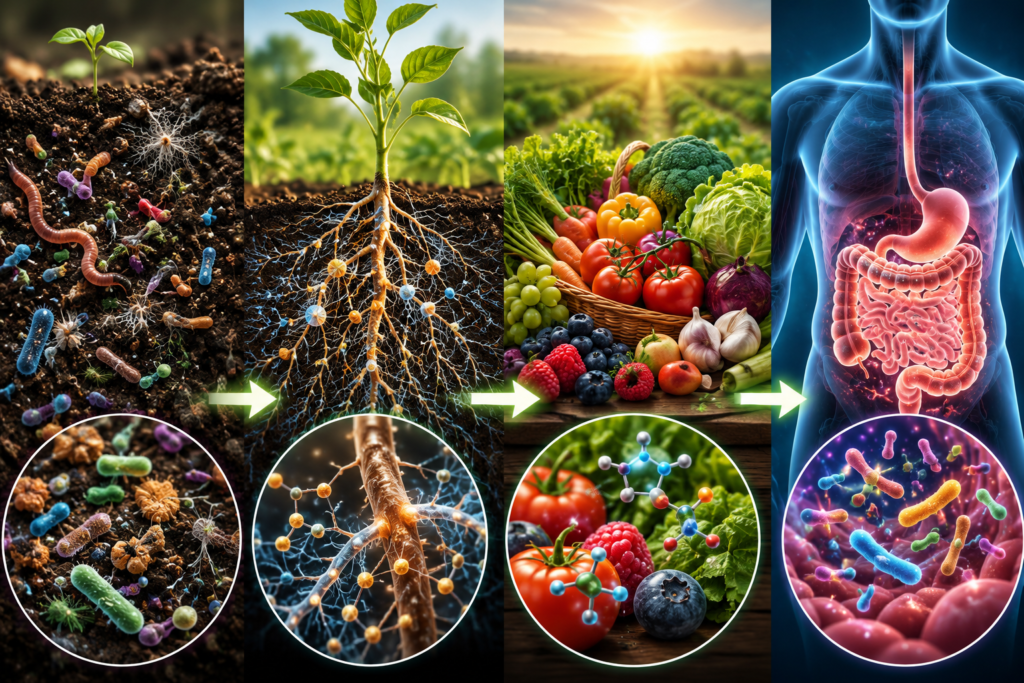
3. How Soil Microbiome Improves Human Gut Health Through Food Diversity
Perhaps the most fascinating discovery of recent years is the relationship between soil biodiversity and the human digestive microbiome.
Although soil microbes themselves do not necessarily colonize the human gut, the foods produced in healthy soils contain diverse compounds that nourish beneficial intestinal bacteria.
This relationship is sometimes described as the “soil-to-gut connection.”
The Human Gut Is Another Living Ecosystem
The average person carries approximately 38 trillion microorganisms inside their digestive tract.
These microbes influence nearly every aspect of health.
Research has associated a healthy gut microbiome with:
- Improved digestion
- Stronger immune defenses
- Reduced inflammation
- Better blood sugar regulation
- Enhanced vitamin production
- Lower risk of chronic disease
However, beneficial gut bacteria require food.
Not just calories.
Specific plant fibers and natural compounds.
Nutrient-Dense Foods Feed Good Gut Bacteria
Foods grown in healthy soils often contain greater concentrations of:
- Dietary fiber
- Resistant starch
- Polyphenols
- Plant antioxidants
- Natural prebiotics
These compounds become food for beneficial gut microbes.
As those microbes ferment fiber, they produce short-chain fatty acids such as:
- Butyrate
- Acetate
- Propionate
These compounds help:
- Strengthen the intestinal lining
- Reduce inflammation
- Support immune regulation
- Improve metabolic health
In simple terms, healthy soil helps grow healthier plants that help feed healthier gut bacteria.
Diversity Matters
One of the strongest predictors of gut health is microbial diversity.
Interestingly, the same principle applies underground.
Healthy soil contains thousands of microbial species.
Healthy human intestines also depend on microbial diversity.
This similarity has led scientists to explore the fascinating parallels between ecological health and human biology.
4. Benefits of Regenerative Agriculture for Human Health
Regenerative agriculture has rapidly gained attention because it focuses on rebuilding living soil rather than simply increasing crop yields.
Instead of treating soil as an inert growing medium, regenerative farming views it as a living ecosystem.
Its primary goals include:
- Increasing microbial diversity
- Building organic matter
- Reducing soil disturbance
- Keeping living roots in the ground
- Growing cover crops
- Integrating livestock responsibly
- Reducing excessive chemical inputs
Each of these practices strengthens the Soil Microbiome.
Why Regenerative Agriculture Is Different
Traditional agriculture often prioritizes maximum production.
Regenerative agriculture prioritizes ecosystem health alongside productivity.
Healthy ecosystems naturally produce healthier food.
Over time, regenerative practices improve:
The result is a more sustainable agricultural system capable of producing nutritious food for future generations.
Benefits of Regenerative Agriculture for Human Health
The health implications extend far beyond farming.
Potential benefits include:
Better Nutritional Quality
Healthier soils frequently produce crops richer in vitamins, minerals, antioxidants, and phytonutrients.
Reduced Chemical Exposure
Lower dependence on pesticides may decrease unnecessary chemical residues entering food systems.
Improved Gut Health
Greater dietary diversity and higher plant compound intake help support beneficial gut bacteria.
Stronger Immune Function
Foods rich in antioxidants and micronutrients contribute to normal immune system function.
Environmental Health Supports Human Health
Cleaner water.
Healthier ecosystems.
Improved biodiversity.
Reduced erosion.
All of these indirectly contribute to healthier communities.
Comparison Table: Conventional Farming vs. Regenerative Agriculture
| Feature | Conventional Farming | Regenerative Agriculture |
|---|---|---|
| Soil Microbial Diversity | Often Reduced | Continuously Improved |
| Organic Matter | Frequently Declines | Gradually Increases |
| Water Retention | Moderate to Poor | High |
| Dependence on Synthetic Fertilizers | High | Lower Over Time |
| Nutrient Density of Crops | Can Vary | Often Improved |
| Carbon Storage | Limited | Significantly Higher |
| Biodiversity | Lower | Higher |
| Long-Term Soil Health | Can Decline | Continuously Improves |
| Support for Gut-Friendly Plant Compounds | Moderate | Higher Potential |
Why This Matters for the Future of Nutrition
Nutrition science is undergoing a major transformation.
For decades, experts focused primarily on counting nutrients after food reached consumers.
Today, researchers increasingly ask a different question:
How were those nutrients created in the first place?
The answer often begins underground.
Healthy microbial communities influence nearly every stage of plant development—from seed germination to nutrient uptake, disease resistance, and the production of beneficial phytochemicals.
Rather than viewing farming and nutrition as separate disciplines, scientists now recognize them as deeply interconnected.
The Connection Between Soil Health and Nutrient-Rich Food demonstrates that protecting soil ecosystems is not just an environmental goal—it is also an investment in public health. Every improvement made beneath the surface has the potential to enhance the nutritional quality of the food we eat and, in turn, support healthier digestive systems and overall well-being.

Conclusion
The science is becoming increasingly clear: protecting the Soil Microbiome is about far more than growing crops—it is about cultivating healthier lives. When we invest in Healthy Soil, we encourage the natural production of Nutrient-Dense Foods, strengthen the Connection Between Soil Health and Nutrient-Rich Food, and support a thriving Gut Health ecosystem. Whether you’re a consumer choosing fresh produce, a gardener enriching your soil, or a farmer adopting regenerative practices, every action contributes to a healthier future that truly starts underground.
About The Author