Regenerative Agriculture
For decades, conversations about health have focused on calories, vitamins, exercise routines, and medical treatments. While these factors remain important, scientists, nutritionists, and agricultural experts are increasingly pointing to something much deeper—literally beneath our feet.
The condition of the soil where food is grown may have a profound impact on human health.
This realization has sparked growing interest in Regenerative Agriculture, a farming approach designed to restore ecosystems, improve biodiversity, rebuild soil health, and produce healthier food. Unlike conventional agricultural systems that often prioritize maximum yield, regenerative farming emphasizes long-term sustainability and ecological balance.
At the same time, researchers continue uncovering fascinating insights about Gut Health, particularly the role of the human microbiome in immunity, digestion, mental wellness, inflammation control, and disease prevention.
An intriguing question emerges:
Could healthier soil create healthier people?
Increasingly, evidence suggests the answer may be yes.
The relationship between soil microbes and human health is becoming one of the most exciting areas of modern nutritional science. As researchers explore the connection between agricultural practices and wellness outcomes, regenerative farming is emerging as a promising solution for producing Nutrient-Dense Foods while supporting environmental sustainability.
This article explores five powerful ways regenerative agriculture may improve gut health, enhance nutrition, and help create a healthier future.

Understanding Regenerative Farming and Soil Health
Before exploring the health benefits, it is important to understand what regenerative agriculture actually means.
Regenerative Agriculture is a farming philosophy focused on rebuilding and improving natural systems rather than simply maintaining them.
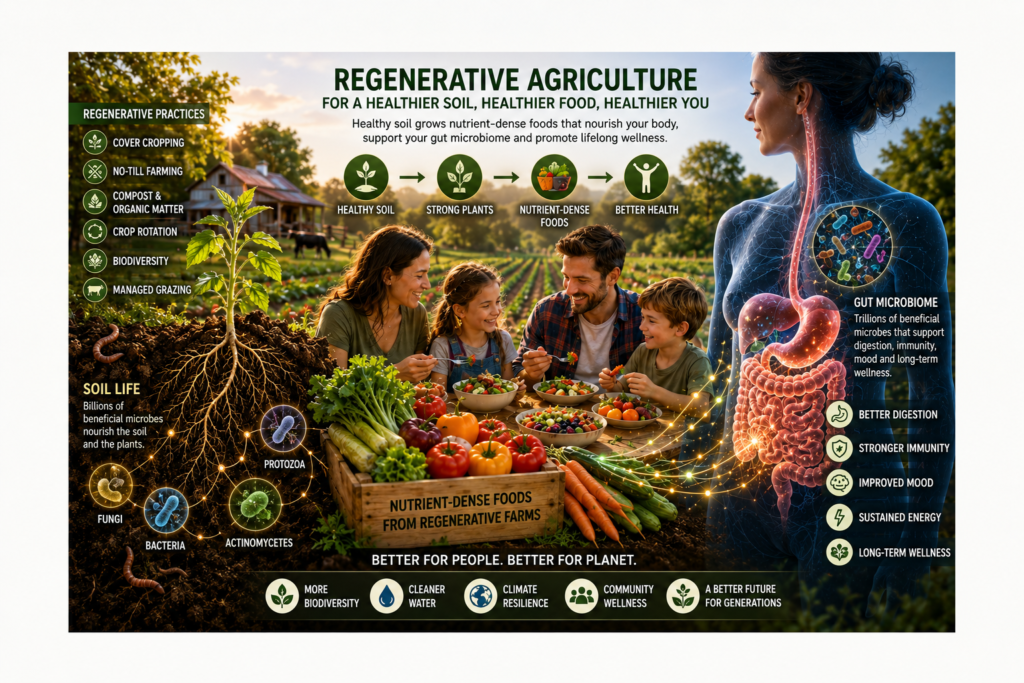
Common regenerative practices include:
- Cover cropping
- Reduced tillage
- Crop rotation
- Compost application
- Managed grazing
- Agroforestry
- Biodiversity enhancement
These practices work together to improve Soil Health, which refers to the soil’s ability to function as a living ecosystem capable of sustaining plants, animals, and humans.
Healthy soil contains:
- Billions of beneficial microorganisms
- Organic matter
- Fungi networks
- Earthworms
- Nutrients
- Natural carbon stores
Rather than being an inert growing medium, soil is a vibrant ecosystem teeming with life.
Regenerative Farming, Soil Health, and Human Wellness: A Quick Overview
| Factor | Conventional Farming | Regenerative Agriculture |
|---|---|---|
| Soil Microbial Diversity | Often Reduced | Increased |
| Organic Matter | Frequently Declines | Continuously Builds |
| Nutrient Density | Can Decrease Over Time | Often Enhanced |
| Chemical Inputs | High Dependence | Reduced Dependence |
| Carbon Storage | Lower | Higher |
| Biodiversity | Limited | Encouraged |
| Long-Term Sustainability | Challenging | Strong |
| Potential Impact on Gut Health | Indirect | Stronger Positive Potential |
Regenerative Agriculture: 5 Powerful and Proven Ways Soil Health Improves Gut Health and Creates Nutrient-Dense Foods for a Healthier Future
1. Regenerative Agriculture Improves Gut Health Naturally Through Diverse Soil Microbes
One of the most fascinating discoveries in recent years involves the relationship between soil microbial diversity and human microbial diversity.
Every healthy spoonful of soil contains billions of microorganisms.
These include:
- Beneficial bacteria
- Fungi
- Protozoa
- Nematodes
- Other microscopic organisms
Many scientists believe exposure to microbial diversity plays an important role in maintaining a healthy immune system and balanced gut microbiome.
The Connection Between Soil Microbes and Human Gut Microbiome Health
The human digestive system contains trillions of microbes collectively known as the gut microbiome.
These microbes influence:
- Digestion
- Immune regulation
- Mood
- Metabolism
- Nutrient absorption
- Inflammation control
Research increasingly suggests that modern lifestyles may reduce exposure to beneficial environmental microbes.
Regenerative farming helps restore microbial diversity in agricultural landscapes, potentially increasing beneficial microbial interactions throughout the food chain.
While eating soil itself is not the goal, consuming food grown in biologically active soils may support richer microbial exposure.
This is one reason experts are paying closer attention to how regenerative agriculture improves gut health naturally.
2. Regenerative Farming Creates More Nutrient-Dense Foods
One of the strongest arguments for regenerative agriculture centers on food quality.
Many consumers focus on appearance when buying food:
- Larger fruits
- Brighter vegetables
- Uniform shapes
However, appearance does not necessarily reflect nutritional value.
Healthy soil serves as a nutrient reservoir.
When soil contains abundant organic matter and microbial activity, plants can access a wider range of nutrients.
Nutrient-Dense Foods from Regenerative Farms for Preventive Healthcare
Several studies comparing regenerative and conventional farming systems have observed differences in:
- Mineral content
- Antioxidants
- Phytochemicals
- Essential nutrients
Nutrient-dense foods may contain higher concentrations of beneficial compounds linked to wellness.
Examples include:
- Polyphenols
- Flavonoids
- Omega-3 fatty acids
- Zinc
- Magnesium
- Iron
These compounds support:
- Immune function
- Cellular repair
- Brain health
- Digestive health
As healthcare increasingly shifts toward prevention rather than treatment, nutrient-rich foods become more important than ever.
This growing interest explains why nutrient-dense foods from regenerative farms for preventive healthcare have become a major topic among nutrition experts.
3. Soil Health Supports Stronger Immune Function Through Better Nutrition
The immune system depends heavily on nutritional status.
Deficiencies in essential vitamins and minerals can weaken immune defenses and increase vulnerability to illness.
Soil Health as the Foundation of Nutritional Resilience
Healthy soils help crops obtain nutrients more efficiently.
When soil ecosystems function properly:
- Nutrients cycle naturally
- Root systems grow deeper
- Plants become more resilient
- Crops develop richer nutritional profiles
The result is food that may contribute more effectively to immune support.
Important immune-supporting nutrients include:
- Vitamin A
- Zinc
- Selenium
- Magnesium
- Iron
Regenerative farming helps maintain the biological processes that make these nutrients available to plants.
This demonstrates another important connection between Soil Health and long-term human wellness.
4. Regenerative Farming Reduces Exposure to Harmful Environmental Stressors
Modern agriculture often relies heavily on synthetic inputs.
While these inputs can increase production, concerns exist regarding:
- Environmental degradation
- Water contamination
- Biodiversity loss
- Soil depletion
Regenerative systems seek to reduce dependency on external chemical interventions by strengthening natural ecosystem functions.
Benefits of Regenerative Farming for Nutrition and Long-Term Wellness
The benefits extend beyond nutrition.
Potential advantages include:
Cleaner Ecosystems
Healthier ecosystems contribute to:
- Cleaner water
- Improved air quality
- Better biodiversity
Reduced Soil Degradation
Healthy soil reduces erosion and nutrient loss.
Greater Food Security
More resilient farming systems are often better equipped to handle climate-related challenges.
Enhanced Community Health
Sustainable food systems can support healthier communities over generations.
These outcomes collectively contribute to the broader benefits of regenerative farming for nutrition and long-term wellness.
5. Regenerative Farming Supports Mental Health Through the Gut-Brain Connection
The relationship between the gut and the brain has become one of the most exciting areas of health research.
Scientists now refer to this communication network as the:
Gut-Brain Axis
The gut and brain constantly exchange signals.
A healthy gut microbiome influences:
- Mood
- Stress management
- Cognitive function
- Emotional resilience
Researchers have linked microbial diversity to improved mental well-being.
How Regenerative Agriculture Improves Gut Health Naturally Through the Gut-Brain Axis
Because regenerative agriculture promotes healthier soils and potentially more nutrient-rich foods, it may indirectly support mental wellness through improved gut function.
Foods rich in:
- Fiber
- Polyphenols
- Micronutrients
help nourish beneficial gut bacteria.
Those bacteria, in turn, produce compounds associated with brain health and emotional regulation.
This emerging area of science highlights how interconnected environmental and human health truly are.

Why Consumers Are Paying Attention to Regenerative Agriculture in 2026
Several trends are driving interest in regenerative agriculture:
Growing Awareness of Gut Health
Consumers increasingly understand the importance of the microbiome.
Demand for Nutrient-Dense Foods
People want foods that offer more than calories.
Interest in Preventive Healthcare
Many individuals seek lifestyle solutions before medical intervention becomes necessary.
Environmental Concerns
Climate resilience and sustainability are becoming purchasing priorities.
Transparency in Food Systems
Consumers want to know how their food is grown.
Together, these trends are pushing regenerative agriculture into the mainstream.
The Future of Nutrient-Dense Foods and Preventive Healthcare
Healthcare systems around the world face mounting pressure from chronic diseases.
Conditions linked to poor nutrition continue to rise.
As a result, healthcare professionals increasingly emphasize prevention.
Food may become one of the most powerful preventive tools available.
Regenerative agriculture offers a framework for producing food that:
- Supports ecological health
- Encourages microbial diversity
- Enhances nutrient availability
- Promotes long-term sustainability
This makes regenerative farming an important part of future conversations about public health.
For readers interested in learning more about soil ecosystems and sustainable food systems, resources from the Food and Agriculture Organization Soil Portal provide valuable educational materials. Likewise, the Rodale Institute offers extensive research and insights into regenerative farming practices and their long-term benefits.
Regenerative Agriculture and Soil Health: Building the Foundation for Nutrient-Dense Foods
When people think about healthy food, they often focus on what appears on the plate—fresh vegetables, colorful fruits, whole grains, and high-quality proteins. However, the journey toward truly nutritious food begins long before harvest. It starts in the soil. The quality of the soil in which crops are grown plays a fundamental role in determining the nutritional value of the food we consume. This is why Regenerative Agriculture has become one of the most important movements in modern farming and nutrition.
At its core, regenerative agriculture is built on the belief that healthy soil creates healthy plants, healthy animals, and ultimately healthy people. Unlike conventional agricultural systems that often rely heavily on synthetic fertilizers and intensive farming methods, regenerative farming focuses on restoring natural soil processes. The goal is not merely to sustain the land but to improve it over time.
Rodale Institute – Regenerative Agriculture Research
https://rodaleinstitute.org/why-organic/organic-basics/regenerative-organic-agriculture/
Understanding Soil Health Beyond Dirt
Many people view soil simply as a medium that holds plant roots in place. In reality, soil is a living ecosystem filled with billions of organisms. A single teaspoon of healthy soil can contain more microorganisms than there are people on Earth. These include bacteria, fungi, protozoa, nematodes, earthworms, and countless other forms of life that work together to maintain soil fertility.
Healthy soil performs several essential functions:
- Stores and cycles nutrients needed by plants.
- Retains water more efficiently.
- Supports diverse microbial communities.
- Reduces erosion and land degradation.
- Sequesters carbon from the atmosphere.
- Enhances plant resilience against pests and diseases.
When soil health declines, these natural functions become less effective. As a result, crops may require more synthetic inputs while delivering fewer nutrients to consumers.
How Regenerative Agriculture Restores Soil Health
Regenerative farmers use a variety of techniques designed to rebuild soil ecosystems naturally. These practices encourage biological activity and improve the structure and fertility of the land.
Some of the most common regenerative farming methods include:
Cover Cropping
Cover crops are plants grown primarily to protect and enrich the soil rather than for harvest. These crops help:
- Prevent soil erosion.
- Increase organic matter.
- Improve moisture retention.
- Feed beneficial soil microbes.
As cover crops decompose, they return valuable nutrients to the soil and create conditions that support healthy plant growth.
Reduced or No-Till Farming
Traditional tillage can disrupt soil structure and destroy beneficial microbial networks. Regenerative agriculture often minimizes or eliminates tillage to preserve soil life.
Benefits include:
- Reduced soil disturbance.
- Improved carbon storage.
- Greater water infiltration.
- Enhanced microbial diversity.
Healthy underground fungal networks can remain intact, helping plants access nutrients more efficiently.
Crop Rotation
Growing the same crop repeatedly in one area can deplete specific nutrients and encourage pest problems. Crop rotation helps maintain balance by introducing different plant species over time.
Advantages include:
- Improved nutrient cycling.
- Reduced pest pressure.
- Enhanced biodiversity.
- Better soil fertility.
Compost and Organic Matter Integration
Adding compost introduces beneficial microorganisms and organic material into the soil.
This process helps:
- Improve soil structure.
- Increase nutrient availability.
- Enhance microbial activity.
- Support long-term fertility.
The result is a thriving soil ecosystem capable of supporting healthier crops.
Why Soil Microbes Matter for Nutrient-Dense Foods
One of the most exciting aspects of regenerative agriculture is its focus on microbial life. Soil microbes act as nature’s nutrient managers. They break down organic matter and transform nutrients into forms that plants can absorb.
Without these microorganisms, many essential nutrients would remain locked in the soil and unavailable to crops.
Beneficial soil microbes help plants access:
- Nitrogen
- Phosphorus
- Potassium
- Zinc
- Magnesium
- Iron
- Calcium
These nutrients are critical not only for plant growth but also for human health.
When soil microbial communities flourish, crops often develop stronger root systems and gain access to a wider range of nutrients. This can contribute to the production of more Nutrient-Dense Foods, which contain higher concentrations of vitamins, minerals, antioxidants, and other beneficial compounds.
The Link Between Soil Health and Food Quality
Food quality is about much more than appearance or yield. A tomato may look perfect on the outside, yet contain fewer nutrients than one grown in biologically active soil.
Healthy soil influences food quality in several important ways:
Increased Mineral Content
Plants grown in nutrient-rich soils often have greater access to essential minerals that contribute to human health.
Enhanced Phytochemical Production
Plants naturally produce protective compounds called phytochemicals. These compounds help plants defend themselves against environmental stress and can provide health benefits when consumed by humans.
Examples include:
- Polyphenols
- Flavonoids
- Carotenoids
- Antioxidants
Better Flavor and Freshness
Many consumers report that food grown using regenerative practices has richer flavor and better overall quality. While flavor can be subjective, healthier soils often contribute to stronger plant development and improved taste characteristics.
Building a More Resilient Food System
Beyond nutrition, regenerative agriculture contributes to the long-term sustainability of food production systems. Healthy soils are more resilient during extreme weather events such as droughts and heavy rainfall.
Some key benefits include:
- Improved water retention during dry periods.
- Reduced flooding and runoff.
- Greater resistance to soil erosion.
- Enhanced carbon sequestration.
- Increased biodiversity.
These advantages help farmers maintain productivity while protecting natural resources for future generations.
Why This Matters for Human Health
The growing interest in Soil Health is not simply about improving farming practices. It is about recognizing the deep connection between the health of ecosystems and the health of people.
As researchers continue exploring the relationship between agriculture and nutrition, evidence increasingly suggests that healthier soils can contribute to healthier diets. Nutrient-dense foods produced through regenerative farming may support better immune function, improved gut health, and long-term wellness.
In many ways, regenerative agriculture represents a return to a simple but powerful principle: when we care for the soil, the soil takes care of us. By rebuilding soil ecosystems and promoting biological diversity, regenerative farming lays the foundation for a future where food is not only abundant but also genuinely nourishing.
The Connection Between Soil Microbes and Human Gut Health
One of the most fascinating discoveries in modern health and agricultural science is the growing recognition that the health of our gut may be closely linked to the health of the soil where our food is grown. While soil and the human digestive system may seem like completely separate worlds, both are home to incredibly complex microbial ecosystems that play essential roles in supporting life. Understanding the connection between soil microbes and human gut microbiome health is helping researchers uncover new insights into nutrition, immunity, and overall wellness.
Healthy soil is far more than a mixture of minerals and organic matter. It is a living ecosystem filled with billions of microorganisms, including bacteria, fungi, protozoa, and other microscopic organisms. These soil microbes perform critical functions such as breaking down organic matter, recycling nutrients, improving soil structure, and supporting plant growth. Without them, plants would struggle to access many of the nutrients they need to thrive.
Similarly, the human gut contains trillions of microorganisms collectively known as the gut microbiome. This community of bacteria, fungi, and other microbes influences nearly every aspect of human health. Scientists now understand that the gut microbiome helps regulate digestion, nutrient absorption, metabolism, immune responses, and even mental health through the gut-brain axis.
The similarities between these two ecosystems are remarkable. Both healthy soil and a healthy gut depend on diversity. In nature, diverse microbial communities tend to be more resilient, productive, and capable of maintaining balance. When microbial diversity declines, both soil ecosystems and human digestive systems become more vulnerable to disruptions and disease.
This is where Regenerative Agriculture enters the conversation. Regenerative farming practices focus on restoring biodiversity above and below the ground. By using methods such as cover cropping, crop rotation, compost application, reduced tillage, and managed grazing, farmers can increase microbial activity and improve overall Soil Health. These practices help create thriving underground ecosystems that support healthier plants and more sustainable food production.
Researchers believe that foods grown in biologically active soils may carry a wider range of beneficial compounds and microbial interactions compared to foods grown in degraded soils. While fruits and vegetables are typically washed before consumption, exposure to diverse environmental microbes through food and natural environments may still contribute to microbial diversity in humans. This concept is gaining attention as scientists explore how modern lifestyles may have reduced people’s contact with beneficial microorganisms found in nature.
The relationship between soil microbes and gut health also extends to nutrient quality. Healthy soil microbes help plants absorb essential minerals such as magnesium, zinc, iron, and calcium. They also support the production of beneficial plant compounds like polyphenols and antioxidants. When people consume these nutrient-rich foods, they provide nourishment not only for themselves but also for the beneficial bacteria living in their digestive systems.
Many of these compounds act as prebiotics, which are substances that feed beneficial gut microbes. A well-nourished gut microbiome can contribute to better digestion, stronger immune function, reduced inflammation, and improved overall health. This demonstrates how the journey from soil to human wellness is more connected than many people realize.
As interest in Gut Health continues to grow, scientists are increasingly viewing soil health as an important part of the larger health picture. The idea that healthier soils can contribute to healthier microbiomes and more Nutrient-Dense Foods represents a powerful shift in how we think about food production. By protecting and restoring soil ecosystems through regenerative agriculture, society may be able to support not only environmental sustainability but also long-term human health and wellness.
Food and Agriculture Organization (FAO) – Soil Biodiversity
https://www.fao.org/global-soil-partnership/areas-of-work/soil-biodiversity/en/

Conclusion: Healthy Soil May Be the Missing Link to Better Human Health
The phrase “healthy soil, healthy people” is no longer simply a slogan.
It reflects an emerging understanding that environmental health and human health are deeply connected.
The evidence continues to grow around:
- Regenerative Agriculture
- Gut Health
- Soil Health
- Nutrient-Dense Foods
From supporting microbial diversity to improving nutritional quality and strengthening preventive healthcare strategies, regenerative agriculture represents far more than a farming trend.
It offers a practical pathway toward healthier ecosystems, healthier communities, and healthier futures.
As we move deeper into 2026 and beyond, one thing is becoming increasingly clear:
The journey to better health may begin not in the pharmacy, but in the soil beneath our feet.
About The Author