Green Farming Technology
Agriculture has always been one of humanity’s greatest achievements. It feeds billions of people, supports global economies, and provides livelihoods for nearly half of the world’s population. Yet, agriculture also faces one of the greatest challenges of the modern era: producing more food while reducing its environmental footprint.
Climate change, soil degradation, water scarcity, biodiversity loss, and rising greenhouse gas emissions are putting unprecedented pressure on farmers across the globe. Traditional farming methods that once sustained generations are increasingly proving insufficient to meet today’s environmental and economic realities.
This is where Green Farming Technology enters the picture.
Rather than viewing technology as merely a tool for increasing production, modern agriculture is embracing innovation as a means of protecting natural resources while ensuring long-term food security. The latest generation of agricultural technologies is designed to make farming smarter, cleaner, and far more efficient.
In 2026, the conversation has shifted beyond simply growing larger harvests. Farmers, governments, researchers, and consumers are asking more meaningful questions:
- How can agriculture become carbon neutral?
- Can artificial intelligence reduce waste?
- Is it possible to increase crop yields while using less water?
- Can renewable energy power modern farms?
- How do we produce food without exhausting the planet’s resources?
Fortunately, exciting innovations are already providing answers.
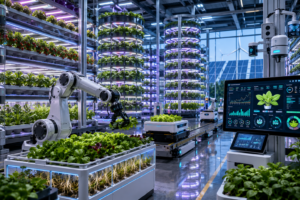
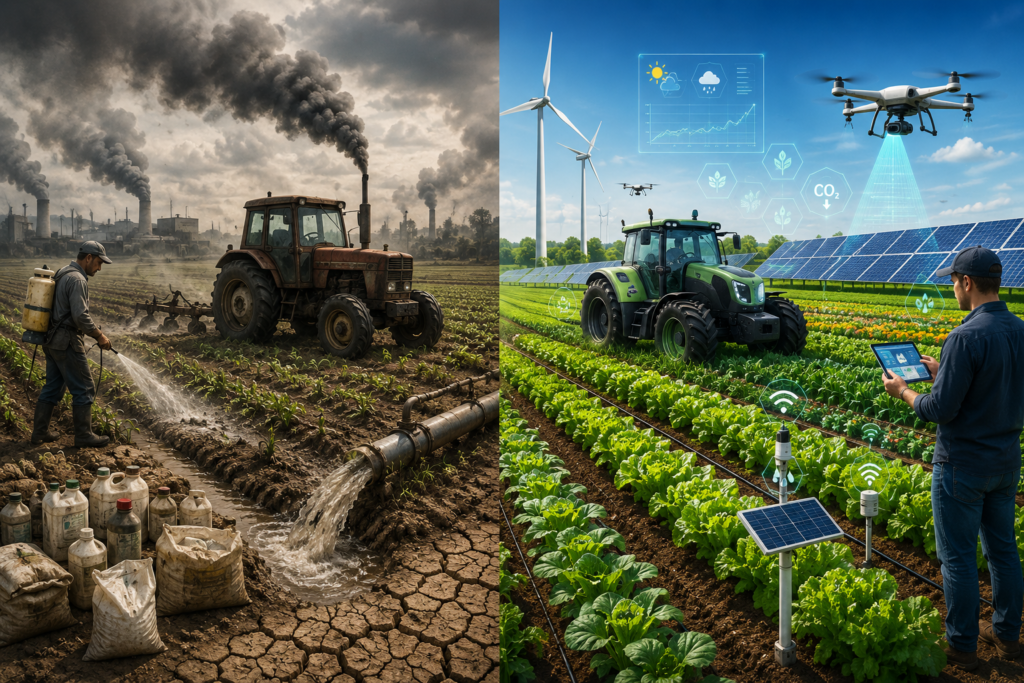
Today’s farms are increasingly powered by artificial intelligence, satellite imagery, autonomous machinery, renewable energy systems, advanced sensors, robotics, and predictive analytics. These technologies are transforming every aspect of agricultural production—from planting and irrigation to harvesting and supply chain management.
The result is a new era of Sustainable Farming, where productivity and environmental responsibility work hand in hand rather than competing against each other.
Whether you are a commercial farmer, agribusiness owner, agricultural student, sustainability advocate, or simply curious about the future of food production, understanding these innovations has never been more important.
In this comprehensive guide, we’ll explore four groundbreaking technologies reshaping global agriculture, explain how they reduce carbon emissions, and examine why experts believe they represent the future of farming.

Why Green Farming Technology Is Becoming Essential for Sustainable Farming
For decades, agricultural success was measured almost exclusively by yield. More crops meant greater success.
Today, that definition has changed dramatically.
Modern agriculture must now balance three critical objectives simultaneously:
- Producing enough food for a growing global population
- Protecting natural ecosystems
- Reducing greenhouse gas emissions
Achieving all three requires smarter systems rather than simply larger farms.
This is precisely why Green Farming Technology has become one of the fastest-growing sectors within agricultural innovation.
Green farming technologies combine environmental sustainability with digital intelligence. They enable farmers to use fewer resources while producing higher-quality crops and maintaining healthy ecosystems.
Instead of relying on blanket applications of fertilizers or pesticides, smart technologies help farmers make highly targeted decisions based on real-time field data.
The benefits are substantial:
- Lower fuel consumption
- Reduced fertilizer use
- Less chemical runoff
- Improved soil health
- Higher crop yields
- Better water conservation
- Lower production costs
- Reduced greenhouse gas emissions
This shift represents one of the most significant transformations agriculture has experienced since the mechanization of farming during the Industrial Revolution.
Green Farming Technology and Sustainable Farming: Why They Go Hand in Hand
Although often used interchangeably, Green Farming Technology and Sustainable Farming are not identical concepts.
Understanding their relationship helps explain why both are essential for the future of agriculture.
| Green Farming Technology | Sustainable Farming |
|---|---|
| Focuses on innovative tools and technologies | Focuses on long-term farming practices |
| Includes AI, robotics, sensors, drones, GPS, renewable energy | Includes soil conservation, biodiversity, crop rotation, water conservation |
| Technology-driven | Practice-driven |
| Reduces waste through automation | Protects natural ecosystems |
| Uses data for decision making | Uses ecological principles for farming |
| Improves efficiency | Improves sustainability |
| Helps reduce carbon emissions | Helps preserve future food production |
The two complement one another.
Technology provides farmers with better information and more efficient tools, while sustainable farming principles ensure those tools are used responsibly.
Together, they create farming systems capable of feeding future generations without exhausting natural resources.
The Growing Need for Climate-Smart Farming Technologies for Carbon Reduction
Agriculture contributes significantly to global greenhouse gas emissions through:
- Livestock methane
- Synthetic fertilizer production
- Diesel-powered machinery
- Land-use changes
- Excessive tillage
- Food waste
As governments around the world commit to net-zero emissions targets, agriculture has become one of the most important sectors for climate action.
This has accelerated investment in Climate-smart farming technologies for carbon reduction.
These technologies help farmers lower emissions by:
Optimizing Fertilizer Use
Artificial intelligence can calculate the exact nutrient requirements for each section of a field.
Instead of applying fertilizer uniformly, farmers apply only what crops actually need.
Benefits include:
- Lower fertilizer costs
- Less nitrous oxide emissions
- Reduced water pollution
- Improved crop health
Reducing Fuel Consumption
Autonomous tractors and GPS-guided machinery minimize unnecessary driving across fields.
This reduces:
- Diesel consumption
- Machinery wear
- Carbon dioxide emissions
- Labor costs
Smarter Irrigation
Water pumping accounts for substantial agricultural energy use.
Smart irrigation systems combine:
- Soil moisture sensors
- Weather forecasts
- Satellite monitoring
- AI algorithms
to irrigate crops only when necessary.
The outcome is lower electricity usage, reduced groundwater depletion, and healthier crops.
Renewable Energy Integration
Many modern farms now operate using:
- Solar panels
- Wind turbines
- Biogas systems
- Battery storage
Renewable energy allows farms to become more energy independent while reducing fossil fuel consumption.
How Technology Is Changing Agriculture Faster Than Ever Before
Agriculture has entered the age of digital transformation.
Only a decade ago, farmers relied heavily on:
- Personal experience
- Weather predictions
- Manual observations
- Historical planting records
While experience remains valuable, today’s decisions increasingly rely on data.
Modern farms generate enormous amounts of information every day.
Examples include:
- Soil nutrient levels
- Moisture content
- Weather forecasts
- Pest activity
- Satellite imagery
- Crop growth rates
- Machinery performance
- Livestock health
Artificial intelligence processes this information within seconds.
Instead of reacting to problems after they occur, farmers can now predict issues before they become costly.
This shift from reactive farming to predictive farming is one of the defining characteristics of modern Green Farming Technology.
Comparison Table: Four Powerful Green Farming Technologies Transforming Agriculture
| Innovation | Primary Purpose | Carbon Reduction Impact | Productivity Benefit | Adoption Trend (2026) |
|---|---|---|---|---|
| AI in Agriculture | Predictive farm management | ★★★★★ | ★★★★★ | Very High |
| Precision Agriculture | Resource optimization | ★★★★★ | ★★★★★ | Very High |
| Renewable Energy Systems | Replace fossil fuels | ★★★★★ | ★★★★☆ | High |
| Smart Climate Monitoring | Weather and risk prediction | ★★★★☆ | ★★★★★ | Rapidly Growing |
Green Farming Technology: 4 Powerful Innovations Creating a Brighter Future for Sustainable Farming in 2026
Innovation #1: AI in Agriculture – The Brain Behind Modern Green Farming Technology
Among every innovation transforming agriculture today, none has attracted as much attention as AI in Agriculture.
Artificial intelligence is no longer a futuristic concept reserved for technology companies. It has become an everyday farming tool capable of improving productivity while dramatically reducing environmental impact.
Farmers are using AI to answer questions that once required years of experience, such as:
- When should seeds be planted?
- Which crops will perform best?
- How much fertilizer is truly needed?
- When is irrigation necessary?
- Where will pests appear next?
- What diseases are developing before symptoms become visible?
By analyzing weather data, satellite imagery, historical yields, soil conditions, and crop health simultaneously, AI systems generate recommendations that are both timely and highly accurate.
This data-driven approach helps eliminate guesswork, enabling farmers to make informed decisions that save resources and improve outcomes.
AI-Powered Green Technology for Sustainable Farming
One of the greatest strengths of AI-powered green technology for sustainable farming is its ability to optimize nearly every farming operation without increasing environmental pressure.
Key applications include:
- Predictive crop management
- Automated irrigation scheduling
- Intelligent fertilizer recommendations
- Early pest and disease detection
- Harvest forecasting
- Autonomous machinery guidance
- Supply chain optimization
Rather than replacing farmers, AI enhances human decision-making by providing actionable insights based on vast amounts of data.
For example, instead of irrigating an entire field, AI systems can identify specific zones that require water. Likewise, fertilizer applications can be adjusted to meet the exact needs of different soil areas, reducing waste and minimizing emissions.
This precision not only lowers operational costs but also supports healthier soils, cleaner waterways, and more resilient farming systems.
Innovation #2: Precision Agriculture – The Foundation of Modern Green Farming Technology
If artificial intelligence serves as the brain of modern agriculture, then Precision Agriculture acts as its eyes, ears, and hands. It enables farmers to manage every square meter of farmland with exceptional accuracy, ensuring that resources are applied only where and when they are truly needed.
Unlike conventional farming methods, which often treat an entire field as though every section has identical conditions, Precision Agriculture recognizes that no two parts of a farm are exactly alike. Soil composition, moisture levels, nutrient availability, and crop growth can vary significantly across the same field. Applying the same amount of fertilizer, water, or pesticides everywhere often leads to waste, higher costs, and unnecessary environmental damage.
Precision Agriculture solves this challenge by combining advanced technologies such as:
- GPS-guided farm equipment
- Geographic Information Systems (GIS)
- Remote sensing
- Satellite imagery
- Soil sensors
- Weather monitoring stations
- Internet of Things (IoT) devices
- Variable Rate Technology (VRT)
Together, these tools create a highly detailed picture of farm conditions, allowing decisions to be based on real-time data instead of assumptions.
How Precision Agriculture Improves Sustainable Farming
One of the greatest strengths of Precision Agriculture is its ability to maximize productivity while minimizing environmental impact.
Instead of relying on generalized farming practices, farmers receive detailed recommendations tailored to specific areas of their fields.
For example:
- A dry section receives additional irrigation.
- Nutrient-deficient soil receives targeted fertilizer.
- Healthy crops avoid unnecessary pesticide spraying.
- Areas vulnerable to disease are monitored more closely.
This targeted approach significantly reduces waste and helps preserve valuable natural resources.
Key Benefits Include
- Lower fertilizer consumption
- Reduced chemical runoff into rivers and lakes
- Improved soil fertility
- Greater water efficiency
- Reduced diesel usage
- Increased crop yields
- Lower greenhouse gas emissions
- Better profitability
These improvements demonstrate why Precision Agriculture is now considered one of the Best green farming technologies to reduce carbon emissions.
Precision Agriculture and Carbon Reduction
Agriculture contributes to greenhouse gas emissions through several activities, including excessive fertilizer application, repeated machinery use, and inefficient irrigation.
Precision Agriculture addresses each of these issues.
Reduced Fertilizer Emissions
Nitrogen fertilizers release nitrous oxide, a greenhouse gas significantly more potent than carbon dioxide.
Precision Agriculture reduces these emissions by ensuring fertilizers are applied only where needed and in the correct amounts.
Efficient Machinery Operation
GPS-guided tractors eliminate unnecessary overlaps during planting, spraying, and harvesting.
Benefits include:
- Lower diesel consumption
- Less soil compaction
- Reduced operating costs
- Fewer carbon emissions
Water Conservation
Smart irrigation systems prevent overwatering while maintaining ideal soil moisture.
This not only conserves freshwater resources but also reduces the energy required for pumping and distribution.
Real-World Applications of Precision Agriculture
Modern farms around the world are already experiencing remarkable results through Precision Agriculture.
Examples include:
Variable Rate Fertilizer Application
Instead of spreading fertilizer evenly across an entire field, specialized equipment adjusts application rates automatically based on soil nutrient maps.
Result:
- Lower fertilizer costs
- Improved crop quality
- Reduced pollutio
GPS Auto-Steering Systems
Modern tractors can navigate fields with remarkable precision.
Advantages include:
- Straighter planting rows
- Reduced fuel consumption
- Increased planting accuracy
- Less operator fatigue
Smart Irrigation
Sensors continuously measure soil moisture.
When moisture levels fall below the optimal range, irrigation begins automatically.
Benefits include:
- Water savings
- Healthier crops
- Reduced energy costs
- Better drought resilience
Yield Mapping
Harvesting equipment records crop yields across every section of a field.
Farmers can then identify:
- High-performing zones
- Low-performing areas
- Nutrient deficiencies
- Soil problems
These insights improve planning for future growing seasons.

Innovation #3: Renewable Energy Systems Driving Green Farming Technology
Agriculture has traditionally depended on fossil fuels.
Diesel powers tractors.
Electric pumps rely on conventional power grids.
Grain dryers consume large amounts of fuel.
Greenhouses often require significant heating energy.
This dependence contributes substantially to greenhouse gas emissions.
Today, renewable energy is changing that reality.
Modern farms increasingly generate their own clean electricity through:
- Solar panels
- Wind turbines
- Biogas digesters
- Small hydro systems
- Battery storage
Renewable energy represents one of the most practical and impactful components of Green Farming Technology.
Solar Energy Is Transforming Modern Farms
Solar power has become increasingly affordable and efficient.
Farmers now install solar panels on:
- Barn roofs
- Equipment sheds
- Irrigation systems
- Greenhouses
- Livestock facilities
Electricity generated during daylight hours powers farm operations while excess energy can often be stored or supplied to local electricity grids, depending on regional policies.
Benefits include:
- Lower electricity bills
- Reduced carbon emissions
- Greater energy independence
- Stable operating costs
- Long-term financial savings
Wind Energy Supporting Sustainable Farming
Many agricultural regions experience consistent wind conditions.
Wind turbines convert this natural resource into clean electricity.
Large farms often generate enough power to operate:
- Irrigation pumps
- Grain handling equipment
- Livestock facilities
- Refrigeration units
- Farm offices
Unlike fossil fuels, wind energy produces virtually no greenhouse gas emissions during operation.
Biogas Systems Turning Waste into Energy
One of agriculture’s greatest strengths is that waste can become a valuable resource.
Livestock manure, crop residues, and food processing waste can all be converted into biogas.
Biogas digesters produce methane that can be used for:
- Heating
- Electricity generation
- Cooking fuel
- Machinery fuel (after upgrading)
Additional advantages include:
- Reduced methane emissions
- Improved manure management
- Renewable energy production
- High-quality organic fertilizer as a by-product
Renewable Energy Supports Sustainable Farming
Renewable energy contributes to Sustainable Farming in several important ways.
Environmental Benefits
- Reduced greenhouse gas emissions
- Cleaner air
- Less fossil fuel dependence
- Improved biodiversity
Economic Benefits
- Lower long-term energy costs
- Protection from rising fuel prices
- Additional income opportunities
- Increased farm resilience
Social Benefits
- Stronger rural economies
- Improved energy security
- New employment opportunities
- Enhanced community sustainability
Innovation #4: Smart Climate Monitoring Systems
Weather has always influenced farming.
However, climate change has made weather patterns increasingly unpredictable.
Unexpected droughts, floods, storms, and heatwaves now threaten agricultural production across many regions.
This is why Climate-smart farming technologies for carbon reduction have become essential.
Smart climate monitoring combines:
- Weather stations
- Satellite observations
- Artificial intelligence
- Climate models
- IoT sensors
Together, these systems provide farmers with highly accurate forecasts and early warnings.
How Climate Monitoring Improves Farming Decisions
Rather than reacting after weather damage occurs, farmers can prepare in advance.
Examples include:
Frost Prediction
Sensors identify conditions favorable for frost formation.
Farmers receive alerts allowing them to protect sensitive crops.
Rainfall Forecasting
AI forecasts rainfall with increasing accuracy.
Farmers avoid unnecessary irrigation, conserving both water and electricity.
Heat Stress Monitoring
Livestock producers receive alerts during dangerous heat conditions.
Protective measures can be implemented before productivity declines.
Disease Forecasting
Many crop diseases develop only under specific weather conditions.
AI predicts disease risk based on:
- Humidity
- Temperature
- Rainfall
- Wind patterns
Early treatment reduces crop losses while minimizing pesticide use.
How AI Is Transforming Sustainable Agriculture in 2026
One of the most exciting developments is the integration of artificial intelligence across every major farming technology.
Instead of operating independently, AI now connects:
- Drones
- Irrigation systems
- Farm machinery
- Weather forecasts
- Satellite imagery
- Market prices
- Soil sensors
- Yield prediction models
This creates a fully connected agricultural ecosystem.
Farmers receive recommendations through smartphones or farm management software.
Many routine tasks can even be automated.
Examples include:
- Starting irrigation systems
- Adjusting fertilizer application
- Detecting crop diseases
- Scheduling harvesting
- Managing farm logistics
This digital transformation illustrates How AI is transforming sustainable agriculture in 2026, making farming more efficient, resilient, and environmentally responsible.
Comparison of the Four Green Farming Technologies
| Technology | Main Purpose | Environmental Benefit | Economic Benefit | Adoption Difficulty |
|---|---|---|---|---|
| AI in Agriculture | Intelligent decision-making | Reduced waste and emissions | Higher yields | Medium |
| Precision Agriculture | Resource optimization | Less fertilizer and water use | Lower input costs | Medium |
| Renewable Energy Systems | Clean farm power | Reduced fossil fuel dependence | Lower energy bills | Medium-High |
| Climate Monitoring Systems | Risk prediction | Better climate adaptation | Reduced crop losses | Low-Medium |
Why Farmers Are Rapidly Adopting Green Farming Technology
Across the world, farmers are recognizing that sustainability and profitability are no longer competing goals—they reinforce one another. Investing in Green Farming Technology helps reduce costs, improve resilience, and meet growing consumer demand for environmentally responsible food production.
Some of the key reasons driving adoption include:
- Rising fuel and fertilizer costs
- Increasing pressure to reduce carbon emissions
- Government incentives for sustainable practices
- Consumer preference for sustainably produced food
- Greater resilience against climate change
- Improved long-term profitability
- Enhanced soil health and biodiversity
- Better compliance with environmental regulations
These technologies are proving that modern agriculture can produce abundant, high-quality food while protecting the planet for future generations.
World Bank. Agriculture and Food. https://www.worldbank.org/en/topic/agriculture
What the Future Holds for Green Farming Technology Beyond 2026
Agriculture has always evolved alongside human civilization, but the pace of change today is unlike anything seen before. Innovations that once seemed futuristic—such as autonomous tractors, AI-powered crop monitoring, robotic harvesting, and digital twins of farmland—are rapidly becoming practical tools for farms of all sizes.
Looking beyond 2026, the future of Green Farming Technology is expected to focus on creating agricultural systems that are not only more productive but also regenerative, resilient, and carbon-neutral. Farmers will increasingly rely on interconnected technologies that communicate with one another, enabling nearly every aspect of production to be monitored and optimized in real time.
Several trends are likely to define the next phase of agricultural transformation.
Food and Agriculture Organization of the United Nations (FAO). Digital Agriculture and Sustainable Food Systems. https://www.fao.org
Hyper-Connected Smart Farms
The farms of tomorrow will function as integrated digital ecosystems. Sensors embedded in the soil, drones flying overhead, weather stations, autonomous machinery, and AI-powered management platforms will continuously exchange data.
This connectivity will allow farmers to:
- Detect crop stress before visible symptoms appear.
- Predict equipment maintenance needs.
- Optimize irrigation based on weather forecasts.
- Monitor livestock health remotely.
- Improve harvest timing for maximum quality.
The result will be greater efficiency, reduced waste, and lower operating costs.
Autonomous Farm Equipment
Automation is expected to expand far beyond self-driving tractors. Emerging technologies include:
- Autonomous seed planters
- Robotic weed removal systems
- AI-controlled sprayers
- Driverless harvesters
- Automated greenhouse management
These systems will help address labor shortages while improving precision and reducing fuel consumption.
Carbon Farming Will Become Mainstream
Governments and private organizations are increasingly encouraging practices that remove carbon dioxide from the atmosphere and store it in soils and vegetation.
Future carbon farming strategies may include:
- Cover cropping
- Agroforestry
- Reduced tillage
- Biochar application
- Precision nutrient management
Farmers who adopt these practices may benefit from participation in carbon credit programs, creating an additional source of income while contributing to climate mitigation.
Biotechnology and Climate-Resilient Crops
Advances in plant breeding and biotechnology are producing crops that are better adapted to changing environmental conditions.
Future varieties are expected to offer:
- Improved drought tolerance
- Greater resistance to pests and diseases
- Enhanced nutrient-use efficiency
- Better tolerance to extreme temperatures
These innovations will complement Climate-smart farming technologies for carbon reduction, ensuring stable food production despite increasingly unpredictable weather patterns.
Practical Tips for Farmers Interested in Green Farming Technology
Transitioning to more sustainable practices does not require replacing every piece of equipment overnight. Incremental changes often provide significant benefits while allowing farmers to manage costs and adapt gradually.
1. Begin with a Farm Assessment
Evaluate current operations to identify opportunities for improvement.
Consider factors such as:
- Fuel consumption
- Water use
- Fertilizer efficiency
- Soil health
- Crop yields
- Energy costs
Understanding your starting point helps prioritize investments with the greatest potential return.
2. Invest in Data Collection
Reliable data forms the foundation of effective decision-making.
Useful tools include:
- Soil moisture sensors
- Weather stations
- GPS-enabled machinery
- Satellite imagery
- Farm management software
Even basic monitoring systems can reveal patterns that improve efficiency and reduce unnecessary inputs.
3. Adopt Precision Agriculture Gradually
Rather than implementing every technology at once, start with solutions that address your farm’s most pressing needs.
For example:
- GPS guidance to reduce overlap during planting.
- Variable-rate fertilizer application.
- Smart irrigation scheduling.
These technologies often deliver measurable savings while laying the groundwork for future innovation.
4. Explore Renewable Energy Opportunities
Renewable energy systems can reduce operating costs over time while lowering greenhouse gas emissions.
Depending on local conditions, suitable options may include:
- Solar-powered irrigation pumps
- Rooftop solar installations
- Biogas digesters
- Small wind turbines
Carefully evaluate installation costs, maintenance requirements, and available incentives before making an investment.
5. Invest in Training
Technology is most effective when users understand how to interpret and apply the information it provides.
Continuous learning helps farmers:
- Improve productivity.
- Reduce input waste.
- Increase profitability.
- Adapt to changing environmental conditions.
Training can be obtained through agricultural extension services, universities, equipment manufacturers, and professional organizations.
Common Challenges and How to Overcome Them
While Green Farming Technology offers significant benefits, adoption is not without challenges.
Understanding these obstacles allows farmers and policymakers to develop effective solutions.
| Challenge | Impact | Possible Solution |
|---|---|---|
| High initial investment | Slower adoption | Financing programs, grants, phased implementation |
| Limited digital skills | Difficulty using advanced tools | Training and technical support |
| Poor internet connectivity | Reduced effectiveness of cloud-based systems | Offline-capable software and improved rural infrastructure |
| Data privacy concerns | Reluctance to share farm data | Clear data ownership policies and secure platforms |
| Equipment compatibility | Integration difficulties | Open standards and interoperable technologies |
Although these issues require attention, ongoing technological improvements and supportive policies are making advanced farming solutions increasingly accessible.

Final Thoughts
The future of agriculture will not be defined solely by larger machinery or higher crop yields. Instead, success will depend on how effectively farmers balance productivity with environmental responsibility.
The innovations explored in this article—AI in Agriculture, Precision Agriculture, renewable energy systems, and Climate-smart farming technologies for carbon reduction—demonstrate that modern farming can achieve both objectives simultaneously.
By adopting AI-powered green technology for sustainable farming, producers gain access to real-time insights that improve decision-making, reduce waste, and strengthen resilience against climate change. Precision Agriculture ensures that valuable resources such as water, fertilizers, and fuel are used efficiently, while renewable energy and climate monitoring systems help lower emissions and improve long-term sustainability.
These advancements are not simply technological upgrades; they represent a shift toward farming systems designed to protect ecosystems, support rural communities, and secure food supplies for future generations.
Whether you manage a large commercial enterprise or a small family farm, embracing Green Farming Technology offers an opportunity to increase efficiency, reduce environmental impact, and build a more resilient agricultural future. As innovation continues to accelerate beyond 2026, those who adapt early will be better positioned to thrive in an increasingly sustainable and technology-driven agricultural landscape.
About The Author