Agroforestry
Agroforestry is entering a new era.
For decades, farmers around the world have faced a growing list of challenges. Climate change is increasing drought frequency. Soil fertility is declining in many regions. Input costs continue to rise. Meanwhile, consumers and governments are demanding more sustainable farming practices.
Against this backdrop, Tree-Based Farming has emerged as one of the most promising solutions for modern agriculture.
Rather than treating trees as obstacles to agricultural production, Tree-Based Farming integrates trees, crops, and livestock into a single productive system. This approach creates multiple income streams while improving environmental sustainability.
One of the most effective forms of Tree-Based Farming is Silvopasture.
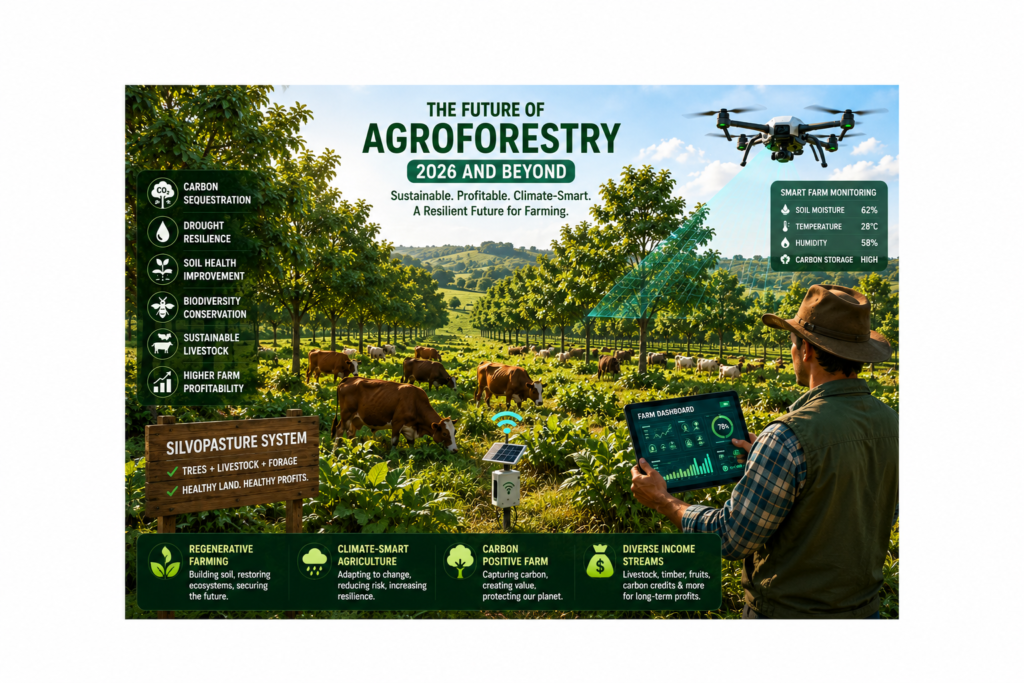
Silvopasture combines trees, forage plants, and livestock within the same area. Instead of separating forests and grazing lands, farmers strategically integrate them to create productive ecosystems that benefit animals, crops, and the environment simultaneously.
In 2026, growing interest in Climate-Smart Agriculture and Regenerative Farming is driving unprecedented adoption of silvopasture systems worldwide. Farmers are discovering that properly managed tree-based grazing systems can:
- Increase farm profitability
- Improve livestock welfare
- Reduce feed costs
- Enhance drought resilience
- Improve soil health
- Increase biodiversity
- Capture carbon
- Generate additional revenue streams
Perhaps most importantly, silvopasture helps farmers future-proof their operations against increasingly unpredictable weather patterns.
As agricultural sustainability becomes a priority across the globe, understanding these systems is no longer optional—it is becoming essential.

Understanding Tree-Based Farming and Why It Matters in 2026
Agroforestry is far more than simply planting trees on farmland.
It is a scientifically designed land management system that intentionally combines:
- Trees
- Crops
- Livestock
The goal is to create beneficial interactions among these components.
Traditional farming often separates these elements. Crops are grown in open fields. Livestock graze on treeless pastures. Forests remain isolated from agricultural production.
Tree-Based Farming challenges this conventional model.
Instead, it recognizes that natural ecosystems thrive through diversity and interaction. By mimicking nature, farmers can build more resilient and productive agricultural systems.
Several global trends are accelerating Tree-Based Farming adoption:
Rising Climate Risks
Increasing droughts, heatwaves, floods, and extreme weather events are forcing farmers to rethink conventional practices.
Growing Demand for Sustainable Agriculture
Consumers increasingly prefer products produced through environmentally responsible methods.
Carbon Market Opportunities
Many governments and private organizations now reward farmers for carbon sequestration through tree-based systems.
Soil Degradation Concerns
Millions of hectares of farmland continue losing productivity due to erosion and nutrient depletion.
Agroforestry directly addresses each of these challenges.
This explains why Tree-Based Farming is becoming one of the fastest-growing sustainable agriculture trends heading into 2027 and beyond.
What Is Silvopasture and Why Are Farmers Adopting It Rapidly?
Silvopasture represents one of the most profitable forms of agroforestry.
The concept is surprisingly simple:
Farmers intentionally integrate:
- Trees
- Grazing livestock
- Forage plants
Within a carefully managed system.
Instead of clearing trees to maximize pasture acreage, silvopasture leverages trees as productive assets.
The result is a farming system that produces:
- Meat
- Milk
- Timber
- Fruit
- Nuts
- Carbon credits
All from the same piece of land.
Key Components of a Successful Silvopasture System
Tree Layer
Trees provide:
- Shade
- Wind protection
- Carbon storage
- Timber income
- Wildlife habitat
Common choices include:
- Oak
- Walnut
- Pine
- Acacia
- Eucalyptus
- Leucaena
Forage Layer
High-quality grasses and legumes provide nutrition for livestock.
Examples include:
- Ryegrass
- Bermuda grass
- Clover
- Alfalfa
Livestock Layer
Animals commonly raised include:
- Cattle
- Sheep
- Goats
- Poultry
When managed correctly, each component supports the others.
This creates a highly productive and resilient agricultural ecosystem.
Agroforestry and Climate-Smart Agriculture: A Perfect Match
Climate-Smart Agriculture focuses on three primary objectives:
- Increasing agricultural productivity
- Building climate resilience
- Reducing greenhouse gas emissions
Integrated Tree Farming excels in all three areas.
This is why many agricultural experts consider tree-based farming systems one of the most practical climate adaptation strategies available today.
How Trees Protect Farms from Climate Extremes
Trees act as natural climate regulators.
Their benefits include:
Temperature Moderation
Shade reduces heat stress on livestock and crops.
Studies consistently show animals gain weight more efficiently when protected from excessive heat.
Improved Water Retention
Tree roots help improve soil structure.
This increases water infiltration and reduces runoff.
Reduced Wind Damage
Tree rows serve as windbreaks that protect crops and animals.
Enhanced Drought Resistance
Deep-rooted trees access water unavailable to shallow-rooted crops.
This improves ecosystem resilience during prolonged dry periods.
These Climate-smart agroforestry practices for drought-resistant farming are becoming increasingly valuable as weather variability continues to rise globally.How Agroforestry Improves Soil Health and Crop Yields in 2026
One of the most important benefits of agroforestry is its ability to restore degraded soils.
Healthy soil forms the foundation of productive agriculture.
Unfortunately, conventional farming practices have depleted soil quality in many regions.
Agroforestry reverses this trend through several mechanisms.
Increased Organic Matter
Falling leaves and decomposing roots continuously add organic material to the soil.
This improves:
- Soil structure
- Nutrient availability
- Water retention
Better Nutrient Cycling
Deep tree roots capture nutrients from lower soil layers.
These nutrients eventually return to the surface through leaf litter.
Reduced Erosion
Tree roots stabilize soil and reduce losses caused by wind and water.
Enhanced Soil Biology
Agroforestry systems support beneficial microorganisms, fungi, and earthworms that contribute to nutrient cycling.
Table: Agroforestry vs Conventional Farming Soil Benefits
| Soil Health Factor | Agroforestry Systems | Conventional Systems |
|---|---|---|
| Organic Matter | High | Moderate to Low |
| Water Retention | Excellent | Moderate |
| Soil Erosion | Minimal | Higher Risk |
| Biodiversity | High | Lower |
| Nutrient Recycling | Strong | Limited |
| Drought Resistance | High | Moderate |
These improvements explain how agroforestry improves soil health and crop yields in 2026 while reducing dependency on expensive synthetic inputs.
1. Strategic Tree Placement for Maximum Productivity
The most successful silvopasture systems begin with intelligent tree placement.
Many farmers make the mistake of planting trees randomly.
However, tree location directly affects:
- Livestock comfort
- Forage growth
- Water management
- Farm productivity
Proper planning considers:
- Sun movement
- Wind direction
- Soil conditions
- Grazing patterns
- Equipment access
Strategically positioned trees create shade during hot periods while minimizing excessive competition with forage crops.
This balance is critical.
Too few trees reduce environmental benefits.
Too many trees can reduce forage production.
The most productive systems achieve harmony between shade and sunlight, creating an environment where livestock, forage, and trees thrive together.
2.Implement Rotational Grazing Within Silvopasture Systems
One of the biggest mistakes farmers make when adopting silvopasture is allowing livestock unrestricted access to the entire grazing area.
While trees provide shade and numerous environmental benefits, unmanaged grazing can damage young trees, reduce forage quality, and eventually decrease overall productivity.
This is where rotational grazing becomes essential.
Rotational grazing involves dividing pastureland into multiple paddocks and moving livestock regularly between them. Instead of continuously grazing one area, animals are given access to specific sections for limited periods before being moved.
When combined with silvopasture, rotational grazing becomes one of the most powerful tools in Climate-Smart Agriculture.
Why Rotational Grazing Works So Well
The benefits extend far beyond pasture recovery.
Improved Forage Quality
Rotational grazing allows grasses and legumes time to regrow after grazing.
This results in:
- Higher nutrient content
- Better livestock nutrition
- Increased forage availability
- Improved pasture longevity
Reduced Soil Compaction
Constant animal traffic in one area can compact soil.
Rotational grazing distributes livestock movement more evenly, helping maintain healthy soil structure.
Better Manure Distribution
Instead of concentrating nutrients in one location, livestock naturally fertilize multiple paddocks.
This reduces fertilizer requirements and improves nutrient cycling.
Enhanced Tree Protection
Young trees are particularly vulnerable to livestock damage.
Rotational systems make it easier to protect newly established tree plantings while maintaining productive grazing.
Profitability Impact of Rotational Silvopasture
Farmers often notice:
- Reduced feed costs
- Higher stocking rates
- Improved pasture productivity
- Better livestock performance
Over time, these benefits contribute significantly to farm profitability.
For many producers, improved grazing management alone can justify the transition to silvopasture.
3. Select Multi-Purpose Trees for Multiple Revenue Streams
The most profitable agroforestry systems do not rely on a single income source.
Instead, they create diversified revenue opportunities.
This is one reason Agroforestry continues to gain attention among forward-thinking farmers.
Trees can provide far more than shade.
The right species can generate:
- Timber revenue
- Fruit production
- Nut harvests
- Livestock forage
- Medicinal products
- Biomass energy resources
- Carbon credit income
Examples of High-Value Multi-Purpose Trees
Walnut
Offers:
- Premium timber
- Nut production
- Excellent long-term investment value
Oak
Provides:
- Durable timber
- Wildlife habitat
- Long-term carbon storage
Leucaena
Popular in tropical regions because it:
- Supplies high-protein livestock fodder
- Improves soil fertility
- Fixes nitrogen naturally
Acacia
Widely used for:
- Soil improvement
- Livestock shade
- Drought resistance
Fruit Trees
Depending on location, farmers may integrate:
- Mango
- Citrus
- Apple
- Pear
- Avocado
This diversification reduces financial risk while increasing resilience during market fluctuations.
The Economics of Revenue Diversification
Traditional grazing systems generally depend on livestock sales alone.
Silvopasture systems can generate income from:
| Revenue Source | Traditional Pasture | Silvopasture |
|---|---|---|
| Livestock | Yes | Yes |
| Timber | No | Yes |
| Fruit/Nuts | No | Yes |
| Carbon Credits | Rare | Yes |
| Biomass Products | Rare | Yes |
| Ecosystem Services | Limited | Potentially Significant |
The ability to earn from multiple products makes silvopasture farming benefits for livestock and farm profitability especially attractive to modern farmers seeking long-term stability.

4. Use Nitrogen-Fixing Trees to Reduce Fertilizer Costs
Rising fertilizer prices remain one of the largest expenses facing agricultural producers.
Fortunately, Agroforestry offers a natural solution.
Nitrogen-fixing trees have the unique ability to convert atmospheric nitrogen into forms usable by plants.
This process naturally enriches the soil and reduces dependency on synthetic fertilizers.
Common Nitrogen-Fixing Tree Species
Popular choices include:
- Leucaena
- Gliricidia
- Black Locust
- Acacia
- Alder
These species create a natural fertility cycle that benefits surrounding forage crops and pasture plants.
How Nitrogen-Fixing Trees Improve Soil Productivity
Their benefits include:
Enhanced Soil Fertility
Additional nitrogen supports healthier plant growth.
Reduced Fertilizer Expenses
Many farmers report significant reductions in purchased fertilizer inputs.
Improved Forage Production
Healthier soils typically produce more productive grazing systems.
Better Soil Structure
Root systems improve aeration and water infiltration.
Regenerative Farming Benefits
This strategy aligns perfectly with Regenerative Farming principles because it:
- Builds soil health
- Reduces external inputs
- Improves ecosystem function
- Supports biodiversity
Rather than relying solely on manufactured nutrients, farmers harness natural biological processes.
This approach not only reduces costs but also contributes to long-term sustainability.
5. Create Climate-Smart Shelterbelts and Windbreak Systems
Weather volatility continues to increase worldwide.
Strong winds, prolonged droughts, and extreme temperatures create serious challenges for agricultural production.
One of the most effective Climate-smart Tree-Based Farming practices for drought-resistant farming involves the strategic use of shelterbelts and windbreaks.
What Are Shelterbelts?
Shelterbelts are rows of trees or shrubs planted specifically to protect agricultural land.
These living barriers create microclimates that improve farm productivity.
Benefits for Livestock
Livestock exposed to harsh environmental conditions often experience:
- Heat stress
- Cold stress
- Reduced feed efficiency
- Lower weight gains
Shelterbelts provide protection that improves animal comfort year-round.
Benefits include:
- Reduced wind chill during winter
- Improved shade during summer
- Lower stress levels
- Better overall health
Benefits for Crops and Forage
Windbreaks can also:
- Reduce soil erosion
- Improve moisture retention
- Protect young plants
- Increase productivity
Long-Term Economic Value
While establishment requires planning and investment, shelterbelts often provide decades of benefits.
These systems contribute to:
- Increased yields
- Reduced input costs
- Enhanced resilience during drought
For farmers seeking climate adaptation strategies, few investments offer such lasting returns.
For additional information on climate-resilient farming practices, farmers can explore resources from the Food and Agriculture Organization (FAO): https://www.fao.org/agroforestry
6. Integrate Livestock Species for Maximum Ecosystem Efficiency
Many farms rely on a single livestock species.
However, mixed-species grazing can dramatically improve silvopasture performance.
Different animals utilize vegetation differently.
When managed correctly, they complement each other rather than compete.
How Mixed Grazing Works
Cattle
Typically prefer:
- Taller grasses
- Broad grazing areas
Sheep
Often consume:
- Shorter grasses
- Fine vegetation
Goats
Naturally browse:
- Shrubs
- Woody plants
- Brush species
Together, these animals create a more balanced grazing ecosystem.
Advantages of Multi-Species Silvopasture
Improved Vegetation Control
Different animals target different plant types.
This reduces weed pressure naturally.
Better Land Utilization
More plant material is converted into productive outputs.
Reduced Parasite Pressure
Some livestock parasites are species-specific.
Mixed grazing can interrupt parasite life cycles.
Enhanced Farm Income
Multiple livestock enterprises create diversified revenue streams.
Livestock Performance Improvements in Silvopasture Systems
Research consistently shows that properly managed silvopasture environments can improve animal welfare.
Benefits often include:
- Lower heat stress
- Increased grazing comfort
- Better feed conversion efficiency
- Improved weight gain potential
- Enhanced reproductive performance
Trees create natural cooling zones that become increasingly important as global temperatures rise.
Why This Matters for Climate-Smart Agriculture
Climate-Smart Agriculture focuses heavily on resilience.
Healthy livestock are more capable of maintaining productivity during environmental stress.
By combining:
- Trees
- Diverse forage
- Multiple livestock species
Farmers create systems that are both productive and adaptable.
This is one reason sustainable silvopasture systems for carbon sequestration and farm income are increasingly viewed as a cornerstone of future agricultural development.
Measuring the Financial Impact of Strategies #2–#6
The combined effects of these practices often produce measurable economic benefits:
| Profitability Factor | Traditional Grazing | Advanced Silvopasture |
|---|---|---|
| Feed Costs | Higher | Lower |
| Fertilizer Costs | Higher | Lower |
| Livestock Productivity | Moderate | Higher |
| Drought Resilience | Moderate | High |
| Carbon Income Potential | Minimal | Significant |
| Revenue Diversity | Limited | Extensive |
| Long-Term Sustainability | Moderate | High |
The cumulative impact can transform a farm from a single-income operation into a diversified, climate-resilient agricultural enterprise.
For further technical guidance on regenerative grazing and silvopasture management, the USDA National Tree-Based Farming Center provides valuable resources: https://www.fs.usda.gov/nac

Agroforestry and Climate-Smart Agriculture: Why Tree-Based Farming Is Transforming Modern Agriculture
Agriculture is undergoing a major transformation as farmers seek sustainable ways to increase productivity while adapting to climate change. One of the most effective solutions gaining global attention is Integrated Tree Farming, a farming approach that integrates trees, crops, and livestock into a single productive system. Unlike conventional farming methods that often separate these elements, Integrated Tree Farming creates a balanced ecosystem where each component supports the others, leading to improved efficiency and resilience.
As extreme weather events become more frequent, Climate-Smart Agriculture has emerged as a critical strategy for ensuring food security and environmental sustainability. Integrated Tree Farming plays a central role in this approach by helping farms withstand drought, reduce soil erosion, improve water retention, and enhance biodiversity. Trees act as natural windbreaks, provide shade for livestock, and help regulate temperatures, making agricultural systems more resilient to climate-related challenges.
Another reason Integrated Tree Farming is transforming modern agriculture is its ability to generate multiple income streams. Farmers can produce livestock, crops, timber, fruits, nuts, and even carbon credits from the same piece of land. This diversification reduces financial risk and increases long-term farm profitability. In a world where agricultural markets and weather patterns are becoming increasingly unpredictable, Integrated Tree Farming offers a practical pathway toward sustainable growth.
Furthermore, Integrated Tree Farming aligns closely with the principles of Regenerative Farming, which focuses on restoring soil health and ecosystem functions. By increasing organic matter, improving nutrient cycling, and supporting beneficial soil organisms, Integrated Tree Farming helps rebuild degraded land while maintaining productive output. As a result, more farmers are recognizing tree-based farming systems not just as an environmental solution, but as a smart business strategy for the future.
Conclusion: Why Agroforestry Is No Longer Optional for Future-Focused Farmers
Agriculture is changing rapidly.
The challenges of climate change, soil degradation, rising input costs, and increasing consumer expectations are forcing producers to rethink traditional approaches.
Agroforestry offers a practical path forward.
By integrating trees, forage, and livestock into a unified system, farmers can achieve goals that once seemed difficult to balance:
- Higher profitability
- Improved livestock welfare
- Better soil health
- Greater drought resilience
- Carbon sequestration
- Enhanced biodiversity
Silvopasture is particularly powerful because it turns farmland into a multifunctional ecosystem that works with nature rather than against it.
The evidence is increasingly clear. Studies show that silvopasture systems can improve ecosystem services, increase carbon storage, reduce heat stress, strengthen climate resilience, and create diversified income opportunities for farmers.
As we move toward 2027 and beyond, farms that embrace Climate-Smart Agriculture and Regenerative Farming principles will likely be better positioned to thrive in a changing world.
For farmers looking to build profitable, resilient, and sustainable operations, Agroforestry is no longer merely an interesting option.
It is increasingly becoming the future of agriculture itself.
About The Author