Smart Irrigation
Water has always been the lifeblood of agriculture. Every crop, every harvest, and every successful farming season depends on access to adequate water. Yet farmers across the world are facing a growing challenge: water is becoming increasingly scarce. Climate change, prolonged droughts, population growth, and increasing food demand are placing unprecedented pressure on agricultural water resources.
This challenge has created a critical question for modern agriculture: How can farmers grow more food while using less water?
The answer is increasingly found in Smart Irrigation.
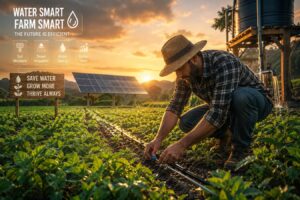
In 2026, Smart Irrigation is no longer a futuristic concept reserved for large commercial farms. It has become one of the most effective tools for Water Conservation and Sustainable Farming. By combining Artificial Intelligence (AI), Internet of Things (IoT) technologies, real-time data analytics, weather forecasting, and automation, farmers can now make highly informed irrigation decisions that dramatically reduce water waste while maximizing crop productivity.
The rise of AI-powered smart irrigation systems for sustainable agriculture is reshaping how farms operate. Instead of relying on guesswork or rigid watering schedules, farmers are using intelligent systems that understand exactly when, where, and how much water crops need.
This shift is not simply about technology. It represents a transformation toward smarter resource management, improved profitability, enhanced environmental stewardship, and greater resilience against climate-related challenges.
In this comprehensive guide, we explore ten powerful ways Smart Irrigation is transforming Water Conservation, supporting Precision Agriculture, and helping farmers build a more sustainable future.
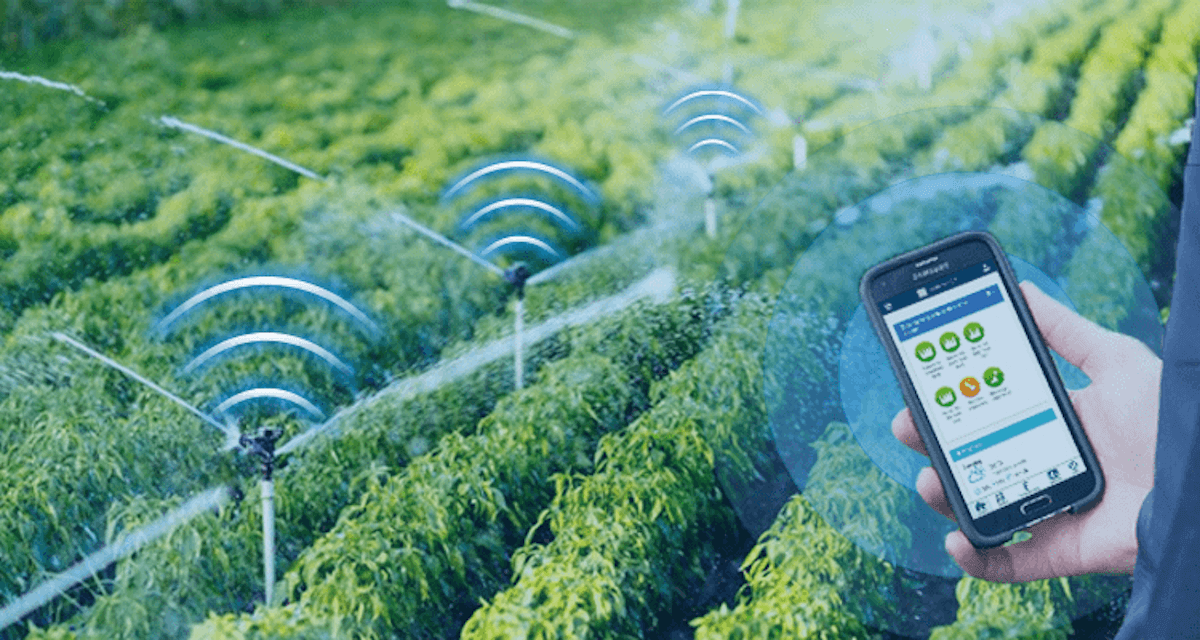
Why it Matters for Water Conservation and Sustainable Farming
Agriculture accounts for approximately 70% of global freshwater withdrawals, making it the largest consumer of water worldwide. Traditional irrigation methods often result in significant inefficiencies, including:
- Overwatering
- Runoff losses
- Soil erosion
- Nutrient leaching
- Increased energy consumption
- Higher production costs
When water is applied without precise measurement, much of it never reaches plant roots where it is needed most.
Smart Irrigation addresses these inefficiencies through data-driven decision-making.
Instead of watering entire fields uniformly, smart systems evaluate:
- Soil moisture levels
- Crop growth stages
- Weather conditions
- Evapotranspiration rates
- Historical irrigation data
- Real-time environmental conditions
The result is better Water Conservation, healthier crops, and more Sustainable Farming practices.
Smart Irrigation vs Traditional Irrigation: A Clear Comparison
| Feature | Traditional Irrigation | Smart Irrigation |
|---|---|---|
| Water Scheduling | Fixed schedules | Real-time adjustments |
| Water Efficiency | Moderate to Low | Very High |
| Labor Requirements | High | Low |
| Data Utilization | Minimal | Extensive |
| Water Waste | Significant | Minimal |
| Crop Monitoring | Manual | Automated |
| Yield Optimization | Limited | Advanced |
| Climate Adaptation | Weak | Strong |
| Operating Costs | Higher over time | Lower long term |
| Sustainability Impact | Moderate | Excellent |
The comparison clearly shows why Smart Irrigation is rapidly becoming a cornerstone of modern Sustainable Farming.
Irrigation: 9 Powerful and Proven Ways AI Is Transforming Water Conservation for Sustainable Farming in 2026
1. Irrigation Uses AI to Deliver Water Exactly Where It Is Needed
One of the most significant breakthroughs in Water Conservation is the ability of AI systems to determine precise water requirements.
Traditional irrigation often follows predetermined schedules regardless of weather or soil conditions.
AI changes this completely.
Modern AI-powered smart irrigation systems for sustainable agriculture analyze thousands of data points every day.
These systems continuously monitor:
- Soil moisture
- Temperature
- Humidity
- Crop growth stages
- Rainfall forecasts
- Historical yield performance
AI algorithms then determine the exact amount of water needed by specific areas within a field.
Benefits include:
- Reduced water waste
- Improved crop health
- Higher yields
- Lower irrigation costs
- Enhanced sustainability
Rather than watering an entire farm equally, AI targets water delivery where it creates maximum value.
2. IoT-Based Irrigation Solutions for Precision Agriculture in 2026 Improve Real-Time Monitoring
The Internet of Things has become one of the most transformative technologies in Precision Agriculture.
IoT sensors placed throughout farms continuously collect valuable information.
Common sensors monitor:
- Soil moisture
- Soil temperature
- Nutrient levels
- Weather conditions
- Water flow rates
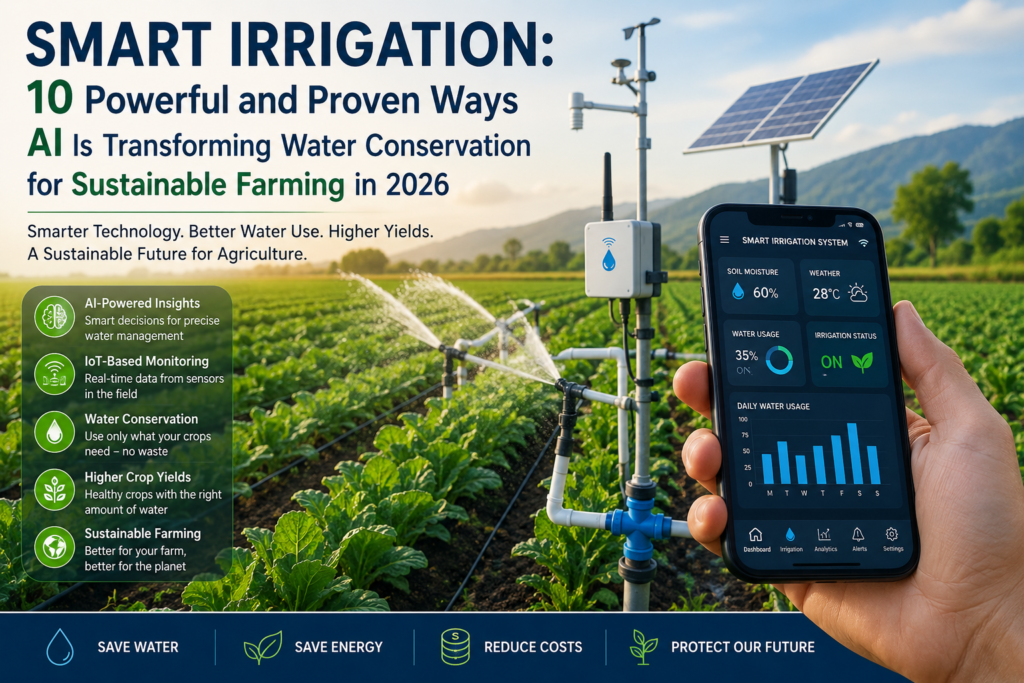
These sensors transmit data to cloud-based platforms where AI analyzes the information instantly.
Farmers can view field conditions directly from:
- Smartphones
- Tablets
- Computers
This level of visibility allows farmers to make smarter irrigation decisions without physically inspecting every field.
The integration of IoT-based irrigation solutions for precision agriculture in 2026 has dramatically increased irrigation efficiency while reducing labor requirements.
3. Smart Irrigation Reduces Water Waste Through Predictive Analytics
One of the most impressive aspects of modern Smart Irrigation is predictive analytics.
Rather than reacting to conditions after problems occur, AI predicts future water requirements.
Predictive models evaluate:
- Weather forecasts
- Seasonal trends
- Historical climate data
- Crop growth projections
For example, if significant rainfall is expected within 24 hours, irrigation schedules are automatically adjusted.
This prevents:
- Overwatering
- Runoff
- Waterlogging
- Nutrient loss
Predictive analytics has become one of the best water conservation techniques for drought-resistant farming because it minimizes unnecessary water use before it occurs.
4. Precision Agriculture Maximizes Every Drop of Water
Precision Agriculture focuses on optimizing resource use at a highly localized level.
Different areas of the same field often have varying:
- Soil types
- Drainage characteristics
- Moisture retention abilities
- Crop performance patterns
Smart Irrigation systems identify these differences.
Variable Rate Irrigation (VRI) technology enables farmers to deliver different amounts of water to different zones.
This targeted approach results in:
- Improved water efficiency
- Better crop uniformity
- Reduced operational costs
- Enhanced profitability
Every drop of water serves a specific purpose.
That is the essence of Precision Agriculture.
5.Irrigation Supports Climate-Smart Farming Practices to Improve Water Efficiency and Crop Yield
Climate uncertainty has become one of the greatest challenges facing agriculture. In many regions, farmers are experiencing unpredictable rainfall patterns, longer dry seasons, and more frequent droughts. These changing conditions make traditional irrigation methods increasingly unreliable.
This is where Climate-smart farming practices to improve water efficiency and crop yield become essential.
Smart Irrigation systems help farmers adapt to changing environmental conditions by using real-time data and AI-driven recommendations. Instead of following fixed watering schedules, irrigation systems continuously adjust according to current and forecasted conditions.
How Smart Irrigation Supports Climate-Smart Agriculture
- Monitors changing weather patterns
- Adjusts watering schedules automatically
- Reduces dependence on manual decision-making
- Protects crops during heatwaves
- Conserves water during drought periods
- Improves resilience against climate extremes
For example, when temperatures suddenly rise, AI systems can increase irrigation frequency while maintaining optimal water efficiency. Likewise, during cooler periods, irrigation can be reduced without negatively affecting crop growth.
The result is a farming system that responds intelligently to environmental changes rather than reacting after damage has already occurred.
USDA Climate Hubs: https://www.climatehubs.usda.gov
Long-Term Benefits
Farmers who adopt climate-smart irrigation often experience:
- Greater yield stability
- Improved water-use efficiency
- Better drought preparedness
- Reduced crop stress
- Lower production risks
As climate variability increases worldwide, Smart Irrigation will become one of the most important tools for agricultural resilience.
6. AI-Powered Smart Irrigation Systems for Sustainable Agriculture Lower Production Costs
Many farmers initially focus on Smart Irrigation because of its water-saving benefits. However, one of the biggest long-term advantages is cost reduction.
Water waste is expensive.
Every unnecessary gallon of water represents:
- Additional pumping costs
- Higher electricity bills
- Increased labor expenses
- Greater equipment wear and tear
AI-powered smart irrigation systems for sustainable agriculture help eliminate these inefficiencies.
Major Cost-Saving Areas
Reduced Water Consumption
Smart systems apply only the amount of water crops actually need.
This can significantly lower:
- Water bills
- Groundwater extraction costs
- Municipal water expenses
Lower Energy Usage
Pumping water requires energy.
Less water usage means:
- Reduced fuel consumption
- Lower electricity costs
- Improved operational efficiency
Reduced Labor Requirements
Automation decreases the need for manual field inspections and irrigation management.
Farmers spend less time:
- Opening irrigation valves
- Monitoring schedules
- Adjusting water applications
Better Crop Performance
Healthier crops often mean:
- Higher yields
- Better-quality produce
- Increased profitability
The financial benefits often make Smart Irrigation one of the highest-return investments available to modern farms.
7. Smart Irrigation Improves Soil Health Through Better Water Conservation
Healthy soil is the foundation of Sustainable Farming.
Unfortunately, improper irrigation can damage soil over time.
Common consequences of overwatering include:
- Soil compaction
- Nutrient leaching
- Root diseases
- Reduced microbial activity
- Increased salinity
Smart Irrigation helps maintain ideal soil moisture conditions.
Why Soil Moisture Matters
Plants thrive when soil contains the correct balance of:
- Water
- Oxygen
- Nutrients
Too much water can suffocate roots.
Too little water can stress plants and reduce growth.
AI and IoT technologies continuously monitor soil conditions and keep moisture levels within optimal ranges.
Benefits for Soil Health
- Improved soil structure
- Enhanced microbial activity
- Better nutrient availability
- Reduced erosion
- Increased organic matter retention
Over time, healthier soils become more productive and require fewer inputs, contributing to long-term sustainability.
8. IoT-Based Irrigation Solutions Enable Remote Farm Management
One of the most exciting developments in Precision Agriculture is remote irrigation management.
Farmers no longer need to be physically present to control irrigation systems.
Through cloud-based platforms and mobile applications, they can:
- Monitor water usage
- Receive alerts
- Adjust irrigation schedules
- Review sensor data
- Analyze field performance
Real-Time Decision Making
Imagine receiving an alert on your smartphone that a section of your field is becoming too dry.
Instead of driving to the farm and manually inspecting conditions, you can:
- View soil moisture data instantly
- Confirm the issue
- Activate irrigation remotely
This level of convenience dramatically improves efficiency.
Advantages of Remote Irrigation Management
- Faster response times
- Reduced labor costs
- Better monitoring capabilities
- Improved water management
- Greater operational flexibility
For large farms managing multiple locations, remote irrigation control has become an invaluable tool.9. Smart Irrigation Strengthens Drought Resilience
Drought remains one of the greatest threats to agricultural productivity.
Many regions are experiencing prolonged periods of water scarcity, making drought resilience a top priority.
Fortunately, Smart Irrigation is among the best water conservation techniques for drought-resistant farming.
How Smart Irrigation Helps During Drought
Prioritizes Critical Water Needs
AI systems identify which crops and zones require immediate attention.
Water can be allocated strategically rather than evenly.
Prevents Water Waste
Every drop is used efficiently.
This is especially important when water supplies are limited.
Extends Available Water Resources
Reduced consumption allows stored water supplies to last longer.
FAO Water Resources: https://www.fao.org/land-water
Supports Crop Survival
Maintaining optimal moisture levels helps crops withstand drought stress.
Drought Resilience Benefits
- Reduced crop losses
- Improved food security
- Better resource allocation
- Increased farm sustainability
As drought events become more common, Smart Irrigation will play a central role in protecting agricultural productivity.
9. Smart Irrigation Creates a More Sustainable Future for Agriculture
The final and perhaps most important benefit of Smart Irrigation is its contribution to global sustainability.
Agriculture must meet growing food demand while reducing environmental impact.
This challenge requires smarter resource management.
Smart Irrigation supports Sustainable Farming by:
- Conserving water
- Reducing energy use
- Protecting soil health
- Lowering greenhouse gas emissions
- Increasing productivity
Sustainability Outcomes
| Sustainability Goal | Impact of Smart Irrigation |
|---|---|
| Water Conservation | Significant improvement |
| Soil Protection | Reduced erosion and degradation |
| Energy Efficiency | Lower pumping requirements |
| Climate Resilience | Stronger adaptation capabilities |
| Crop Productivity | Increased yields |
| Resource Optimization | Maximum efficiency |
| Long-Term Viability | Improved farm sustainability |
These outcomes demonstrate why Smart Irrigation is becoming a cornerstone of modern agricultural systems.Additional Water-Smart Farming Techniques That Complement Smart Irrigation
While Smart Irrigation delivers substantial benefits, combining it with other sustainable practices can create even greater results.

Mulching
Mulching helps retain soil moisture and reduce evaporation.
Benefits include:
- Lower irrigation requirements
- Improved soil temperature regulation
- Reduced weed growth
Cover Cropping
Cover crops improve soil health and water retention.
Advantages include:
- Reduced erosion
- Better nutrient cycling
- Increased organic matter
Conservation Tillage
Reducing soil disturbance helps preserve moisture.
Benefits include:
- Improved water infiltration
- Enhanced soil structure
- Reduced runoff
Rainwater Harvesting
Collecting rainfall provides an additional water source.
This can help:
- Supplement irrigation systems
- Reduce water costs
- Improve drought preparedness
Drought-Tolerant Crop Varieties
Selecting crops adapted to local conditions can significantly reduce water demand.Future Trends in Smart Irrigation Beyond 2026
The evolution of Smart Irrigation is only beginning.
Several emerging technologies are expected to shape agriculture through 2027 and beyond.
Advanced AI Models
Future systems will provide:
- More accurate yield predictions
- Improved irrigation recommendations
- Enhanced risk management
Drone Integration
Drones will increasingly monitor:
- Crop stress
- Water distribution
- Field variability
Satellite Monitoring
Satellite imagery will help farmers assess large-scale field conditions with greater accuracy.
Digital Twins for Agriculture
Virtual farm models may allow farmers to simulate irrigation decisions before implementing them.
Autonomous Irrigation Systems
Fully automated systems could manage irrigation with minimal human intervention.
These innovations will further strengthen Water Conservation and Sustainable Farming efforts worldwide.
Smart Irrigation Technologies Driving Precision Agriculture in 2026
Agriculture is undergoing a remarkable transformation, and much of this change is being driven by innovative irrigation technologies. In the past, farmers often relied on fixed watering schedules or visual observations to determine when crops needed water. While these methods worked to some extent, they frequently resulted in either overwatering or underwatering, both of which can negatively affect crop performance and waste valuable resources.
Today, advanced irrigation technologies are making it possible to apply water with a level of accuracy that was once unimaginable. By combining sensors, automation, weather forecasting tools, and data analytics, farmers can make more informed decisions about when and how much water their crops require. This shift is helping agricultural operations become more productive, efficient, and environmentally responsible.
Weather-Based Irrigation Scheduling
Weather plays a critical role in crop water requirements. Factors such as temperature, humidity, wind speed, and rainfall all influence how much moisture plants lose throughout the day.
Modern irrigation technologies incorporate weather data to create more accurate watering schedules. Instead of applying water at fixed intervals, these systems account for changing environmental conditions and adjust accordingly.
For example:
- Irrigation may be postponed if rain is forecasted.
- Water application can be increased during periods of extreme heat.
- Cooler weather may require less frequent watering.
This approach helps maximize efficiency while minimizing unnecessary water use.
Automation Reduces Human Error
One of the greatest advantages of advanced irrigation technology is automation. Managing irrigation manually can be time-consuming, especially for large farming operations. Human error can also lead to inconsistent watering practices that affect crop growth and resource use.
Automated systems simplify this process by handling many routine tasks independently. Once programmed, they can:
- Start and stop irrigation cycles automatically
- Monitor field conditions continuously
- Adjust water application rates
- Send alerts when issues arise
- Generate performance reports
This allows farmers to focus on other important aspects of farm management while maintaining confidence that irrigation is being handled effectively.
Variable Rate Irrigation Enhances Efficiency
Not every part of a field has the same water requirements. Soil type, elevation, drainage patterns, and crop growth can vary significantly across a single farm.
Variable Rate Irrigation (VRI) addresses this challenge by allowing different sections of a field to receive different amounts of water. Rather than treating an entire field as one uniform area, VRI applies water based on the specific needs of each zone.
Benefits of this approach include:
- More efficient resource use
- Improved crop uniformity
- Reduced runoff
- Better yield potential
- Lower operational expenses
By matching water application to actual field conditions, farmers can achieve better results while using fewer resources.
Data-Driven Decision Making in Agriculture
The growing use of digital technologies has introduced a new era of data-driven farming. Irrigation systems now generate large amounts of valuable information that can be used to improve management decisions over time.
Farmers can analyze trends such as:
- Seasonal water usage
- Soil moisture patterns
- Crop response to irrigation
- Weather impacts on productivity
- Field performance across different zones
These insights help identify opportunities for improvement and support more strategic planning in future growing seasons.
Frequently Asked Questions About Smart Irrigation
What is Smart Irrigation?
Smart Irrigation uses AI, IoT sensors, weather data, and automation to optimize water application based on real-time field conditions.
How does Smart Irrigation save water?
It applies water only when needed and in the correct amounts, reducing waste caused by overwatering.
Is Smart Irrigation suitable for small farms?
Yes. Many affordable solutions are now available for farms of all sizes.
What role does AI play in Smart Irrigation?
AI analyzes environmental data and recommends or automates irrigation decisions to maximize efficiency.
Can Smart Irrigation improve crop yields?
Absolutely. Better water management often results in healthier crops and increased productivity.
A New Standard for Agricultural Water Management
As water resources become increasingly strained, efficient irrigation practices are no longer optional—they are essential. Modern irrigation technologies provide farmers with practical tools to address these challenges while maintaining productivity and profitability.
By integrating automation, real-time monitoring, weather intelligence, and field-specific management, today’s irrigation solutions are setting a new standard for agricultural water management. They enable producers to make smarter decisions, reduce waste, and build more resilient farming systems capable of meeting future demands.
The continued adoption of these technologies is expected to play a major role in shaping the future of agriculture, helping farmers produce more with less while protecting one of the world’s most valuable resources: water.

Conclusion: The Future of Water Conservation Starts with Irrigation
Agriculture stands at a crossroads.
Farmers must produce more food for a growing population while facing increasing pressure on water resources. Traditional irrigation methods are no longer sufficient to meet these challenges.
Smart Irrigation offers a practical and proven solution.
By combining Artificial Intelligence, IoT technology, Precision Agriculture, and Climate-smart Farming Practices, farmers can dramatically improve Water Conservation while increasing productivity and profitability.
The ten strategies explored in this guide demonstrate that Smart Irrigation is far more than a technological trend. It is a transformational approach to Sustainable Farming that addresses some of agriculture’s most pressing challenges.
From real-time monitoring and predictive analytics to drought resilience and remote management, AI-powered smart irrigation systems for sustainable agriculture are helping farmers make smarter decisions every day.
As we move through 2026 and beyond, the farms that embrace intelligent water management will be better positioned to thrive in an increasingly resource-conscious world.
The future of agriculture is not simply about using more resources. It is about using resources more wisely.
And that future begins with Smart Irrigation.
About The Author