Preserve Vegetables
Fresh vegetables are one of the most valuable foods we can have in the kitchen. They add color, flavor, vitamins, minerals, fiber, and variety to everyday meals. Yet there is a frustrating problem that almost everyone who buys or grows vegetables eventually faces: fresh produce does not stay fresh forever.
You buy a basket of tomatoes, peppers, onions, carrots, leafy vegetables or other produce, and everything looks perfect on the first day. A few days later, however, some of the vegetables begin to soften, wilt, discolor or develop mold.
For households with reliable refrigeration, the refrigerator provides an important tool for slowing down deterioration. But what happens when there is no refrigerator, electricity is unreliable, refrigerator space is limited, or you simply want to store certain vegetables in a more appropriate way?
This is where learning to preserve vegetables becomes extremely useful.
Vegetable preservation is not necessarily about finding one magical technique that makes every vegetable last for months. It is about understanding what causes vegetables to deteriorate and choosing a storage or preservation method that matches the particular vegetable.
Some vegetables benefit from cool, humid storage. Others prefer a relatively dry environment. Some can be cured and stored for weeks or months. Others can be dried, fermented, pickled or processed into products that last much longer than the original fresh vegetable.
The important thing is to stop thinking of a refrigerator as the only possible preservation tool.
In fact, the Food and Agriculture Organization explains that temperature, humidity and ventilation are important factors in determining the storage life of fruits and vegetables. (FAOHome)
That means successful vegetable storage begins with something surprisingly simple: understanding the needs of the vegetable.
In this guide, we will explore 10 powerful and practical ways to preserve vegetables without a refrigerator, including methods suitable for homes, farms, markets and communities where refrigeration may be unavailable or unreliable.

Preserve Vegetables by Understanding What Makes Fresh Produce Spoil
Before discussing individual preservation methods, it helps to understand why vegetables deteriorate.
A vegetable may have been harvested from the soil, but it is not necessarily “dead” after harvest. Many fresh vegetables continue to respire and lose water after they are harvested. Their tissues gradually change, and microorganisms can begin multiplying when conditions are favorable.
Several factors influence how quickly this happens.
Preserve Vegetables by Controlling Temperature
Temperature has a major effect on how quickly fresh produce deteriorates.
Generally, higher temperatures accelerate many deterioration processes. However, this does not mean that putting every vegetable in the coldest possible place is automatically best.
Different vegetables have different temperature requirements.
For example, potatoes, sweet potatoes and dry onions are commonly kept in dry storage rather than refrigerated storage. USDA guidance specifically identifies potatoes, sweet potatoes and dry onions among produce that should be kept in dry storage under appropriate conditions
This is an important lesson in vegetable preservation:
The best storage temperature depends on the vegetable.
Preserve Vegetables by Managing Moisture
Water is another major factor.
Fresh vegetables naturally contain a large amount of water. If the storage environment is too dry, vegetables can lose moisture and become limp or shriveled.
On the other hand, excessive surface moisture can encourage decay and mold.
This is why simply putting wet vegetables into a tightly sealed container can sometimes make the problem worse.
The goal is to create storage conditions appropriate for the particular produce.
Preserve Vegetables by Preventing Physical Damage
Bruises, cuts and broken surfaces can accelerate deterioration.
A vegetable with damaged skin is generally more vulnerable to moisture loss and microbial contamination than an intact vegetable.
Before storing vegetables, remove:
- Severely damaged produce
- Rotten vegetables
- Vegetables with spreading mold
- Produce with leaking or broken surfaces
- Produce that is already badly overripe
One spoiled vegetable can also affect others stored close to it.
Preserve Vegetables by Improving Air Circulation
Good ventilation is another useful principle.
When vegetables are packed too tightly together, heat and moisture can accumulate around them.
This can create conditions that encourage deterioration.
Instead of piling everything into one large sealed container, use appropriate baskets, crates, shelves, mesh bags or other food-safe storage arrangements that allow reasonable air movement.
Preserve Vegetables: 10 Powerful and Easy Methods That Work
There is no universal preservation method for every vegetable.
The best approach is to combine several techniques depending on what you have available and how long you want to store the produce.
Here are 10 practical methods.
1. Preserve Vegetables Through Proper Room-Temperature Storage
One of the easiest ways to preserve vegetables without a refrigerator is also one of the most overlooked: store the right vegetables correctly at room temperature.
Not every vegetable needs refrigeration immediately after purchase or harvest.
Some vegetables are naturally suited to dry storage.
Examples include:
- Dry onions
- Garlic
- Potatoes
- Sweet potatoes
- Winter squash
- Certain mature pumpkins
The key is to keep these vegetables in an appropriate environment rather than simply leaving them anywhere in the kitchen.
A good storage location should generally be:
- Dry
- Clean
- Relatively cool
- Well ventilated
- Protected from direct sunlight
- Protected from pests
- Away from sources of excessive heat
USDA guidance lists potatoes, sweet potatoes and dry onions among produce suitable for dry storage rather than refrigeration. (Farm Service Agency)
How to preserve vegetables through room-temperature storage
Start by selecting healthy, undamaged produce.
Do not store vegetables that are already wet, bruised or visibly rotten alongside healthy produce.
For dry-storage vegetables:
- Sort the vegetables.
- Remove damaged specimens.
- Allow appropriate vegetables to dry if they are damp.
- Place them in a clean, ventilated storage area.
- Keep them away from direct sunlight.
- Inspect them regularly.
- Remove vegetables showing signs of rot.
This method is especially useful because it requires little equipment.
However, room-temperature storage is not the same as simply leaving vegetables on the kitchen counter.
Storage conditions matter.
A hot, humid kitchen may dramatically shorten the storage life of produce compared with a cool, dry and ventilated storage area.
2. Preserve Vegetables by Drying Them Properly
Drying is one of the oldest forms of food preservation.
The basic idea is simple: reduce the amount of available moisture so microorganisms have a much less favorable environment for growth.
Properly dried vegetables can become significantly lighter, easier to store and useful for cooking long after the fresh produce would have deteriorated.
The National Center for Home Food Preservation describes drying as an established preservation method that can produce foods that do not require refrigeration.
However, there is an important safety point.
Do not assume that outdoor sun drying is automatically safe for every vegetable
This is one of the biggest mistakes people make when searching for natural ways to preserve vegetables without refrigeration.
The National Center for Home Food Preservation specifically advises against outdoor sun drying of most vegetables because vegetables generally have lower sugar and acidity than many fruits, making uncontrolled outdoor drying more risky.
So if you want to dry vegetables, controlled conditions are preferable.
You can use:
- A food dehydrator
- A suitable oven
- Another controlled drying method appropriate for the vegetable
Vegetables that can be dried
Depending on the vegetable and the method used, examples may include:
- Carrots
- Okra
- Peppers
- Tomatoes
- Onions
- Leafy vegetables
- Green beans
- Some root vegetables
Preparation varies by vegetable.
Some vegetables benefit from blanching before drying. Blanching involves briefly heating vegetables and then cooling them, and it can help prepare certain vegetables for drying while supporting quality.
The National Center for Home Food Preservation provides specific preparation and blanching recommendations for different vegetables.
How to preserve vegetables through drying
A general process is:
- Select fresh, healthy vegetables.
- Wash them properly.
- Trim damaged sections.
- Cut vegetables into reasonably uniform pieces.
- Follow an appropriate pre-treatment for that vegetable.
- Dry using a controlled method.
- Continue drying until the vegetables reach the appropriate dry texture.
- Cool completely.
- Package in clean, moisture-resistant containers.
- Store in a cool, dry and dark place.
Vegetables should be thoroughly dry before storage.
According to the National Center for Home Food Preservation, vegetables should generally be dried until they are brittle or crisp.
Why drying is so powerful
Imagine buying several kilograms of fresh vegetables during harvest season.
Instead of allowing all of them to spoil, some can be processed into a dried form.
This can:
- Reduce waste
- Extend usability
- Save storage space
- Create convenient cooking ingredients
- Make seasonal vegetables available later
Drying is therefore not merely an emergency technique. It can be a practical household and agricultural strategy.
3. Preserve Vegetables Through Fermentation
Fermentation is another fascinating form of vegetable preservation.
Instead of trying to keep vegetables exactly as they were when harvested, fermentation deliberately changes the food through the activity of desirable microorganisms.
The process can increase acidity and create distinctive flavors.
Examples include fermented:
- Cabbage
- Cucumbers
- Carrots
- Peppers
- Other suitable vegetables
Fermented vegetables are not simply vegetables that have been left to “go sour.”
Safe fermentation requires appropriate ingredients, proportions, temperatures, cleanliness and time.
The USDA explains that fermentation involves microorganisms converting sugars into organic acids, increasing acidity in the food. (USDA ARS)
How to preserve vegetables through fermentation
A safe fermentation process begins with good raw materials.
Use:
- Fresh vegetables
- Clean containers
- Food-grade equipment
- The correct amount of salt
- A reliable fermentation recipe
One particularly important warning is do not randomly reduce the salt in a fermentation recipe.
USDA guidance for home fermentation explains that the amount of salt is important to the safety, texture and flavor of fermented vegetables.
This means online improvisation can be dangerous.
If you are fermenting vegetables for long-term preservation, use a tested recipe rather than guessing the quantities.
Why fermentation is valuable
Fermentation can transform surplus vegetables into foods with:
- A longer useful life
- Different flavors
- Different textures
- Culinary versatility
For farmers and households with seasonal surpluses, fermentation can turn a short-term abundance into a product that can be enjoyed later.
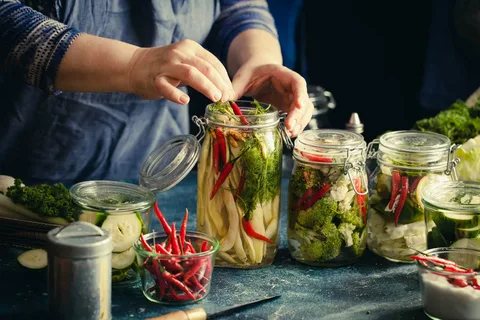
4. Preserve Vegetables by Pickling
Pickling is another traditional form of food preservation.
Pickling generally involves creating an acidic environment around vegetables, often using vinegar and other ingredients.
Common examples include:
- Pickled cucumbers
- Pickled carrots
- Pickled peppers
- Pickled onions
- Pickled cauliflower
- Pickled green tomatoes
- Mixed pickled vegetables
Pickling can be particularly useful when you have more vegetables than you can consume fresh.
The National Center for Home Food Preservation provides tested recipes for numerous vegetable pickles.
Preserve vegetables safely through pickling
This is an area where safety should never be treated casually.
Acidity is not simply about taste.
It also plays a critical role in preventing the growth of dangerous microorganisms.
The National Center for Home Food Preservation warns that vinegar, water and food proportions should not be changed casually in tested pickling recipes because the correct acidity is important for safety.
Therefore:
- Use tested recipes.
- Use vinegar with the specified acidity.
- Follow the recommended proportions.
- Do not randomly dilute the vinegar.
- Use clean jars and equipment.
- Follow the recommended processing method.
Pickling is more than cucumber preservation
Many people associate pickling only with cucumbers.
But pickling can be used with many vegetables.
This makes it an interesting option when you have excess produce that needs a different life beyond the fresh form.
A basket of excess carrots, peppers or onions does not necessarily have to become waste.
With an appropriate tested preservation process, it can become a useful pantry product.
5. Preserve Vegetables Through Curing
Curing is particularly useful for certain crops.
Some vegetables naturally lend themselves to curing because the process helps prepare them for longer storage.
Examples include:
- Onions
- Garlic
- Potatoes in appropriate contexts
- Sweet potatoes
- Certain mature bulbs and tubers
Curing generally involves allowing the harvested produce to undergo controlled drying or conditioning under suitable conditions before long-term storage.
The exact process depends heavily on the crop.
Why curing helps preserve vegetables
Harvested crops can contain surface moisture and tissues that are vulnerable to damage.
Proper curing can help create a more suitable protective condition before storage.
For example, onions are commonly cured so their outer layers become dry and protective.
How to preserve vegetables by curing
A general approach is:
- Harvest mature produce carefully.
- Avoid unnecessary cuts and bruises.
- Clean away loose soil where appropriate without introducing excess moisture.
- Allow the crop to cure under suitable conditions.
- Once properly cured, move it into appropriate storage.
- Inspect regularly for decay.
Do not confuse curing with simply leaving vegetables outside in the sun.
Excessive heat, rain, humidity or uncontrolled exposure can damage produce.
The objective is controlled preparation for storage.
6. Preserve Vegetables in Cool, Dark and Well-Ventilated Storage
When people hear “without refrigeration,” they sometimes imagine that the only alternative is a warm kitchen.
That is not true.
Traditional vegetable storage can take advantage of environmental conditions.
A cool, dark and ventilated storage space can be surprisingly useful for suitable crops.
Depending on your location and the vegetable, possible storage areas include:
- A pantry
- A cool storeroom
- A ventilated cupboard
- A suitable cellar
- A shaded storage room
- A properly designed root-storage area
The exact suitability depends on local temperature and humidity.
Why darkness matters
Light can affect the quality of certain vegetables.
Potatoes, for example, are generally stored away from light.
Why ventilation matters
Ventilation helps reduce the accumulation of excess moisture and heat.
However, ventilation should not mean strong hot air blowing directly over produce.
The goal is balanced environmental control.
Why humidity matters
Vegetables lose water after harvest.
FAO guidance notes that most vegetables require relatively high humidity to reduce excessive water loss, although specific requirements vary considerably between commodities. (FAOHome)
This creates an interesting balance:
You want enough humidity to prevent excessive drying, but you do not want persistent surface moisture that encourages decay.
That is why vegetable storage is more sophisticated than simply “keep everything somewhere cool.”
7. Preserve Vegetables by Separating Different Types of Produce
One of the simplest improvements you can make to vegetable storage is to stop treating all produce as if it behaves the same way.
Different vegetables have different storage requirements.
Some produce also produces gases that can accelerate ripening or deterioration in nearby produce.
Ethylene is particularly important.
Certain fruits produce ethylene, which can influence the ripening and deterioration of other produce.
USDA guidance notes that ethylene-producing fruits can cause many vegetables and other sensitive produce to deteriorate more rapidly. (Farm Service Agency)
Preserve vegetables by creating storage groups
Instead of placing everything together, organize your produce.
For example:
Dry-storage group
- Dry onions
- Garlic
- Potatoes
- Sweet potatoes
Cool, moist-storage group
- Certain leafy vegetables
- Carrots
- Broccoli
- Other vegetables that require cooler, humid conditions
Produce requiring different handling
- Tomatoes
- Cucumbers
- Eggplant
- Peppers
The exact storage requirements vary, so the important lesson is not memorizing one universal temperature.
The lesson is:
Know what you are storing before deciding where to store it.
This simple habit can make a major difference.
8. Preserve Vegetables by Buying and Harvesting at the Right Stage
Sometimes the best food preservation method is not a preservation method at all.
It is better planning.
If you purchase far more fresh vegetables than you can use within a reasonable period, even excellent storage may not prevent waste.
Likewise, farmers who harvest at unsuitable stages may have greater post-harvest losses.
Preserve vegetables by matching supply with consumption
Instead of purchasing one enormous quantity of highly perishable vegetables, consider buying smaller quantities more frequently when practical.
For farmers, harvest planning can be equally important.
Consider:
- Expected market demand
- Available storage
- Expected weather
- Transportation time
- Processing capacity
- Household consumption
Why this works
Food preservation begins before storage.
If you know that tomatoes will be abundant next week, for example, you can prepare drying, processing or other preservation arrangements before the harvest arrives.
This changes preservation from a reaction into a strategy.
9. Preserve Vegetables by Processing Them Into Other Foods
Sometimes the smartest way to preserve a vegetable is to stop trying to preserve it in its original form.
Instead, transform it.
Examples include turning suitable vegetables into:
- Sauces
- Pastes
- Powders
- Dried flakes
- Fermented products
- Pickles
- Cooked shelf-stable products using tested preservation methods
Tomatoes are an excellent example.
A household with an abundance of tomatoes may not be able to keep all of them fresh for an extended period without refrigeration.
But depending on the chosen method, tomatoes can be processed into products that are easier to store.
Peppers can similarly be dried or processed.
Leafy vegetables can be dried under controlled conditions.
Carrots can be dried for later cooking.
The key idea
Preservation does not have to mean keeping food unchanged.
Sometimes preservation means changing the form of the food so that it remains useful for longer.
This is especially important for farmers and households dealing with seasonal abundance.
10. Preserve Vegetables by Using Low-Cost Cooling Alternatives
If you do not have a refrigerator, there may still be ways to create a cooler storage environment.
This is particularly relevant in regions where electricity is unreliable or refrigeration is expensive.
One approach is evaporative cooling.
Evaporative cooling uses the cooling effect created when water evaporates.
Traditional systems can use materials such as:
- Wet sand
- Clay pots
- Water
- Shade
- Ventilation
The design must allow appropriate airflow and prevent the vegetables from becoming excessively wet.
Preserve vegetables using an evaporative cooler
A simple principle is:
- Place an inner container containing the vegetables inside or alongside a suitable outer structure.
- Use a porous material capable of holding water where appropriate.
- Keep the structure shaded.
- Maintain moisture in the cooling material.
- Allow air movement.
- Avoid direct contact between produce and dirty water.
- Monitor the vegetables frequently.
Modern variations include evaporative cooling chambers and other low-energy storage technologies.
This is not merely an old-fashioned idea. Research in Nigeria has also examined off-grid vegetable storage approaches, including evaporative cooling systems and solar-powered cold storage.
The broader lesson is encouraging:
Preserving vegetables without a conventional refrigerator does not necessarily mean giving up on temperature management.
You can sometimes use low-energy environmental cooling instead.
Preserve Vegetables: Which Method Should You Choose?
Choosing the right method depends on four major questions:
- What vegetable are you preserving?
- How long do you want to keep it?
- What equipment do you have?
- Do you want to maintain the vegetable in fresh form or transform it?
Here is a simple comparison.
| Preservation Method | Best For | Main Advantage | Main Challenge |
|---|---|---|---|
| Dry storage | Onions, garlic, potatoes, sweet potatoes | Simple and inexpensive | Requires suitable environment |
| Controlled drying | Peppers, tomatoes, carrots, okra and suitable vegetables | Long storage potential | Requires proper drying |
| Fermentation | Cabbage, cucumbers and suitable vegetables | Creates distinctive preserved foods | Requires correct salt and process |
| Pickling | Cucumbers, carrots, peppers, onions and more | Extends useful life and adds flavor | Acidity and recipe safety are important |
| Curing | Onions, garlic and selected crops | Helps prepare crops for storage | Requires correct curing conditions |
| Cool storage | Suitable fresh produce | Maintains produce closer to fresh form | Temperature and humidity must be appropriate |
| Evaporative cooling | Selected fresh vegetables | Low-energy cooling option | Requires water and suitable design |
| Processing | Tomatoes, peppers and other suitable crops | Converts surplus into useful products | Requires preparation and safe processing |
| Better purchasing/harvesting | All vegetables | Prevents excess waste | Requires planning |
| Separation of produce | Mixed vegetables and fruits | Reduces cross-effects | Requires organization |
Preserve Vegetables: How to Store Fresh Vegetables Without a Fridge for Longer
If your goal is specifically to how to store fresh vegetables without a fridge for longer, start with the basics.
1. Buy or harvest healthy vegetables
Do not begin with vegetables that are already badly damaged.
Choose firm produce with minimal bruising.
2. Do not automatically wash everything before storage
Some vegetables are better stored dry rather than wet.
If washing is necessary, make sure produce is handled appropriately and does not remain unnecessarily wet before storage.
3. Remove damaged vegetables
Inspect the produce before placing it into storage.
A single rotten vegetable can become a source of contamination for nearby produce.
4. Match the storage environment to the vegetable
Some vegetables prefer cooler and humid conditions.
Others prefer dry storage.
Do not use one storage method for everything.
5. Keep produce away from excessive heat
Avoid locations directly beside:
- Cooking stoves
- Hot appliances
- Direct sunlight
- Hot roofs
- Enclosed areas with poor ventilation
6. Check vegetables regularly
Storage is not a “set it and forget it” process.
Inspect your vegetables regularly.
Look for:
- Mold
- Soft spots
- Unusual odors
- Leaking
- Shriveling
- Discoloration
- Excessive moisture
Remove deteriorating produce quickly.
7. Use older vegetables first
A simple first-in, first-out system can significantly reduce household waste.
Use the vegetables that were stored first before opening newer supplies.
Preserve Vegetables: Best Ways to Keep Vegetables Fresh Without Refrigeration
If you want to keep vegetables in a relatively fresh state rather than turning them into dried or fermented products, focus on environmental management.
The most useful principles are:
Keep suitable vegetables cool
Temperature affects the rate at which produce deteriorates.
Keep the storage area shaded
Direct sunlight can heat vegetables and accelerate quality loss.
Maintain appropriate humidity
Do not assume that completely dry air is ideal for every vegetable.
Many vegetables lose water rapidly in very dry conditions.
Provide ventilation
Avoid trapping vegetables in environments where condensation continually forms.
Prevent physical damage
Handle vegetables gently during harvest, transportation and storage.
Separate incompatible produce
Keep vegetables away from produce that may accelerate deterioration through ethylene exposure.
Inspect frequently
Early detection is one of the cheapest preservation tools available.
Preserve Vegetables: Natural Ways to Preserve Vegetables Without Refrigeration
Natural food preservation methods have existed for centuries.
Long before modern refrigerators, households relied on environmental control, drying, fermentation, salting, curing and other techniques to protect food.
Some of these methods remain highly relevant today.
Drying
Drying reduces moisture and creates a product that can be stored for later use.
Fermentation
Fermentation changes the food through desirable microbial activity and increased acidity.
Salting
Salt has historically played an important role in preserving certain foods and supporting fermentation.
However, correct proportions are important.
Pickling
Acidic environments can help preserve suitable vegetables when tested recipes and safe processing methods are followed.
Curing
Curing can prepare suitable crops for longer storage.
Cool storage
Natural or low-energy cooling can slow deterioration without requiring a conventional refrigerator.
The most effective strategy is often not choosing just one method.
It is combining methods.
For example, a farmer may:
- Keep onions in dry storage.
- Dry excess peppers.
- Process surplus tomatoes.
- Ferment suitable vegetables.
- Sell highly perishable leafy vegetables quickly.
- Use evaporative cooling for appropriate fresh produce.
This creates a more resilient food preservation system.
Preserve Vegetables: How Farmers Can Reduce Post-Harvest Losses
Vegetable preservation is not only a household issue.
For farmers, traders and food businesses, it can directly affect income.
A farmer can produce an excellent crop and still lose money if too much of it deteriorates before reaching consumers.
Post-harvest management therefore deserves as much attention as production.
Harvest carefully
Avoid unnecessary bruising and cuts.
Sort immediately
Separate healthy produce from damaged produce.
Grade produce
Different sizes and quality levels may have different markets and storage requirements.
Reduce unnecessary exposure to heat
Harvested vegetables should not be left in direct sun longer than necessary.
Use appropriate containers
Containers should protect vegetables from crushing and allow suitable ventilation.
Process surplus produce
When the market cannot absorb everything immediately, preservation can convert surplus into products with a longer useful life.
Develop multiple markets
Farmers can potentially sell fresh produce while also processing part of their harvest into preserved products.
This can reduce dependence on a single market window.
FAO research emphasizes the relationship between temperature and post-harvest deterioration, showing why effective temperature management is important in extending the useful life of fresh produce. (FAO Open Knowledge )

Preserve Vegetables: Common Mistakes That Make Fresh Produce Spoil Faster
Sometimes the problem is not a lack of preservation techniques.
It is the wrong technique.
Here are common mistakes to avoid.
Preserve Vegetables Without Washing and Storing Them While Wet
Excess surface moisture can contribute to decay.
If a vegetable needs washing before storage, handle it appropriately and avoid trapping unnecessary moisture around the produce.
Preserve Vegetables by Leaving Them in Direct Sunlight
Direct sunlight can heat produce.
A shaded storage area is generally more appropriate for many stored vegetables.
Preserve Vegetables by Using One Storage Method for Everything
This is a major mistake.
Potatoes do not have identical storage requirements to leafy vegetables.
Onions do not have identical requirements to cucumbers.
Learn the needs of the specific crop.
Preserve Vegetables by Sealing Everything in Plastic
A sealed plastic bag may trap moisture and condensation.
The correct packaging depends on the vegetable and preservation method.
Preserve Vegetables by Ignoring Damaged Produce
Rotten produce should not simply remain in the same storage container as healthy produce.
Sort frequently.
Preserve Vegetables by Guessing Fermentation Salt Levels
Fermentation is not an area for random experimentation when food safety is involved.
Use a tested recipe.
Preserve Vegetables by Sun-Drying Every Vegetable
This is another common misconception.
Outdoor sun drying is not automatically appropriate for vegetables. The National Center for Home Food Preservation specifically cautions against outdoor drying of most vegetables under uncontrolled conditions.
Preserve Vegetables: Food Safety Rules You Should Never Ignore
Preserving food at home can be economical and rewarding, but safety must come before convenience.
This is particularly important with low-acid vegetables.
Improper preservation can create serious food safety risks.
For example, USDA warns that dry canning vegetables without liquid can be extremely hazardous because of the risk of botulism. (Ask USDA)
Therefore, never assume that an old family trick or social media recipe is automatically safe.
Follow these basic food preservation rules
- Start with good-quality produce.
- Clean preparation surfaces.
- Use food-grade containers.
- Wash your hands before handling food.
- Avoid visibly spoiled vegetables.
- Use tested preservation recipes.
- Follow recommended processing times.
- Follow specified acidity levels.
- Do not randomly reduce salt in fermentation recipes.
- Store preserved foods according to the method used.
- Discard questionable food rather than tasting it to determine whether it is safe.
The National Center for Home Food Preservation recommends using tested recipes from reliable sources for home canning because incorrect processes can create serious foodborne illness risks. (Home Food Preservation)
For anyone planning to can vegetables, the safest approach is to follow a research-based recipe exactly rather than inventing your own processing times.
Preserve Vegetables: How Long Can Fresh Vegetables Last Without a Refrigerator?
There is no single number of days that applies to every vegetable.
That is an important point.
The storage life of vegetables depends on:
- Vegetable variety
- Harvest maturity
- Temperature
- Relative humidity
- Physical damage
- Air movement
- Sanitation
- Storage method
- Presence of pests
- Ethylene exposure
- Initial quality
For example, dry onions under suitable storage conditions can behave very differently from leafy greens.
Similarly, a healthy, properly cured bulb can last much longer than a bruised vegetable stored in a hot and humid room.
FAO data demonstrate just how strongly temperature can affect deterioration rates in non-chilled fresh vegetables. As temperature rises, deterioration can accelerate dramatically. (FAO Open Knowledge )
This is why articles promising that “every vegetable will last exactly 30 days without a refrigerator” should be treated cautiously.
Good vegetable preservation is about conditions, not magic numbers.
Preserve Vegetables: A Simple Weekly Storage Routine for Your Home
If you want a practical routine, you can keep things simple.
On purchase or harvest day
Sort everything.
Separate:
- Vegetables for immediate consumption
- Vegetables for short-term storage
- Vegetables suitable for drying
- Vegetables suitable for pickling or fermentation
- Damaged produce requiring immediate use
Two or three days later
Inspect stored vegetables.
Look for:
- Softening
- Mold
- Excess moisture
- Sprouting
- Unusual smells
- Shriveling
During the week
Use the oldest vegetables first.
Do not allow vegetables that are already deteriorating to remain buried underneath fresh produce.
During harvest seasons
If you grow vegetables, begin preservation planning before the harvest becomes overwhelming.
Ask:
- How much can my household consume?
- How much can I sell?
- What can I dry?
- What can I ferment?
- What can I pickle?
- What can be stored fresh?
- What requires faster processing?
This simple planning exercise can dramatically reduce waste.
Preserve Vegetables: The Best Strategy Is Usually a Combination of Methods
One of the biggest insights from food preservation is that there is no single “best” method.
The best method depends on the vegetable.
For example:
Onions:
Dry curing and appropriate dry storage may be more useful than refrigeration.
Potatoes:
A cool, dark, dry storage environment may be appropriate.
Peppers:
Some can be dried or processed.
Tomatoes:
Depending on their condition and intended use, they may be processed, dried using a controlled method, or consumed relatively quickly.
Leafy vegetables:
These tend to be more delicate and generally require more careful temperature and moisture management.
Cabbage:
It may be suitable for storage under appropriate conditions or fermentation.
Carrots:
Depending on conditions, they may be stored using suitable cool and humid methods or processed for longer storage.
The important lesson is to match the technique to the crop.
Preserve Vegetables: Why Traditional Knowledge Still Matters
Modern refrigeration is incredibly useful, but it is not the only answer.
Traditional communities around the world developed preservation methods because food had to survive periods of abundance and scarcity.
Drying, fermenting, curing and pickling were not merely culinary traditions.
They were survival technologies.
Today, these methods still have value because they can:
- Reduce food waste
- Lower dependence on refrigeration
- Preserve seasonal abundance
- Create new food products
- Support small-scale food businesses
- Help households manage food costs
Modern science has not necessarily replaced traditional preservation.
Instead, science helps us understand why some traditional techniques work and how to make them safer and more consistent.
That distinction is important.
The goal should not be to reject traditional methods.
The goal is to combine useful traditional knowledge with modern food safety principles.
Preserve Vegetables: What 2026 Food Storage Trends Teach Us About the Future
Food preservation is becoming increasingly relevant as households, farmers and food businesses look for ways to reduce waste and use resources more efficiently.
In places where electricity is expensive or unreliable, low-energy preservation methods can become particularly valuable.
Research in Nigeria has examined solar-powered and evaporative cooling approaches for off-grid storage of vegetables, showing that alternatives to conventional cold storage continue to attract attention.
This does not mean refrigerators are becoming unnecessary.
Far from it.
Refrigeration remains extremely important for many foods.
But it does suggest that the future of food storage may involve multiple preservation technologies working together.
These may include:
- Solar-powered cooling
- Evaporative cooling
- Improved drying technologies
- Better packaging
- Small-scale processing
- Fermentation
- Improved farm storage
- Better post-harvest handling
- Data-driven temperature monitoring
For farmers in developing agricultural markets, these technologies could become increasingly important in reducing losses between the farm and consumer.
Preserve Vegetables: A Practical Checklist Before You Store Anything
Before storing or preserving vegetables, ask yourself these questions:
Vegetable preservation checklist
1. Is the vegetable healthy?
If it is already badly spoiled, preservation is not the answer.
2. Is it dry or appropriately prepared for storage?
Avoid unnecessary moisture.
3. Does this vegetable prefer dry or humid storage?
Different crops behave differently.
4. Does it need cooling?
Some vegetables are more sensitive to heat than others.
5. Is the storage area shaded?
Avoid unnecessary heat from sunlight.
6. Is there enough ventilation?
Prevent excessive moisture accumulation.
7. Are different produce types separated appropriately?
Do not assume all produce can be stored together.
8. Do I need to process this vegetable instead?
If fresh storage is difficult, drying, pickling or fermentation may be better.
9. Am I following a tested preservation process?
Especially important for fermentation and canning.
10. Am I checking the food regularly?
Storage requires monitoring.

Preserve Vegetables: Frequently Asked Questions
Can you preserve vegetables without a refrigerator?
Yes. Depending on the vegetable, you can use dry storage, controlled drying, curing, fermentation, pickling, cool storage, evaporative cooling and other appropriate preservation methods.
However, not every method works for every vegetable.
What is the easiest way to preserve vegetables without refrigeration?
For suitable crops, proper dry storage can be one of the easiest methods. Drying can also be practical when you want much longer storage, but it must be performed under appropriate conditions.
What vegetables can be stored without a refrigerator?
Suitable crops may include dry onions, garlic, potatoes, sweet potatoes and certain mature squash when stored under appropriate conditions.
Other vegetables may require different approaches.
How can I keep vegetables fresh without refrigeration?
Start with healthy produce and control temperature, humidity, ventilation, sunlight, physical damage and produce combinations.
The exact approach depends on the vegetable.
Is sun drying safe for vegetables?
Do not assume that it is.
Controlled drying is generally preferable for vegetables because uncontrolled outdoor conditions can create food safety and quality problems. The National Center for Home Food Preservation does not recommend outdoor sun drying for most vegetables. (Home Food Preservation)
Can vegetables be preserved with salt?
Salt can play an important role in certain preservation and fermentation methods. However, quantities matter. For fermented vegetables, do not arbitrarily reduce the salt called for in a tested recipe.
Is pickling a good way to preserve vegetables?
Yes, when performed using an appropriate tested recipe and safe processing method.
Pickling can preserve many vegetables while also creating a different flavor profile.
How can farmers preserve vegetables after harvest?
Farmers can combine careful harvesting, sorting, shade, appropriate containers, suitable storage, drying, fermentation, pickling, processing and low-energy cooling technologies.
The best strategy depends on the crop and market.
How do you store vegetables without a fridge for longer?
The answer depends on the vegetable. Store dry-storage crops in appropriate dry conditions, use controlled cooling for suitable fresh vegetables, and process highly perishable surplus through methods such as drying, fermentation or pickling.
Preserve Vegetables: Final Thoughts
Learning how to preserve vegetables without a refrigerator is not about finding one secret trick.
It is about understanding food.
Fresh vegetables contain water. They continue to change after harvest. Temperature affects deterioration. Humidity affects moisture loss. Physical damage creates opportunities for spoilage. Poor ventilation can create unwanted moisture. Some produce releases gases that affect other produce. And preservation methods such as fermentation and pickling require careful control.
Once you understand these principles, vegetable storage becomes much less mysterious.
You begin to see that the refrigerator is only one tool in a much larger food preservation system.
Dry onions may need a dry environment.
Potatoes may need darkness.
Certain vegetables may benefit from cool, humid conditions.
Peppers and other suitable produce may be dried.
Cabbage and other vegetables can be fermented.
Suitable vegetables can be pickled.
Certain crops can be cured.
And where electricity is limited, low-energy cooling systems can offer another option.
The most powerful approach is therefore not to ask, “What is the best way to preserve vegetables?”
Instead, ask:
“What does this particular vegetable need to remain useful for as long as possible?”
That small change in thinking can help households reduce waste, help farmers protect more of their harvest, and make seasonal produce available for longer.
Most importantly, it reminds us that food preservation does not have to begin with expensive equipment.
Sometimes it begins with something much simpler: better knowledge, better handling and the right preservation method for the right vegetable.
For readers who want to explore the science behind food preservation further, the Food and Agriculture Organization’s post-harvest guidance provides useful information about temperature, humidity and storage conditions for fresh produce. FAO post-harvest storage guidance
For detailed, research-based home preservation methods, including drying, fermentation, pickling and canning, readers can also consult the National Center for Home Food Preservation. National Center for Home Food Preservation
Important: Preservation methods vary by vegetable. For canning, fermentation and other processes where food safety depends on specific proportions, temperatures or processing times, use tested instructions rather than improvising.
About The Author