Water Saving Irrigation
Water is one of the most valuable resources on any farm, yet it is often one of the easiest to waste.
For a small farmer, this problem becomes even more serious during the dry season. A shallow well may take longer to refill, a borehole may require more pumping, water costs may increase, and crops can begin competing for the same limited supply. When irrigation is poorly managed, farmers may spend more money pumping water without necessarily producing more food.
This is where water saving irrigation becomes more than a farming technique. It becomes a strategy for protecting farm income, improving crop performance, reducing unnecessary water use and making a small farm more resilient to unpredictable weather.
The good news is that saving irrigation water does not always require expensive technology.
A farmer can begin with something as simple as mulching around crops, repairing leaking pipes, watering at better times of the day or collecting rainwater. At the other end of the spectrum, modern farmers can use drip irrigation, soil-moisture sensors, automated valves and smart irrigation systems to apply water according to actual crop needs.
The important lesson is that there is no single irrigation method that is perfect for every small farm.
The best approach depends on the crop, soil type, farm size, water source, available budget, local climate and the farmer’s ability to maintain the system.
Smallholder irrigation is increasingly important because farmers who depend entirely on rainfall are particularly exposed to drought and changing rainfall patterns. CGIAR notes that irrigation can help smallholders reduce crop-failure risks and improve resilience to water shortages, while affordability, energy access and scalability remain important barriers to adoption.
CGIAR: Irrigation for Smallholder Farmers
For farmers preparing for another dry season, the goal should therefore not simply be to obtain more water. The smarter goal is to produce more with every unit of water already available.
In this guide, we explore nine practical and proven water saving irrigation methods that small farms can use in 2026 and continue using in the years ahead.

Water Saving Irrigation: Why Small Farms Need Better Water Management
Water management is becoming increasingly important for agriculture.
A farmer can have fertile soil, good seeds and sufficient fertilizer, but if crops do not receive the right amount of water at the right time, yields can still suffer.
The problem is not always a lack of water. Sometimes the problem is that water is being applied inefficiently.
Imagine two farmers growing the same vegetable crop.
The first farmer floods the field whenever the soil appears dry. Large amounts of water are applied at once, but some runs away from the root zone, some evaporates and some moves deeper than the roots can effectively use.
The second farmer applies smaller amounts of water directly around the crop’s root zone. The soil is monitored regularly, and irrigation is adjusted according to crop growth and weather conditions.
The second farmer may actually achieve better results while using less water.
That is the basic philosophy behind water saving irrigation.
Efficient irrigation is not simply about reducing the amount of water applied. It is about reducing unnecessary losses while ensuring that crops receive enough moisture to remain productive.
Good irrigation management can help farmers:
- Reduce water waste.
- Lower pumping costs.
- Reduce unnecessary fuel or electricity consumption.
- Protect crops during dry periods.
- Improve soil moisture management.
- Reduce runoff.
- Reduce evaporation.
- Improve fertilizer-use efficiency.
- Increase the productivity of available water.
- Make dry-season farming more reliable.
- Reduce unnecessary labor.
- Improve farm profitability.
Research and extension guidance also emphasize irrigation scheduling and soil-moisture monitoring as important parts of efficient irrigation management. Irrigation should be based on crop needs and soil conditions rather than simply following a fixed routine.
This distinction is extremely important.
A farmer who waters every morning simply because that is the usual routine may sometimes be irrigating crops that still have adequate moisture.
Likewise, a farmer who waits until plants visibly wilt may already have allowed excessive water stress to develop.
The better approach is to understand what the crop and soil are telling you.
Water Saving Irrigation: How to Choose the Right Method for Your Farm
Before buying an irrigation system, take a step back.
The most expensive irrigation system is not automatically the best system for a small farm.
A farmer should first understand the conditions of the farm.
Water Saving Irrigation and Farm Water Source
Start with the water source.
Is your water coming from:
- A borehole?
- A shallow well?
- A river?
- A stream?
- A reservoir?
- A rainwater storage tank?
- A farm pond?
- A community water source?
The reliability of the source matters.
A system that requires continuous high water pressure may not be suitable for a farmer whose water source is limited or whose pump operates for only a few hours each day.
A gravity-fed system may be more practical in some locations.
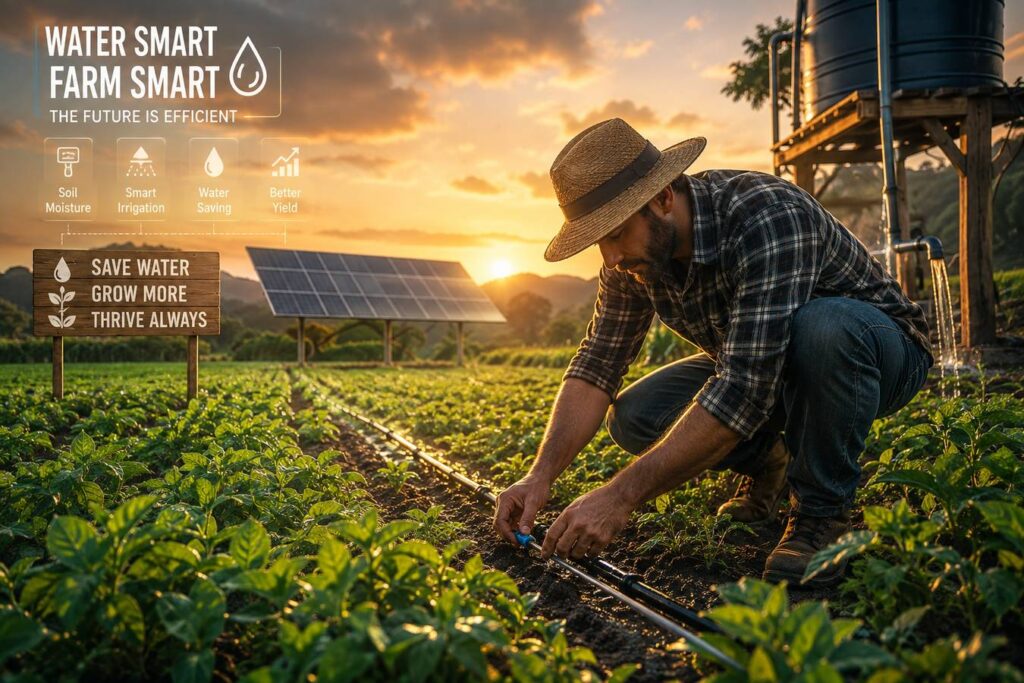
A solar-powered pump may make sense where sunlight is abundant and fuel or grid electricity is expensive.
Water Saving Irrigation and Soil Type
Soil determines how quickly water moves through the field.
Sandy soils generally drain water quickly and may require smaller, more frequent irrigation applications.
Clay soils can hold more water but may absorb it slowly and become waterlogged when too much is applied too quickly.
Loamy soils often provide a useful balance of drainage and water-holding capacity.
This means irrigation should not be designed independently of soil.
Water Saving Irrigation and Crop Type
Different crops have different water requirements.
Leafy vegetables, tomatoes, peppers, cucumbers and many other horticultural crops can benefit significantly from consistent moisture management.
Fruit trees have deeper root systems and may require different irrigation arrangements.
Crops at different growth stages can also have different water requirements.
A newly transplanted crop may require frequent attention to prevent establishment problems, while a mature crop may have a much larger root zone.
Water Saving Irrigation and Farm Size
A farmer cultivating a small backyard vegetable plot does not necessarily need a sophisticated automated irrigation network.
Likewise, a farmer cultivating several hectares may quickly find manual watering too labor-intensive.
The system should therefore grow with the farm.
Water Saving Irrigation: 9 Best Methods for Small Farms
There are many ways to improve irrigation efficiency, but nine methods stand out for small farms because they combine practicality, affordability and water-saving potential.
These methods can also be combined.
For example, a farmer can use drip irrigation together with mulch, rainwater harvesting and soil-moisture monitoring.
The result can be significantly better than relying on one technique alone.
Water Saving Irrigation Method 1: Drip Irrigation for Direct Root-Zone Watering
Drip irrigation is one of the most widely discussed water-efficient irrigation methods for small farms, and for good reason.
Instead of releasing large amounts of water across the entire field, drip systems deliver water slowly through pipes or emitters positioned close to plants.
The objective is simple: place water where the crop can use it.
This reduces the amount of water unnecessarily exposed to the sun, wind and non-crop areas.
CGIAR describes drip irrigation as a highly water-efficient approach because water is delivered close to the plant’s root zone, reducing losses associated with runoff, evaporation and deep percolation when the system is properly designed and managed.
Water Saving Irrigation Benefits of Drip Systems
A properly managed drip system can provide several advantages:
- Water is delivered close to crop roots.
- Irrigation can be applied in smaller quantities.
- Less water reaches unwanted areas between crop rows.
- Leaf surfaces remain relatively dry compared with overhead irrigation.
- Weed growth may be reduced in areas that are not directly irrigated.
- Fertilizer can potentially be delivered through irrigation water where appropriate.
- Water application can be more uniform when the system is correctly designed.
- Labor requirements can be reduced.
However, drip irrigation is not magic.
A poorly installed or poorly maintained drip system can waste water too.
Blocked emitters can create dry spots. Leaking connectors can waste water. Incorrect pressure can result in uneven distribution.
That is why maintenance is just as important as installation.
Water Saving Irrigation and the Best Drip Irrigation System for Small Farms
When looking for the best drip irrigation system for small farms, do not begin by asking which brand is most expensive.
Instead, ask:
- How large is the farm?
- How many crops are being irrigated?
- What is the available water pressure?
- What is the water quality?
- Is filtration required?
- Can replacement parts be obtained locally?
- Can the farmer repair the system?
- What is the total installation cost?
- How much labor will it save?
- Can the system be expanded later?
For a very small farm, a simple gravity-fed drip system may be sufficient.
A raised tank can provide pressure through gravity, allowing water to flow through tubing toward crop rows.
For larger plots, a pump and more structured distribution system may be necessary.
The right system is the one that the farmer can afford, operate and maintain consistently.
Water Saving Irrigation Maintenance Tips for Drip Systems
Farmers using drip irrigation should regularly:
- Inspect pipes for leaks.
- Check emitters for blockage.
- Clean filters where applicable.
- Check whether all crop rows are receiving similar amounts of water.
- Inspect connectors.
- Flush lines when necessary.
- Protect exposed pipes from unnecessary physical damage.
- Monitor water pressure.
- Replace damaged components promptly.
One of the biggest mistakes is installing a drip system and then forgetting about it.
Efficient irrigation is a management process, not simply a piece of equipment.
Water Saving Irrigation Method 2: Low-Cost Irrigation Systems for Small Farms
Not every farmer can afford a commercial irrigation installation.
Fortunately, low-cost irrigation systems for small farms can provide practical alternatives.
Small farmers have developed creative ways to deliver water efficiently using locally available materials.
These can include:
- Gravity-fed drip systems.
- Small storage tanks.
- Simple hoses.
- Perforated pipes.
- Bottle-based slow watering.
- Small watering cans.
- Manually controlled drip lines.
- Simple micro-irrigation arrangements.
The key principle is controlled delivery.
A slow release of water near the root zone can be more useful than pouring a large volume of water over an entire plot.
Water Saving Irrigation With Recycled Bottles
For very small gardens, perforated plastic bottles can sometimes be used as a simple slow-release watering device.
A farmer can fill a bottle with water and create a small opening that allows water to escape gradually near the root zone.
This should not be confused with a replacement for professionally designed irrigation.
However, it can be useful for:
- Small vegetable gardens.
- Nursery plants.
- Individual fruit trees.
- Household gardens.
- Experimental plots.
CGIAR has documented examples of farmers in Ghana experimenting with low-cost bottle-based drip arrangements to help crops withstand dry-season water stress.
The larger lesson is not that every farmer should use bottles.
The lesson is that efficient water application can sometimes be achieved without immediately investing in a complex irrigation network.
Water Saving Irrigation and Gravity-Fed Systems
Gravity can become a farmer’s free source of pressure.
Where the terrain and water-storage arrangement allow it, a tank can be positioned above the field so water moves downhill through pipes.
This can reduce dependence on continuous pumping.
A gravity-fed system can be particularly attractive where:
- The farm is relatively small.
- The water source can fill a storage tank.
- The field is positioned below the tank.
- Electricity is expensive or unreliable.
- The farmer wants a simple system.
The farmer still needs to ensure that pressure is adequate and water is distributed evenly.
Water Saving Irrigation Method 3: Smart Irrigation and Soil-Moisture Monitoring
Technology is changing the way farmers think about irrigation.
Smart irrigation uses information to determine when and how much water should be applied.
The technology can be as simple as a soil-moisture meter or as advanced as a system involving sensors, automated valves, weather information and digital controls.
The principle remains the same:
Do not irrigate simply because the clock says it is time. Irrigate because the crop and soil require water.
Water Saving Irrigation and Soil-Moisture Sensors
A soil-moisture sensor measures moisture conditions in the soil.
Instead of guessing whether the soil is dry, a farmer can use measurements to make a better irrigation decision.
This is particularly useful when weather conditions change rapidly.
For example, if rain has recently fallen, a scheduled irrigation cycle may no longer be necessary.
Similarly, if hot, windy weather causes the soil to dry faster than expected, irrigation may need to be adjusted.
University irrigation guidance recommends monitoring soil moisture and considering crop growth, soil characteristics and expected water demand when making irrigation decisions.
Water Saving Irrigation With Automated Irrigation
Automation can take smart irrigation one step further.
A basic automated system may include:
- A timer.
- An electric valve.
- A pump.
- Irrigation tubing.
- A sensor.
- A controller.
A more advanced system can use multiple sensors and environmental information.
But small farmers should be careful about buying technology simply because it looks modern.
The question should always be:
Will this technology save enough water, labor or money to justify its cost?
A simple moisture meter that helps a farmer avoid unnecessary irrigation may provide more practical value than an expensive system that is difficult to maintain.
Water Saving Irrigation Method 4: Irrigation Scheduling
One of the cheapest ways to save water is to improve when irrigation happens.
This is known as irrigation scheduling.
A farmer who applies water at the wrong time can lose a significant portion of it before the crop benefits.
Irrigation scheduling considers factors such as:
- Crop growth stage.
- Soil moisture.
- Soil type.
- Weather.
- Temperature.
- Recent rainfall.
- Root depth.
- Expected rainfall.
- Crop water demand.
Water Saving Irrigation and Morning Watering
For many farming situations, irrigating during cooler periods can reduce evaporation compared with watering during the hottest part of the day.
Early morning can therefore be a useful irrigation period.
Evening irrigation can also reduce evaporation, but farmers should consider crop disease risks in situations where prolonged leaf wetness is a concern, particularly with overhead irrigation.
The ideal timing depends on the irrigation method, crop and local conditions.
Water Saving Irrigation and Avoiding Overwatering
More water does not necessarily mean healthier crops.
Overwatering can:
- Waste water.
- Increase pumping costs.
- Reduce oxygen in the root zone.
- Encourage some diseases.
- Cause nutrient leaching.
- Damage crops sensitive to waterlogging.
- Increase unnecessary labor.
The objective should be to maintain suitable moisture in the root zone rather than keep the soil permanently saturated.
Water Saving Irrigation Method 5: Mulching to Protect Soil Moisture
Mulching is not an irrigation system in the traditional sense, but it can dramatically improve the effectiveness of irrigation.
A layer of suitable material placed around plants protects the soil surface.
Common mulch materials include:
- Dry grass.
- Crop residues.
- Straw.
- Leaves.
- Composting organic materials.
- Certain agricultural mulch films.
Mulch acts like a protective blanket.
It can reduce direct exposure of soil to sunlight and help slow moisture loss from the soil surface.
Water Saving Irrigation and Organic Mulch
Organic mulch can provide additional benefits as it decomposes.
Depending on the material and management, it can contribute organic matter to the soil.
Healthy soils generally have better structure and can support better water management than severely degraded soils.
Farmers should avoid placing wet or diseased plant material directly against crop stems.
Mulch should also be managed according to local pest and disease conditions.
Water Saving Irrigation and Weed Control
Weeds compete with crops for water.
A field full of weeds can therefore reduce the amount of water available to the crop.
Mulching can help suppress some weeds, reducing competition.
This creates a useful combination:
less evaporation + fewer weeds + better soil protection = more efficient use of irrigation water.
Water Saving Irrigation Method 6: Rainwater Harvesting and Farm Water Storage
Rainfall is free water, but only if it is captured and stored safely.
Rainwater harvesting allows farmers to collect water during rainy periods for later agricultural use.
Depending on the farm, water can be collected from:
- Rooftops.
- Greenhouses.
- Farm buildings.
- Prepared catchment areas.
- Drainage channels.
- Other suitable surfaces.
Storage options may include:
- Water tanks.
- Farm ponds.
- Reservoirs.
- Lined pits.
- Drums for very small gardens.
Water Saving Irrigation and Dry-Season Water Storage
The dry season is exactly when stored water becomes valuable.
A farmer who collects water during periods of heavy rainfall can reduce pressure on wells, boreholes and other sources later.
However, water harvesting must be designed carefully.
Farmers should consider:
- Storage capacity.
- Water quality.
- Structural safety.
- Mosquito control.
- Contamination risks.
- Overflow management.
- Evaporation losses.
- Local regulations.
- Whether the collected water is suitable for the intended crop.
Water Saving Irrigation and Farm Ponds
A farm pond can provide larger storage capacity than a small tank.
But ponds can lose water through seepage and evaporation.
Where appropriate, lining, vegetation management, shade considerations and good pond design can help reduce losses.
The purpose is not simply to collect as much water as possible.
It is to collect usable water while minimizing unnecessary losses.
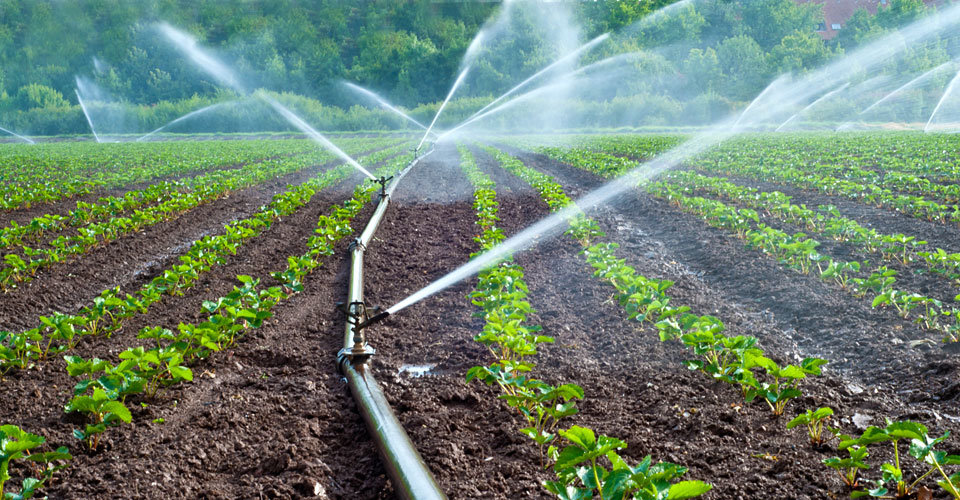
Method 7: Micro-Sprinklers for Targeted Farm Irrigation
Sprinkler systems vary widely.
Large overhead sprinklers can cover broad areas, while micro-sprinklers deliver water over smaller zones.
For some crops, micro-sprinklers can provide a useful compromise between conventional sprinklers and drip systems.
They may be suitable for:
- Orchards.
- Nurseries.
- Certain vegetables.
- Fruit trees.
- Small horticultural plots.
The advantage is that water can be applied over a defined area rather than flooding an entire field.
However, wind can affect sprinkler distribution.
Evaporation can also occur before water reaches the soil, particularly during hot and windy conditions.
Therefore, farmers should choose micro-sprinklers based on crop requirements, climate and water availability.
Method 8: Improve Soil Water Retention
Sometimes the best irrigation strategy starts with the soil rather than the irrigation equipment.
A farm with poor soil structure may require more frequent irrigation because water is lost rapidly.
Improving soil health can therefore increase the value of every irrigation cycle.
Water Saving Irrigation and Organic Matter
Organic matter can improve soil structure and support water retention.
Depending on local conditions, farmers may use:
- Well-decomposed compost.
- Properly prepared manure.
- Crop residues.
- Green manure.
- Cover crops.
The goal is to build a soil environment where water can enter, remain available to plants and move through the root zone appropriately.
Water Saving Irrigation and Soil Compaction
Compacted soil can interfere with infiltration and root development.
When soil becomes compacted, water may run off instead of entering the root zone.
Farmers can reduce unnecessary compaction by avoiding excessive traffic on wet soil and using appropriate soil-management practices.
Water Saving Irrigation and Cover Crops
Cover crops can help protect soil from direct exposure to sun and heavy rainfall.
They can also contribute to soil health.
However, cover crops themselves use water.
Therefore, farmers in severely water-limited areas need to select cover crops carefully and manage them according to the local season and cropping system.
Method 9: Combine Irrigation With Crop and Farm Planning
The final method is perhaps the most important because it brings all the other methods together.
Efficient irrigation should not exist separately from farm planning.
A farmer should think about:
- What crop will be planted?
- When will it be planted?
- How much water does it require?
- How long is the growing cycle?
- What is the expected dry period?
- How much water is available?
- Which crops have higher market value?
- Which crops tolerate temporary water stress?
- How much irrigation labor is available?
Water Saving Irrigation and Crop Selection
A farmer with limited water should be careful about choosing crops that require more water than the farm can reliably supply.
This does not mean avoiding high-value crops.
Instead, it means matching crop selection with available resources.
For example, a farmer might divide a farm into zones based on crop water needs.
High-value vegetables can receive targeted irrigation while less water-demanding crops are managed differently.
This is much more efficient than applying exactly the same irrigation schedule to every crop.

Water Saving Irrigation: Comparison of the 9 Methods
The table below provides a simple comparison to help small farmers decide where to begin.
| Water-saving method | Initial cost | Water-saving potential | Best suited for | Maintenance | Main advantage |
|---|---|---|---|---|---|
| Drip irrigation | Medium | High | Vegetables, fruits, row crops | Medium | Direct root-zone watering |
| Gravity-fed drip | Low–Medium | High | Small farms | Medium | Low energy requirement |
| Smart irrigation | Medium–High | High | Farms using technology | Medium–High | Data-based irrigation |
| Irrigation scheduling | Very Low | Medium–High | Almost every farm | Low | Prevents unnecessary watering |
| Mulching | Low | Medium | Vegetables, fruits, field crops | Low | Reduces moisture loss |
| Rainwater harvesting | Low–High | High | Farms with seasonal rainfall | Medium | Stores water for later use |
| Micro-sprinklers | Medium | Medium–High | Orchards, nurseries, vegetables | Medium | Controlled area coverage |
| Soil improvement | Low–Medium | Medium | Most farms | Medium | Improves water retention |
| Crop and farm planning | Very Low | Medium–High | All farms | Low | Matches water supply with crop needs |
The most important point is that farmers do not necessarily have to choose only one.
A small vegetable farmer could combine:
rainwater harvesting + mulch + gravity-fed drip + irrigation scheduling.
Another farmer could combine:
borehole + solar pump + drip irrigation + soil-moisture monitoring.
The best system is the one that fits the farm’s actual circumstances.
Water Saving Irrigation: How to Build a Low-Cost System Step by Step
Farmers with limited capital can start small.
There is no need to irrigate an entire farm immediately.
Begin with the most valuable or water-sensitive section.
Step 1: Water Saving Irrigation Starts With Measuring Your Water
Determine approximately how much water is available.
Ask:
- How quickly does the well recover?
- How much water can the pump deliver?
- How large is the storage tank?
- How much water does the farm use each day?
- Does the source become weaker during the dry season?
Without understanding supply, it is difficult to design an efficient system.
Step 2: Water Saving Irrigation Requires Mapping the Farm
Divide the farm into irrigation zones.
Consider:
- Crop type.
- Soil type.
- Slope.
- Distance from water source.
- Plant spacing.
- Areas that dry quickly.
- Areas that remain wet longer.
This makes irrigation easier to manage.
Step 3: Water Saving Irrigation Should Prioritize the Root Zone
Do not think of irrigation as watering the entire field.
Think about watering the crop’s root zone.
This mindset naturally encourages targeted methods such as drip irrigation and micro-irrigation.
Step 4: Water Saving Irrigation Needs Filtration Where Necessary
Water containing sand, sediment or organic particles can block small irrigation emitters.
A suitable filter can protect the system.
The exact filtration requirement depends on the water source and equipment.
Step 5: Water Saving Irrigation Requires Testing
Before planting a large area, test the system.
Check whether water reaches all rows.
Observe:
- Pressure.
- Flow.
- Leaks.
- Blocked emitters.
- Uneven distribution.
- Drainage problems.
A small test can prevent an expensive mistake.
Water Saving Irrigation: How to Save Water During the Dry Season
Dry-season farming presents a different challenge from rainy-season farming.
Rainfall may be absent for weeks.
The farmer therefore becomes responsible for maintaining adequate soil moisture.
The following practices can make a significant difference.
Water Saving Irrigation During Cooler Hours
Avoid irrigating during periods when evaporation is likely to be extremely high.
Early morning can often be a practical period.
The exact schedule should depend on the irrigation method and crop.
Water Saving Irrigation With Mulch
Apply suitable mulch around crops to protect soil moisture.
Do not create conditions that encourage pests or disease around plant stems.
Water Saving Irrigation With Regular Monitoring
Do not wait until the entire field looks dry.
Check soil moisture regularly.
Farmers can use:
- Soil-feel methods.
- Moisture meters.
- Sensors.
- Observation of crop condition.
- Weather information.
Water Saving Irrigation and Leak Detection
A small leak may appear insignificant.
But a leak running every day can waste a surprisingly large amount of water over an entire growing season.
Inspect:
- Hoses.
- Pipes.
- Connectors.
- Tank outlets.
- Valves.
- Emitters.
- Pump connections.
Repair leaks immediately.
Water Saving Irrigation: Common Mistakes Small Farmers Should Avoid
Efficient irrigation can fail because of simple mistakes.
Water Saving Irrigation Mistake 1: Watering on a Fixed Schedule Without Checking Soil
A calendar can be useful, but crops do not always follow a calendar.
Rainfall, temperature, wind and crop growth can change water requirements.
Use schedules as a starting point, then adjust according to conditions.
Water Saving Irrigation Mistake 2: Applying Too Much Water at Once
Large applications can result in runoff or deep drainage.
Smaller applications may be more efficient where the irrigation method and soil permit.
Water Saving Irrigation Mistake 3: Ignoring Leaks
A leaking pipe is an irrigation problem, not a minor inconvenience.
Water Saving Irrigation Mistake 4: Buying Technology Without Training
A farmer may purchase a smart irrigation controller but never configure it correctly.
Technology only works when it is understood and maintained.
Water Saving Irrigation Mistake 5: Installing Drip Irrigation Without Filtration
Poor-quality water can clog emitters.
Water Saving Irrigation Mistake 6: Treating Every Crop the Same
Tomatoes, onions, leafy vegetables, maize and fruit trees do not necessarily have identical water requirements.
Water Saving Irrigation Mistake 7: Ignoring Soil
The irrigation system cannot compensate for every soil-management problem.
Healthy soil is part of water management.
Water Saving Irrigation: Is Drip Irrigation Always the Best Choice?
Drip irrigation is excellent, but it is not automatically the best choice for every farm.
It may be less attractive when:
- The farmer cannot maintain the system.
- Water contains excessive sediment.
- Replacement parts are difficult to obtain.
- The field layout makes installation complicated.
- The crop does not benefit enough to justify the cost.
- The farmer has insufficient pressure or storage.
- The system is too large for the farmer’s actual needs.
A farmer should calculate the economics.
Suppose a drip system costs a significant amount but saves labor, water and crop losses. It may eventually pay for itself.
But if the farmer cannot maintain it or obtain replacement parts, the investment may become a burden.
This is why affordability should be considered alongside efficiency.
CGIAR research on low-cost gravity-fed drip systems has highlighted both the water-efficiency benefits and an important lesson: technology adoption can decline when farmers do not receive adequate training and ongoing support.
In other words:
The best irrigation technology is not necessarily the most advanced. It is the technology that a farmer can successfully use for years.
Water Saving Irrigation: Smart Irrigation Versus Traditional Irrigation
Smart irrigation is attracting increasing attention because sensors and digital tools can help farmers make better decisions.
But traditional irrigation should not be dismissed.
A farmer can achieve impressive efficiency simply by:
- Checking soil moisture.
- Watering at suitable times.
- Using mulch.
- Repairing leaks.
- Delivering water close to roots.
- Maintaining equipment.
Smart technology can improve this process, but it does not replace good agricultural judgment.
Think of technology as an assistant rather than a substitute for understanding the farm.
Water Saving Irrigation: The Role of Solar-Powered Pumps
Energy costs can become a major part of irrigation expenses.
Solar-powered pumps are therefore attracting attention among farmers who want to reduce dependence on diesel or grid electricity.
A solar-powered irrigation system can include:
- Solar panels.
- A pump.
- Water storage.
- Pipes.
- Irrigation equipment.
- A controller where appropriate.
One advantage is that solar energy is available during daylight hours when water can be pumped into storage.
The farmer can then potentially irrigate from the stored water later.
However, solar pumping should still be carefully designed.
The cost of panels, pump capacity, storage and irrigation equipment must be considered together.
A farmer should avoid purchasing a pump that is far larger than necessary.
Likewise, insufficient pumping capacity can make the irrigation system unreliable.
Water Saving Irrigation: Why Water Storage Matters
Water availability and water storage are two different things.
A farm may have a reliable water source but still struggle during peak demand if water cannot be stored efficiently.
Storage gives farmers flexibility.
For example:
Rainy period → collect water → store water → dry season → use stored water strategically.
Storage can also allow a pump to operate at a convenient time while irrigation occurs later.
This can make the entire system more manageable.
However, farmers should calculate storage needs carefully.
A tank that is too small may run out quickly.
An unnecessarily large tank can consume capital that might have been better invested elsewhere.
Water Saving Irrigation: How to Calculate Whether Your System Is Working
Farmers should not judge irrigation efficiency only by looking at green plants.
Track actual results.
Useful indicators include:
- Water used per week.
- Pump operating hours.
- Fuel or electricity costs.
- Crop yield.
- Irrigated area.
- Labor hours.
- Crop losses.
- Number of irrigation cycles.
- Water-source recovery time.
A simple farm notebook can provide valuable information.
For example:
Week 1: 10 pump hours, 100 units of water, healthy crop.
Week 2: 12 pump hours, 120 units of water, similar crop performance.
If water use keeps increasing without an improvement in yield or crop quality, the farmer should investigate.
This could indicate:
- Leaks.
- Overwatering.
- Poor distribution.
- Increased evaporation.
- Soil problems.
- Changing crop water requirements.
Good farm management is built around observation.
Water Saving Irrigation: How Farmers Can Combine the 9 Methods
The real power comes from combining methods.
Consider a small vegetable farm.
The farmer could start by harvesting rainwater into a storage tank.
The tank supplies a gravity-fed drip system.
The crop rows are covered with mulch.
The farmer checks soil moisture before irrigation.
Watering occurs during cooler hours.
Leaks are inspected weekly.
The farmer records water usage and crop yield.
This is no longer simply an irrigation system.
It is a complete water-management strategy.
Another farmer with more resources might use:
- A solar pump.
- A storage tank.
- Drip irrigation.
- Soil-moisture sensors.
- Automated valves.
- Weather-based irrigation scheduling.
- Mulching.
- Crop zoning.
The technologies differ, but the principle is identical:
Apply the right amount of water, to the right place, at the right time.
Water Saving Irrigation: A Practical Strategy for Nigerian Small Farms
For many Nigerian farmers, dry-season irrigation is particularly important because it can create opportunities to produce crops outside the main rainy season.
Small-scale irrigation is already an important part of agricultural development in Nigeria, and recent World Bank reporting highlights ongoing efforts to modernize irrigation management and improve water efficiency.
World Bank: How Smarter Irrigation Is Changing Nigerian Farming
For a Nigerian smallholder, the appropriate system may vary considerably between regions.
A farmer in the north may face intense dry-season heat and limited rainfall.
A farmer in the south may have greater rainfall availability but still experience periods of dry weather.
A vegetable farmer near an urban market may also have a different economic calculation from a farmer growing staple crops.
This is why irrigation decisions should be local.
Water Saving Irrigation for Vegetable Farmers
Vegetable farmers can benefit from targeted irrigation because many vegetables require reliable moisture for good growth and quality.
Drip irrigation, mulch and regular monitoring can form a powerful combination.
Water Saving Irrigation for Fruit Farmers
Fruit trees may benefit from localized irrigation around the root zone.
Young trees may require particularly careful attention during establishment.
Water Saving Irrigation for Small Mixed Farms
Mixed farms can divide crops into irrigation zones according to water requirements.
This prevents unnecessary uniform watering.
Water Saving Irrigation: How Much Water Should You Apply?
There is no universal number that applies to every crop and farm.
The amount depends on:
- Crop.
- Growth stage.
- Soil.
- Weather.
- Root depth.
- Irrigation method.
- Rainfall.
- Water-holding capacity.
- Field conditions.
This is why simplistic advice such as “water every crop with X liters every day” can be misleading.
Instead, farmers should observe the root zone and understand how quickly the soil loses available moisture.
University extension guidance recommends considering soil water conditions, crop growth and irrigation demand when scheduling irrigation rather than relying solely on fixed timing.
For practical farm management, the question should therefore be:
Does the crop need water now, and how much water is necessary to replenish the root zone without causing unnecessary losses?
That is a much better question than:
What time do I normally water?
Water Saving Irrigation: The Connection Between Irrigation and Fertilizer
Water management affects fertilizer management.
When excessive irrigation pushes water below the root zone, nutrients can move away from where crops can use them.
This is one reason over-irrigation can become expensive.
Farmers spend money on fertilizer and then potentially lose some of its value through poor water management.
Targeted irrigation can help keep water and nutrients closer to the active root zone.
In some drip systems, fertigation—the application of soluble nutrients through irrigation water—can be used.
However, fertigation requires appropriate equipment, fertilizer compatibility and careful management.
Farmers should avoid introducing fertilizers into irrigation systems without understanding the equipment and crop requirements.
Water Saving Irrigation: The Economic Benefits for Small Farmers
Saving water is not only an environmental objective.
It can also improve the farm’s financial performance.
Consider a farmer using a fuel-powered pump.
Every extra hour of pumping can mean:
- More fuel.
- More equipment wear.
- More labor.
- More maintenance.
- More water extraction.
If a better irrigation system reduces unnecessary pumping, the savings can accumulate.
Likewise, reducing crop stress can potentially improve:
- Yield.
- Product quality.
- Marketable produce.
- Crop survival.
- Production consistency.
A farmer should therefore calculate irrigation efficiency in terms of money saved and value produced, not only liters of water.
Water Saving Irrigation: What Farmers Should Buy First
If the farm has a limited budget, prioritize investments carefully.
A sensible order may be:
First: Fix Existing Losses
Repair leaks.
Second: Improve Irrigation Timing
Start monitoring soil moisture and crop condition.
Third: Protect the Soil
Use appropriate mulch and improve soil organic matter.
Fourth: Improve Water Delivery
Consider drip or micro-irrigation where economically appropriate.
Fifth: Add Storage
Capture and store water where feasible.
Sixth: Add Technology
Consider sensors, automated valves or smart controllers after the basic system works properly.
This order matters.
There is little value in buying an expensive smart controller for an irrigation system that leaks water everywhere.
Water Saving Irrigation: A 2026 Checklist for Small Farmers
Before the dry season begins, walk around the farm and ask these questions:
Water Source
- Is the water source reliable?
- How much water is available?
- Does the source change during the dry season?
- Is the water quality suitable?
Irrigation Equipment
- Are pipes leaking?
- Are emitters blocked?
- Is the pump working efficiently?
- Are filters clean?
- Is water distributed evenly?
Soil
- Does the soil hold moisture well?
- Is there excessive compaction?
- Is mulch available?
- Can organic matter be improved?
Crops
- Which crops need the most water?
- Which crops have the highest economic value?
- Are crops grouped according to water requirements?
- What growth stages are most sensitive to water stress?
Scheduling
- When is irrigation occurring?
- Is the soil actually dry?
- Has rainfall recently occurred?
- Is water being applied during high evaporation periods?
Finances
- How much does irrigation cost?
- How much fuel or electricity is used?
- What is the expected yield?
- Would a drip system reduce costs?
- Can replacement parts be obtained locally?
What Will Matter Most Beyond 2026?
The future of small-farm irrigation is unlikely to depend on one revolutionary machine.
Instead, it will probably involve a combination of simple and advanced technologies.
Farmers are increasingly interested in:
- Drip irrigation.
- Solar-powered pumps.
- Soil-moisture sensors.
- Automated irrigation.
- Weather-informed scheduling.
- Rainwater harvesting.
- Low-pressure systems.
- Affordable irrigation services.
- Digital farm-management tools.
But technology must remain practical.
A sophisticated irrigation system that cannot be repaired locally is less useful than a simple system that a farmer understands completely.
This is especially important for smallholder agriculture.
Affordability, access to spare parts, training, energy availability and technical support can determine whether irrigation technology succeeds or fails.
Recent CGIAR work on irrigation-as-a-service also highlights another emerging model: farmers may increasingly access irrigation equipment and water through flexible service arrangements rather than purchasing every component themselves.
This could make modern irrigation more accessible to farmers who cannot afford large upfront investments.
Water Saving Irrigation: The Biggest Lesson for Small Farmers
The biggest lesson is surprisingly simple:
Water efficiency begins with management, not equipment.
A farmer does not need to immediately purchase the most sophisticated irrigation system available.
Start by understanding the farm.
Understand the soil.
Understand the crop.
Understand the water source.
Understand how much water is being used.
Then identify where the losses occur.
Maybe the problem is evaporation.
Maybe it is runoff.
Maybe it is a leaking pipe.
Maybe irrigation is happening too frequently.
Maybe the soil cannot hold moisture.
Maybe weeds are competing with crops.
Maybe water is being applied far from the roots.
Maybe the farmer simply does not have enough storage.
Once the problem is identified, the solution becomes much clearer.
For one farmer, that solution may be drip irrigation.
For another, it may be mulch.
For another, it may be a simple rainwater tank.
For a technology-focused farmer, it may be smart irrigation with soil-moisture sensors.
The most successful approach is usually the one that solves the farm’s actual problem without creating a bigger financial or maintenance burden.
Frequently Asked Questions
Water Saving Irrigation: What Is the Most Efficient Irrigation Method for a Small Farm?
Drip irrigation is often considered one of the most water-efficient options because it can deliver water directly near plant roots. However, its actual performance depends on system design, maintenance, pressure, water quality and management.
For some farmers, a well-managed gravity-fed drip system may be more appropriate than a sophisticated pressurized system.
Water Saving Irrigation: Is Drip Irrigation Worth It for Small Farms?
It can be, particularly for high-value crops and farms where water or pumping costs are significant.
However, farmers should calculate the cost of installation, maintenance, replacement parts and expected benefits before investing.
Water Saving Irrigation: What Is the Cheapest Way to Irrigate a Small Farm?
There is no single cheapest method for every farm.
Simple approaches can include:
- Watering cans.
- Gravity-fed systems.
- Reused containers for very small plots.
- Simple drip arrangements.
- Rainwater harvesting.
- Mulching to reduce irrigation demand.
The cheapest system is not necessarily the most economical if it requires excessive labor.
Water Saving Irrigation: How Does Mulching Save Water?
Mulch covers the soil surface and can reduce direct exposure to sunlight and wind, helping slow moisture loss. It can also suppress some weeds that compete with crops for water.
Water Saving Irrigation: Can Solar Pumps Help Small Farmers?
Yes, solar pumps can reduce reliance on fuel or grid electricity in suitable locations. However, the system needs to be properly sized, and the cost of panels, pumps, storage and irrigation equipment should be considered together.
Water Saving Irrigation: How Often Should a Small Farm Be Irrigated?
There is no universal schedule.
Irrigation frequency depends on crop, soil, weather, root depth and irrigation method.
The better approach is to monitor soil moisture and crop condition and adjust irrigation accordingly.
Water Saving Irrigation: Is Smart Irrigation Expensive?
It can be.
However, smart irrigation does not always require a complicated system.
A basic soil-moisture meter can be a useful starting point.
Farmers can gradually add technology as the farm grows and as the financial benefits become clear.
Water Saving Irrigation: Can Rainwater Be Used for Farming?
Yes, rainwater can be collected and stored for agricultural use where appropriate. Farmers should ensure that collection and storage systems are safe and that water quality is suitable for the intended purpose.
Water Saving Irrigation: How Can Farmers Reduce Water Loss?
Farmers can reduce losses by:
- Using targeted irrigation.
- Fixing leaks.
- Irrigating at suitable times.
- Using mulch.
- Monitoring soil moisture.
- Improving soil health.
- Harvesting rainwater.
- Maintaining irrigation equipment.
- Avoiding unnecessary overwatering.
Final Thoughts for Farmers
The future of small-scale farming will depend increasingly on how intelligently farmers manage limited resources.
Water is one of those resources that cannot be treated as unlimited.
The objective is not necessarily to use the smallest possible amount of water.
The objective is to use water efficiently enough to keep crops productive without unnecessary waste.
For a small farm, this can begin with simple actions.
Repair the leaking hose.
Cover the exposed soil.
Water at a better time.
Check the soil before switching on the pump.
Collect rainwater when possible.
Group crops according to their needs.
Then, when the farm is ready, consider drip irrigation, micro-irrigation, solar pumping or smart irrigation technology.
The nine methods discussed in this guide—drip irrigation, low-cost systems, smart irrigation, scheduling, mulching, rainwater harvesting, micro-sprinklers, soil improvement and better crop planning—should not be viewed as isolated solutions.
They work best as parts of a larger water-management strategy.
A small farmer who learns to manage water carefully can potentially reduce unnecessary expenses, protect crops during dry periods and make better use of every drop available.
That is the real promise of water saving irrigation in 2026 and beyond.
The smartest farm is not necessarily the farm with the most expensive equipment.
It is the farm where every important resource is used with purpose.
And when water is treated as an investment rather than simply something that comes out of a pipe, even a small farm can become more productive, resilient and prepared for the challenges ahead.
About The Author