Cassava varieties
Walk through a cassava farm in Nigeria and it can be easy to assume that one cassava plant is much like another.
The leaves may look similar. The stems may look similar. And after several months in the field, the differences between varieties can sometimes be difficult to notice unless you know what to look for.
But underneath the soil, those differences can become extremely important.
Two farmers can cultivate cassava on similar land, plant around the same period, apply similar amounts of fertilizer and harvest at roughly the same time, yet end up with very different results.
One farm may produce roots that are preferred by processors because of their starch or dry-matter characteristics. Another may produce roots better suited to fresh consumption. One variety may perform better where disease pressure is high, while another may be more attractive for a particular processing market.
This is why selecting the right cassava varieties should be one of the first decisions a farmer makes—not something considered after the farm has already been established.
Nigeria has a long history of cassava improvement. Research organizations including the International Institute of Tropical Agriculture (IITA) and the National Root Crops Research Institute (NRCRI) have worked on varieties designed around farmer needs such as higher productivity, disease resistance, dry matter, starch, adaptability and market preferences. IITA reports that improved varieties can deliver significant productivity gains compared with local checks, while NRCRI’s cassava programme focuses on high-yielding, disease-resistant and nutritionally improved varieties.

For Nigerian farmers, therefore, the question should not simply be:
“Which cassava variety gives the highest yield?”
A better question is:
“Which cassava variety gives me the combination of yield, disease resistance, maturity, quality and market value that fits my farm?”
That distinction can make a major difference to profitability.
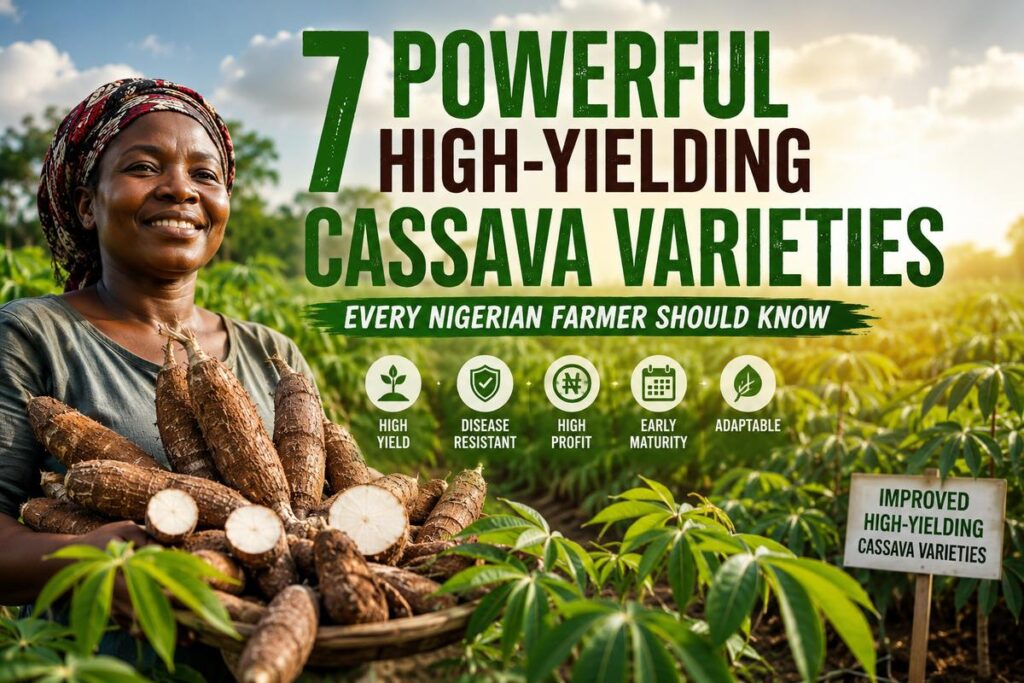
In this guide, we examine seven important high-yielding cassava varieties and improved options relevant to Nigerian farmers, explain what makes each one interesting, and discuss how to choose among them.
Cassava Varieties: What Makes an Improved Cassava Variety Different?
Before looking at individual varieties, it is important to understand what farmers mean when they talk about improved cassava varieties.
An improved variety is not simply a cassava plant with a new name.
Breeding programmes evaluate cassava for specific characteristics and select plants that offer useful combinations of traits. Depending on the breeding objective, these traits may include:
- Higher fresh-root yield
- Higher dry-matter content
- Higher starch content
- Resistance or tolerance to important diseases
- Better adaptation to particular environments
- Better performance under certain production conditions
- Lower cyanogenic potential in varieties intended for particular food uses
- Suitability for industrial processing
- Suitability for gari and other traditional products
- Better consumer characteristics
- Early or appropriate maturity
- Greater resilience to environmental stresses
IITA’s cassava breeding programme specifically describes its work as developing varieties that are high yielding, disease resistant and climate resilient, while also supporting improved planting-material systems. (IITA)
This matters because yield alone does not determine profitability.
Suppose one variety produces a large quantity of roots but has characteristics that are poorly matched with the processor buying from you. Another variety may produce slightly less fresh root but have stronger demand because of its starch or processing characteristics.
The second option could potentially make more business sense.
This is why serious cassava farming should always connect the variety to the intended market.
Cassava Varieties: The 7 High-Yielding Options Nigerian Farmers Should Know
There are many cassava varieties associated with Nigerian production and breeding programmes. The seven discussed here are not presented as a universal ranking from number one to number seven.
Rather, they represent important improved or widely used options that illustrate the different opportunities available to farmers.
The seven are:
- TME 419
- Game Changer
- Obasanjo-2
- Baba-70
- Hope
- Poundable
- UMUCASS 42
The right choice will depend on location, soil, rainfall, disease pressure, planting material, farm management and—perhaps most importantly—the market the farmer intends to serve.
Cassava Varieties #1: TME 419
TME 419 is one of the most recognizable names when discussing improved cassava varieties in Nigeria.
Unlike some newer varieties whose names are strongly associated with particular product profiles, TME 419 has become widely known among farmers and processors.
IITA has described TME 419 as a popular variety among Nigerian farmers, and research evaluating cassava for gari production used TME 419 as a check because of its strong performance and good product-yield characteristics.
Why TME 419 remains important among cassava varieties
One reason TME 419 continues to attract attention is its connection to processing.
Farmers producing cassava for gari, fufu and related products need to think beyond the number of roots harvested. The amount and quality of processed product obtained from those roots can have a major effect on the economics of production.
TME 419 has therefore become particularly relevant in discussions around cassava processing.
However, farmers should avoid assuming that popularity automatically means it is the best variety for every farm.
A variety that performs well in one location may not necessarily perform identically under another combination of:
- Soil type
- Rainfall
- Planting date
- Weed pressure
- Fertility
- Disease pressure
- Plant population
- Management practices
Who should consider TME 419?
TME 419 may be particularly interesting for farmers who:
- Produce cassava for processing
- Have access to markets for gari or related products
- Want a widely recognized improved variety
- Can obtain healthy planting material
- Are prepared to manage weeds properly
- Want a variety with an established history in Nigerian cassava production
But even with a familiar variety, good agronomy remains essential.
A genetically improved plant cannot compensate indefinitely for poor management.
Cassava Varieties #2: Game Changer
The name itself tells you something about the breeding objective.
Game Changer was among five cassava varieties released around 2020 through collaboration involving IITA, NRCRI and partners.
IITA describes Game Changer as a variety developed with industrial use in mind, particularly because of its high starch and dry-matter characteristics.
This makes it particularly interesting when thinking about the future of commercial cassava farming.
Why Game Changer stands out among high yielding cassava varieties
Industrial cassava demand can be very different from household food demand.
Factories may require cassava for:
- Starch
- Industrial flour
- Food ingredients
- Other processed products
- Bio-based applications
For such markets, processors may care about characteristics that are not obvious when looking at the cassava plant above ground.
Dry matter and starch can be especially important.
IITA reported that Game Changer and Obasanjo-2 were developed for industrial products and have high starch and dry-matter content, with dry matter reported at almost 40% in the organization’s description of the varieties.
That makes Game Changer particularly interesting for farmers considering high yielding cassava varieties for commercial farming in Nigeria.
What farmers should consider
Before planting Game Changer on a large commercial farm, however, the farmer should investigate the buyer.
Ask:
- Is there a processor purchasing this type of cassava?
- What quality specifications does the buyer require?
- What is the expected harvesting period?
- Does the processor buy directly from farmers?
- What is the expected farm-gate price?
- How far is the farm from the processing facility?
- What transportation costs will be involved?
This is where cassava farming changes from ordinary crop production into an agricultural business.
Cassava Varieties #3: Obasanjo-2
Obasanjo-2 is another improved cassava variety associated with Nigeria’s modern cassava breeding efforts.
Like Game Changer, it was among the varieties developed with specific market needs in mind.
IITA identifies Obasanjo-2 as a high-yielding option suited to industrial products, with high starch and dry-matter characteristics.
Why Obasanjo-2 deserves attention
The biggest lesson from Obasanjo-2 is that modern cassava breeding is increasingly concerned with what happens after harvest.
Traditionally, farmers might judge cassava primarily by:
“How many roots did I harvest?”
Commercial agriculture asks a more sophisticated question:
“How much value can I extract from every tonne I harvest?”
If an industrial processor values starch and dry matter, then those characteristics can influence the attractiveness of a variety.
This is particularly relevant as Nigeria’s cassava value chain becomes increasingly connected to processing and industrial applications.
Obasanjo-2 and commercial cassava farming
For commercial farmers, Obasanjo-2 can be considered where there is a reliable market for its intended product profile.
But commercial farmers should not make a variety decision based on the name alone.
The real equation is:
Variety + agronomy + market + logistics + price = farm profitability
A high-performing variety planted far away from the buyer can become less attractive once transportation costs are included.
Cassava Varieties #4: Baba-70
Baba-70 is another variety released through the improved cassava breeding programme.
IITA describes Baba-70 as one of the varieties developed around particular market and production needs and notes its suitability for granulated and paste products. It is also described as adaptable to dry environments and having low cyanogenic potential.
What makes Baba-70 interesting?
Climate variability is becoming an increasingly important consideration for farmers.
Rainfall does not always behave as predictably as farmers would like. The beginning of the rainy season can shift, dry periods can become more difficult to predict, and soil moisture can vary considerably between locations.
This means farmers increasingly need to think about resilience—not just maximum production under perfect conditions.
Baba-70’s reported adaptation to dry environments makes it an interesting option where farmers face relatively drier conditions.
However, “adaptable to dry environments” should not be interpreted as “does not need water.”
Cassava is relatively resilient compared with many crops, but it still needs suitable soil moisture, establishment conditions and management to achieve good productivity.
Where Baba-70 may fit
Baba-70 can be considered by farmers interested in:
- Granulated cassava products
- Paste-related markets
- Improved varieties
- Areas where dry conditions are a concern
- More resilient production systems
As always, planting material should come from a reliable source.
Cassava Varieties #5: Hope
Hope is an especially interesting example of how farmers’ needs can influence crop breeding.
The variety was developed through the Nigerian cassava research system and collaboration with partners.
IITA identifies Hope among the improved varieties developed for granulated and paste products and associates the variety with income opportunities for farmers producing gari and fufu.
Why Hope matters for cassava farming
The name is appropriate because the variety represents an important idea in agricultural development:
A crop variety should solve a real problem.
Farmers do not necessarily need a plant that looks impressive in a research plot.
They need something that can help them make a living.
That means breeders have to consider:
- What farmers want
- What processors want
- What consumers want
- What women processors need
- What markets are willing to pay for
- What diseases are affecting production
- What environments farmers operate in
IITA has explained that the development of these improved varieties considered the needs of stakeholders including farmers, women, processors and consumers.
Hope and processing markets
For farmers whose main business is supplying cassava for gari or fufu production, Hope deserves consideration alongside other improved options.
However, the most important question remains local demand.
If a processor in your area strongly prefers another variety, that market information should influence your decision.
Cassava Varieties #6: Poundable
Poundable is another variety developed through the same broader generation of improved cassava breeding.
Unlike a variety designed mainly around industrial starch applications, Poundable was developed with fresh consumption characteristics in mind.
IITA reports that Poundable has low cyanide potential and can soften relatively quickly during boiling, making it suitable for fresh consumption after appropriate processing.
Why Poundable is different
This variety illustrates an important point:
The best cassava variety is not necessarily the one with the biggest roots.
Imagine a farmer serving a market where consumers specifically value cassava for direct food preparation.
The characteristics those consumers want may be very different from what an industrial starch factory wants.
For fresh consumption, factors such as:
- Texture
- Cooking characteristics
- Taste
- Ease of processing
- Consumer preference
- Cyanogenic potential
- Root quality
can become extremely important.
Poundable and market segmentation
For farmers close to urban food markets, restaurants, local processors or consumer-oriented cassava businesses, varieties developed around fresh-consumption characteristics may deserve more attention.
The opportunity is to match production with a known customer.
That is a principle that applies to almost every profitable agricultural enterprise.
Cassava Varieties #7: UMUCASS 42
UMUCASS 42 is another important improved cassava variety associated with Nigerian cassava research.
IITA reported that UMUCASS 42 and UMUCASS 43 were released in 2013 after collaborative development involving IITA and NRCRI. The varieties were reported to perform well in different cassava production regions and were described as having high yield, high dry matter and good disease resistance. Pre-release trials reported potential maximum yields in the range of 49–53 tonnes per hectare for the two varieties.
This is an important distinction:
Potential yield from trials is not the same thing as guaranteed yield on a farmer’s field.
A farmer should never read a trial figure and assume that planting the variety automatically means harvesting the same number of tonnes per hectare.
Actual yield depends on:
- Variety
- Planting material quality
- Soil fertility
- Rainfall
- Planting date
- Weed control
- Plant population
- Disease pressure
- Pest pressure
- Land preparation
- Fertilizer management
- Harvest timing
- Farmer skill
Why UMUCASS 42 remains relevant
UMUCASS 42 demonstrates that improved cassava varieties have been part of Nigeria’s agricultural research system for years.
It also shows why farmers should distinguish between:
genetic potential and field performance.
A variety with excellent genetic potential still needs an appropriate production environment.
Cassava Varieties: Comparison of the 7 Improved Options
The following table provides a simplified comparison to help farmers understand the primary positioning of each option.
| Cassava Variety | Main Strength/Positioning | Potential Market/Use | Important Consideration |
|---|---|---|---|
| TME 419 | Popular improved variety with strong processing relevance | Gari, fufu and related products | Match planting material and management to local conditions |
| Game Changer | High starch and dry-matter characteristics | Industrial processing | Best considered where industrial buyers exist |
| Obasanjo-2 | High-yielding, high dry-matter and starch profile | Industrial products | Confirm processor requirements before planting at scale |
| Baba-70 | Adaptability to dry environments and low cyanogenic potential | Granulated and paste products | Still requires appropriate moisture and good agronomy |
| Hope | Developed around farmer and processing needs | Gari, fufu and related products | Local market preference should guide selection |
| Poundable | Fresh-consumption characteristics | Fresh food market | Consumer preference and processing quality matter |
| UMUCASS 42 | High yield, high dry matter and disease resistance | Food and processing markets | Trial potential should not be confused with guaranteed farm yield |
The characteristics above are based on descriptions from Nigerian cassava research and IITA materials. (IITA)
Cassava Varieties: Which Are the Best for High Yield in Nigeria?
This is probably the question most farmers want answered.
But there is no single variety that can honestly be declared the best cassava variety for every farmer in Nigeria.
Nigeria contains several agro-ecological conditions, and farms differ greatly in rainfall, soil, disease pressure, management and market access.
A variety that performs exceptionally well in one environment may not be the most profitable choice somewhere else.
IITA’s cassava research emphasizes the importance of improved varieties alongside agronomy, planting density, nutrition and weed management.
Instead of asking which variety is number one, divide the decision according to your objective.
If your priority is industrial processing
Consider varieties such as:
- Game Changer
- Obasanjo-2
Their reported starch and dry-matter characteristics make them particularly relevant to industrial markets.
If your priority is gari and traditional processing
Consider:
- TME 419
- Hope
- Other locally recommended improved varieties
TME 419 has been evaluated specifically in relation to gari production and is recognized for its processing performance. (IITA)
If dry conditions are a major concern
Baba-70 may be worth investigating because of its reported adaptability to dry environments.
If fresh consumption is your target
Poundable is particularly interesting because of its fresh-consumption characteristics.
If you prioritize documented yield potential and disease resistance
UMUCASS 42 is an option worth investigating, with IITA reporting strong performance characteristics in pre-release trials.
Cassava Varieties: Why High Yield Does Not Come From Genetics Alone
Here is one of the biggest lessons farmers should take from this article:
A high-yielding variety does not automatically produce a high-yielding farm.
Think of improved genetics as the engine of a vehicle.
The engine may be powerful, but the vehicle still needs fuel, maintenance, good tyres and a suitable road.
The same applies to cassava.
You can plant an excellent variety and still achieve poor results because of:
- Late planting
- Poor-quality stems
- Excessive weed competition
- Poor soil fertility
- Incorrect plant spacing
- Disease
- Pest damage
- Poor land preparation
- Drought stress
- Waterlogging
- Planting unsuitable material
IITA reports that integrated weed management, when combined with improved varieties and appropriate agronomic practices, can dramatically improve cassava productivity.
Therefore, farmers searching for high-yielding cassava should not focus exclusively on the variety name.
Cassava Varieties: The Importance of Quality Planting Material
Cassava is commonly propagated vegetatively using stem cuttings.
This creates a major advantage: farmers can reproduce a desirable variety without relying on botanical seed.
But it also creates a major risk.
If planting material carries diseases or is poor quality, the problem can move from one planting cycle to another.
This is why farmers should obtain cassava stems from trustworthy sources whenever possible.
Good planting material should be:
- True to the intended variety
- Healthy
- Free from obvious disease symptoms
- Mature enough for planting
- Vigorous
- Properly handled
- Suitable for the farmer’s environment
IITA’s current cassava work emphasizes the importance of clean planting material and stronger cassava seed systems as part of improving productivity. (IITA)
A farmer may spend money preparing land, purchasing fertilizer and hiring labour, only to lose much of the investment because the planting material was poor.
That is an avoidable mistake.
Cassava Varieties: How to Choose the Right Variety for Your Farm
Choosing among improved cassava varieties should be treated as a decision-making process.
Before buying stems, answer these questions.
1. What are you producing cassava for?
This should be the first question.
Are you producing for:
- Household consumption?
- Gari?
- Fufu?
- Fresh cassava?
- Industrial starch?
- High-quality cassava flour?
- Animal feed?
- A processing company?
- Local traders?
Your answer can immediately eliminate varieties that do not fit your market.
2. Where is your farm located?
Nigeria’s agricultural environments are not identical.
A farmer should consider:
- Rainfall pattern
- Soil type
- Drainage
- Temperature
- Length of growing season
- Disease pressure
- Local experience with specific varieties
Ask farmers in your area which improved varieties have performed well under similar conditions.
Even better, speak with an agricultural extension officer or agronomist before establishing a large farm.
3. What does your buyer want?
This question can save you from an expensive mistake.
If you have access to a processor, ask for its preferred variety and quality requirements before planting.
Do not plant first and search for the buyer later if you can avoid it.
For industrial cassava, characteristics such as starch and dry matter can influence suitability.
For food markets, processing and consumer characteristics can matter more.
4. How far is the market?
Cassava is bulky.
Transporting large quantities of fresh roots over long distances can become expensive.
That means a farmer should calculate:
Expected selling price – production cost – transportation cost – marketing cost = approximate margin
A variety that looks profitable on paper may become less attractive if the farm is far from the processing plant.
5. What diseases are common in your area?
Disease resistance should be part of variety selection.
Cassava mosaic disease and other constraints have historically affected cassava productivity in Nigeria and across Africa.
Improved breeding programmes therefore place significant emphasis on disease resistance. IITA’s breeding programme specifically highlights disease-resistant cassava as a major target.
Cassava Varieties: The Role of Weed Management in High Yield
If there is one management issue that deserves far more attention, it is weeds.
Cassava does not immediately form a canopy capable of completely suppressing weeds. During the early stages of growth, weeds can compete strongly with cassava plants for:
- Water
- Nutrients
- Light
- Space
IITA notes that cassava is particularly vulnerable to weed competition during the first 10–16 weeks after planting, and its Six Steps approach combines site selection, weed identification, tillage, spacing, herbicide use where appropriate and post-emergence weed management. (ProPas)
The organization’s research has reported farmer-managed yields exceeding 20 tonnes per hectare under appropriate weed management compared with a cited national average of around 9 tonnes per hectare in the relevant programme context.
That tells us something important:
The variety is only one part of the yield equation.
Good weed management begins before planting
Farmers should:
- Clear the field properly
- Prepare the land adequately
- Plant at an appropriate time
- Use appropriate spacing
- Monitor weeds early
- Avoid allowing weeds to become established
- Combine suitable cultural and mechanical practices
- Use herbicides only when appropriate and according to approved product instructions
The exact weed-control programme should depend on the farm’s ecology, weed species and production system.
Cassava Varieties: Why Planting Time Matters
Planting at the wrong time can reduce the opportunity for cassava to establish properly.
The ideal planting window depends on the local rainfall pattern and production environment.
Generally, farmers want enough soil moisture to support establishment without exposing newly planted stems to prolonged waterlogging or severe moisture stress.
Good establishment gives cassava an early advantage.
Poor establishment creates gaps in the field, encourages weeds and can reduce the number of productive plants available at harvest.
Before planting, farmers should therefore consider:
- Onset of reliable rainfall
- Soil moisture
- Land preparation
- Stem availability
- Labour availability
- Expected harvest period
- Market timing
Agronomic decision-support systems developed for cassava production have incorporated factors such as planting date, soil conditions, fertilizer, weed management and expected market conditions because these variables interact with one another. (IITA)
Cassava Varieties: Spacing and Plant Population Matter
Another common mistake is assuming that simply planting more stems automatically means more cassava.
It does not.
Plant population influences:
- Competition between plants
- Root development
- Canopy formation
- Weed suppression
- Nutrient use
- Labour requirements
- Final yield
The correct spacing can depend on:
- Variety
- Soil fertility
- Cropping system
- Whether cassava is intercropped
- Farm mechanization
- Local recommendations
Farmers should therefore use recommended spacing rather than copying the arrangement used by another farmer without understanding why it was selected.
IITA’s cassava agronomy work specifically considers plant density as one of the variables that influence production.
Cassava Varieties: Fertilizer and Soil Fertility
Cassava is sometimes described as a crop that can survive on poor soils.
That statement has encouraged a dangerous misconception.
Survival is not the same as profitable productivity.
Cassava can tolerate conditions that would severely affect some other crops, but farmers targeting commercial yields still need to pay attention to soil fertility.
The nutrients required and the appropriate fertilizer strategy depend on the soil and cropping system.
Rather than blindly applying the same fertilizer rate every year, farmers should consider:
- Soil testing where practical
- Previous crops
- Organic matter
- Expected yield
- Cropping system
- Variety
- Rainfall
- Fertilizer prices
- Expected cassava selling price
IITA’s Akilimo agronomy decision-support work was designed to provide more tailored recommendations around fertilizer, planting density, land preparation, weed management and harvesting.
This approach is better than guessing.
Cassava Varieties: Disease and Pest Management
High-yielding cassava varieties are valuable partly because breeders have worked to improve resistance to major diseases and other production constraints.
But resistance does not mean farmers should ignore field monitoring.
Walk through your farm regularly.
Look for:
- Unusual leaf patterns
- Leaf distortion
- Poor plant growth
- Stem damage
- Insect infestation
- Abnormal root development
- Premature leaf loss
- Plants that look significantly different from surrounding plants
Early detection is generally easier to manage than discovering a serious problem shortly before harvest.
Farmers should also avoid moving questionable planting materials from one field to another.
If you suspect a serious disease problem, seek advice from an agricultural extension professional or relevant research institution.
Cassava Varieties: Harvesting at the Right Time
Choosing an improved variety is only part of the story.
Harvest timing can also affect the value obtained from the crop.
The ideal harvest period depends on the variety, production objective and market.
A farmer producing for fresh consumption may have different considerations from a farmer supplying an industrial processor.
The farmer should therefore understand:
- When the variety reaches marketable maturity
- Whether the processor has a preferred harvest age
- How long roots can remain in the field without losing desired quality
- Whether the roots are intended for immediate processing
- Transport arrangements
- Labour availability during harvest
Cassava roots are also highly perishable once harvested, so the logistics between harvesting and processing should be considered in advance.
For commercial farmers, harvesting should be planned as part of the entire production cycle—not treated as an afterthought.
Cassava Varieties: How to Make Cassava Farming More Profitable
A farmer can increase the probability of profitability by thinking like a business owner rather than only as a crop producer.
Before planting, calculate expected costs.
These may include:
- Land acquisition or rent
- Land clearing
- Ploughing
- Harrowing
- Ridging
- Planting stems
- Labour
- Fertilizer
- Weed control
- Pest and disease management
- Harvesting
- Bagging or loading
- Transportation
- Marketing
Then estimate expected revenue.
For example:
Expected revenue = expected tonnes harvested × expected farm-gate price
But do not stop there.
Calculate a realistic margin after costs.
This is especially important when considering high yielding cassava varieties for commercial farming in Nigeria.
A variety with high production potential may require management that costs more.
A variety with excellent market demand may require transportation to a distant processor.
A variety with lower yield might still be attractive if it requires less investment and has a strong local market.
Agricultural profitability is rarely about one variable.
Cassava Varieties: Why Farmers Should Consider the Processor Before Planting
One of the most powerful strategies for commercial cassava farming is to establish the market before establishing the farm.
Imagine a farmer planting 20 hectares of cassava without knowing who will buy the roots.
When harvest arrives, the farmer discovers that:
- Local buyers are offering a lower price than expected
- The preferred processor is too far away
- Transportation is expensive
- The buyer wants a different variety
- The processor has already sourced enough cassava
- The roots do not meet the buyer’s quality specifications
The farmer is then forced to accept whatever market is available.
A better approach is to identify potential buyers before planting.
Ask processors:
- Which varieties do you prefer?
- What dry-matter or starch characteristics do you require?
- What volume do you purchase?
- What months do you buy?
- Do you collect from farms?
- Where is your processing facility?
- How do you determine price?
- Do you have minimum delivery quantities?
This is especially important when considering industrial varieties such as Game Changer and Obasanjo-2.
Cassava Varieties: What the 2026 Improved Variety Landscape Means for Farmers
The phrase “improved cassava varieties in Nigeria 2026” should not be interpreted to mean that every useful cassava variety was released in 2026.
Rather, 2026 is a useful point at which farmers can assess the expanding portfolio of improved genetics already developed and released through Nigerian and international research partnerships.
IITA reported in 2024 that it had developed and released hundreds of high-quality cassava varieties across Africa, with 56 varieties released in Nigeria, covering product profiles including industry, fresh market, biofortification, and granulated and paste products
This is significant.
It means farmers increasingly have the opportunity to move away from a one-variety-fits-all approach.
Instead, varieties can be matched to:
- Location
- Climate
- Disease pressure
- Processing
- Food consumption
- Industrial markets
- Nutritional objectives
- Farmer preferences
The future of cassava farming is therefore likely to involve not just higher yield, but better-matched yield.
Cassava Varieties: The Biggest Mistakes Farmers Should Avoid
Even experienced farmers can make costly mistakes when selecting planting material.
Here are some of the most important ones.
Buying stems simply because they are cheap
Cheap stems are not necessarily economical.
Poor planting material can result in poor establishment and lower productivity.
Choosing a variety because another farmer uses it
Your neighbour’s farm is not identical to yours.
Different soil, rainfall, management and markets can produce different results.
Ignoring the buyer
Producing cassava without considering the market can turn a promising crop into a difficult business.
Focusing only on fresh-root yield
Starch, dry matter, processing quality, disease resistance and consumer preference can also influence value.
Ignoring weeds
A good variety can perform poorly when surrounded by aggressive weeds.
Planting too late
Poor establishment can reduce productivity and create management problems.
Using unhealthy stems
Disease can move with planting material.
Applying fertilizer blindly
More fertilizer is not automatically better. The correct strategy depends on the soil, variety, crop system, and economic objective.
Assuming trial yield equals farm yield
Research trial results demonstrate potential under specified conditions. They should not be interpreted as guaranteed farm performance.
Cassava Varieties: A Practical Selection Checklist for Nigerian Farmers
Before purchasing cassava stems, run through this checklist.
Variety
- What is the exact variety name?
- Is it officially recognized or recommended?
- Is the planting material true to type?
Farm environment
- Is the variety suited to your production environment?
- Is the field well drained?
- Is rainfall adequate for establishment?
Disease
- What diseases are common in your area?
- Does the variety have useful resistance characteristics?
Market
- Who will buy the cassava?
- What variety does the buyer prefer?
- Is the market for food, gari, fufu, starch or another product?
Yield
- What yield potential has been reported?
- Under what conditions?
- What management was used?
Planting material
- Are the stems healthy?
- Are they vigorous?
- Where were they sourced?
Economics
- What will the stems cost?
- How much will labour cost?
- How much will weed management cost?
- What are transportation expenses?
- What is the expected selling price?
This checklist can help prevent a farmer from making a decision based purely on the attractiveness of a variety’s name.
Cassava Varieties: How to Build a Better Commercial Cassava Farm
If your goal is commercial production, consider dividing the business into five stages.
Stage 1: Market research
Identify your potential buyers before planting.
Stage 2: Variety selection
Choose varieties based on the market, environment and agronomic characteristics.
Stage 3: Quality planting material
Purchase healthy stems from a reliable source.
Stage 4: Agronomic management
Focus on:
- Timely planting
- Correct spacing
- Weed control
- Soil fertility
- Disease monitoring
- Proper field maintenance
Stage 5: Harvest and logistics
Know:
- When the crop should be harvested
- How many workers are needed
- Who will transport the roots
- Where the roots will be processed
- What price is expected
This turns cassava farming into a coordinated value-chain business.
Cassava Varieties: The Role of Research and Extension Services
Farmers do not have to make every decision alone.
Nigeria has agricultural research institutions, universities, extension services and development organizations working on cassava.
NRCRI’s cassava programme focuses on breeding and genetic improvement, agronomy, post-harvest technology and capacity building. It also reports collaboration with IITA in the development and release of improved varieties. (National Root Crops Research Institute)
Farmers should take advantage of these knowledge resources.
When possible, ask local extension professionals about:
- Recommended varieties
- Planting dates
- Disease problems
- Fertilizer recommendations
- Weed management
- Plant spacing
- Suitable planting material sources
Local knowledge can be particularly valuable because agricultural performance is strongly influenced by location.
Cassava Varieties: What Farmers Should Know About “Highest Yield”
Searches for “best high yielding cassava varieties in Nigeria” often suggest that farmers want a simple list.
But agricultural science rarely works that way.
A variety’s yield can vary significantly depending on conditions.
For example, a variety’s performance may be influenced by:
Genetics × environment × management
This is sometimes called the genotype-by-environment interaction.
In simple language, it means:
The same variety can behave differently when the environment or management changes.
Therefore, farmers should be cautious about anyone promising a specific yield without explaining the conditions under which that yield was achieved.
The responsible approach is to treat published yield figures as indicators of potential—not guarantees.
Cassava Varieties: Can Farmers Plant More Than One Variety?
Yes, farmers may consider diversifying varieties, particularly on larger farms.
Instead of planting the entire farm with one variety, a farmer could potentially allocate portions of the farm to varieties suited to different markets or production objectives.
For example:
- One portion for a local gari market
- Another for an industrial buyer
- Another for fresh consumption
However, this should be done strategically.
Managing several varieties can increase complexity.
Farmers may need to track:
- Planting dates
- Field locations
- Harvest dates
- Buyers
- Processing requirements
- Planting material separately
For small farms, simplicity may be more valuable than diversification.
For larger commercial operations, carefully planned diversification can help spread market and production risks.
Cassava Varieties: Why the Future Is About More Than Yield
The future of cassava breeding is moving toward a broader definition of performance.
Researchers are increasingly interested in varieties that combine:
- High yield
- Disease resistance
- Drought resilience
- Nutritional value
- Low cyanogenic potential where appropriate
- High starch
- High dry matter
- Better processing quality
- Consumer preference
- Commercial value
IITA’s current breeding programme describes these broader objectives, including high-yielding, disease-resistant and climate-resilient varieties alongside improved seed systems and site-specific agronomy.
This is good news for farmers.
It means the future farmer may not have to choose simply between:
“high yield” and “good quality.”
Breeding programmes are increasingly attempting to combine multiple valuable characteristics into improved varieties.
Frequently Asked Questions
Which cassava varieties are considered high yielding in Nigeria?
Several improved varieties have high yield potential, including options such as TME 419, Game Changer, Obasanjo-2, Baba-70, Hope and UMUCASS varieties. However, actual yield depends heavily on environment and management.
What is the best cassava variety for commercial farming in Nigeria?
There is no universally best variety. Industrial farmers should select varieties based on their target processor, required quality characteristics, farm environment, disease pressure and expected economics.
Is TME 419 still a good cassava variety?
TME 419 remains an important and widely recognized improved variety, particularly in relation to processing and gari production. Farmers should nevertheless confirm that it fits their local market and production conditions.
Which cassava varieties are suitable for industrial processing?
Game Changer and Obasanjo-2 are particularly notable because IITA describes them as high-yielding varieties with high starch and dry-matter characteristics suited to industrial products.
Which cassava variety is suitable for dry environments?
Baba-70 is notable because IITA describes it as adaptable to dry environments. However, farmers should still consider local rainfall, soil moisture and agronomic management.
Which cassava variety is good for fresh consumption?
Poundable was specifically developed with fresh-consumption characteristics and is described by IITA as having low cyanogenic potential and favorable cooking and pounding characteristics after appropriate processing. (IITA)
Does an improved cassava variety guarantee high yield?
No.
Improved genetics can increase yield potential, but actual performance depends on planting material, soil, rainfall, weeds, nutrition, pests, diseases, spacing, planting time and other management factors.
How many months does cassava take to mature?
Cassava maturity varies according to variety, environment and production objective. Farmers should use the recommended harvest period for the specific variety and market rather than relying on one universal number.
Can cassava be grown commercially on a large farm?
Yes. Nigeria has a large cassava value chain involving farmers, traders, processors and industrial users. Commercial production should, however, be planned around market demand, logistics, production costs and appropriate varieties.
Cassava Varieties: Final Advice for Nigerian Farmers
Choosing among cassava varieties is one of the most important decisions you will make before planting.
But the strongest lesson from modern cassava research is that farmers should stop looking for a magical variety that solves every production problem.
There is no variety that can replace good farm management.
There is no variety that can guarantee profitability regardless of market conditions.
And there is no variety that will perform identically in every Nigerian environment.
The better approach is to match the variety to the farm.
If you are producing for industrial markets, investigate varieties such as Game Changer and Obasanjo-2, particularly because of their reported starch and dry-matter characteristics.
If your focus is traditional processing, TME 419 and Hope deserve consideration alongside other locally recommended improved varieties.
If dry conditions are an important concern, Baba-70 is worth investigating.
If fresh consumption is your target, Poundable offers characteristics specifically associated with that market.
And if you are interested in documented improved performance, UMUCASS 42 is another variety worth discussing with an agricultural extension professional.
But remember the larger picture.
A successful cassava farm is built from several connected decisions:
Good variety + healthy planting material + suitable environment + timely planting + proper spacing + effective weed management + adequate nutrition + disease monitoring + reliable market = stronger production potential.
That is the real secret behind profitable cassava farming.
Nigeria already has an impressive portfolio of improved cassava genetics. The opportunity for farmers is to become more deliberate about choosing the variety that matches their land and their market.
Instead of asking only, “Which cassava variety gives the highest yield?”, ask the more profitable question:
“Which cassava variety gives me the best combination of yield, quality, resilience and market value on my farm?”
That question can lead to a much better farming decision.
About The Author