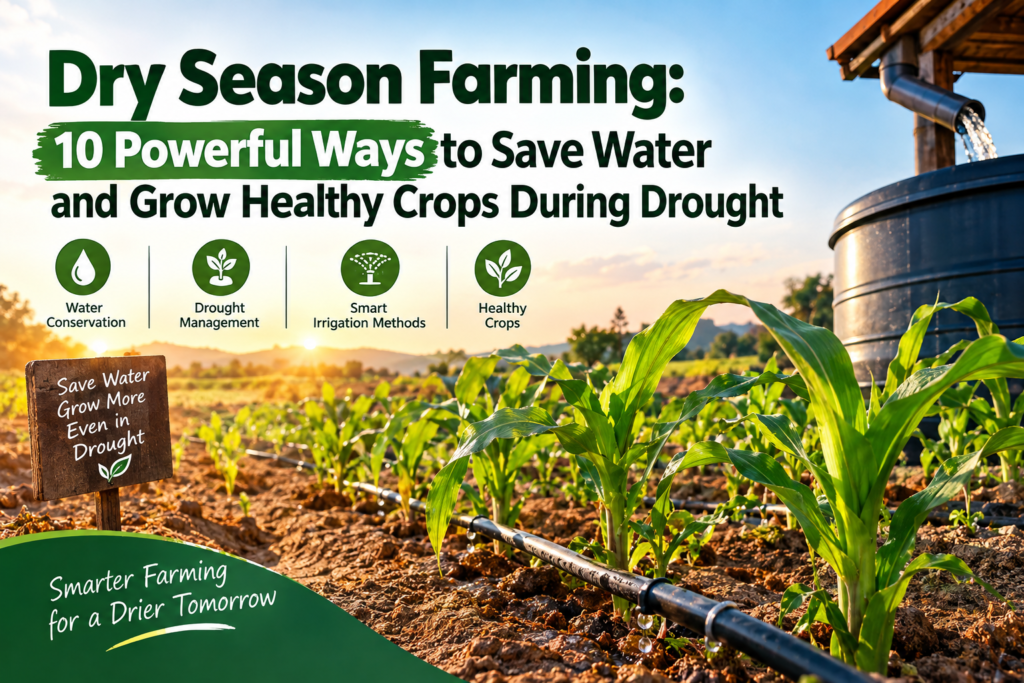
Dry Season Farming
Dry season farming can be both an opportunity and a challenge.
When rainfall becomes scarce, temperatures rise, and the soil begins to lose moisture quickly, farmers have to make every drop of water count. A farm that performed well during the rainy season can suddenly become difficult to manage when natural rainfall disappears.
The problem is not simply that there is less water.
The bigger problem is that water can be lost before crops have a chance to use it.
It can evaporate from exposed soil. It can run away from the root zone. It can be applied unevenly through inefficient irrigation. Weeds can compete with crops for available moisture. Poor soil structure can prevent water from being stored effectively. Even watering at the wrong time of day can reduce the amount of water that actually benefits the crop.
This is why successful dry season farming is not simply about finding a large water source.
It is about learning how to manage, store, distribute and conserve water intelligently.
Water conservation has become increasingly important for agriculture because farmers in many regions are dealing with more uncertain rainfall and periods of water stress. FAO identifies agriculture as the largest user of freshwater globally and emphasizes improving agricultural water management so farmers can produce more reliably with limited water resources.
For small farmers, this does not necessarily mean purchasing expensive technology or constructing a sophisticated irrigation network.
Many effective practices are surprisingly simple.
Mulching, improving soil health, harvesting rainwater, controlling weeds, watering at appropriate times, selecting suitable crops, reducing unnecessary soil disturbance and improving irrigation efficiency can all contribute to better water management.
The goal is not to eliminate water use.
The goal is to make sure that the water you use actually reaches the crop, remains available around the root zone, and contributes to productive growth.
In this guide, we will examine 10 practical ways to conserve water during dry season farming, protect crops from drought and improve the productivity of the water already available on your farm.

What Is Dry Season Farming?
Dry season farming refers to crop production during a period when rainfall is limited or absent and farmers depend more heavily on stored water, irrigation, soil moisture or other water-management practices.
The length and severity of the dry season vary considerably depending on location.
In tropical regions, farmers may experience several months with very little rainfall. In semi-arid areas, the challenge may be even greater because evaporation can be high and water sources may already be limited.
Dry season farming can involve:
- Irrigated vegetable production
- Rice production
- Maize production
- Tomato farming
- Pepper cultivation
- Onion production
- Cucumber farming
- Leafy vegetables
- Fruit production
- Small-scale horticulture
- Nursery production
- Fodder production
The advantage is that farmers may be able to produce crops outside the main rainy season, potentially creating opportunities for income when some other farms are not producing.
However, the cost of water, pumping, labor and irrigation can also increase.
This makes water conservation a central part of successful dry season production.
Dry Season Farming and the Importance of Water Conservation
Water is more than an input in agriculture. It is one of the conditions that determines whether a crop can establish, grow, flower and produce a harvest.
Plants use water for several essential processes.
Water helps plants:
- Transport nutrients
- Maintain cell structure
- Carry out photosynthesis
- Regulate temperature
- Develop roots
- Produce leaves
- Flower and set fruit
- Transport minerals through plant tissues
When water becomes scarce, plants begin to experience stress.
The first signs may not always be dramatic. Leaves may become slightly less vigorous, growth may slow, and plants may develop smaller leaves. As stress continues, wilting, flower drop, poor fruit development and yield reduction can occur.
Severe and prolonged drought stress can eventually kill crops.
That is why farmers should not wait until plants are visibly wilting before thinking about water management.
Good Drought Management begins before severe stress occurs.
Instead of asking:
“How can I get more water?”
A better question is:
“How can I make better use of the water I already have?”
That change in thinking can transform dry season farming.
Dry Season Farming: 10 Powerful Ways to Save Water and Grow Healthy Crops
1. Dry Season Farming Starts With Mulching
One of the simplest water conservation techniques available to farmers is mulching.
Mulch is a protective layer placed on top of the soil around crops.
It can be made from suitable organic materials such as:
- Dry grass
- Straw
- Leaves
- Crop residues
- Chopped plant material
- Composting materials
- Rice husks
- Other locally available plant residues
In some production systems, farmers may also use appropriate manufactured mulching materials.
Why does mulch matter?
Bare soil is exposed directly to sunlight and wind. During hot weather, water close to the soil surface can evaporate quickly.
Mulch creates a protective layer between the soil and the surrounding environment.
This can help:
- Reduce evaporation
- Keep soil cooler
- Protect the soil surface
- Reduce weed growth
- Reduce erosion
- Improve soil organic matter when organic mulch decomposes
- Maintain more favorable moisture conditions around the roots
Mulching is particularly useful in dry season farming because the objective is not simply to apply water but to keep water available for longer.
Imagine two farms receiving the same amount of irrigation.
Farm A leaves the soil completely exposed.
Farm B covers the soil around the crops with an appropriate mulch layer.
The second farm may be able to retain moisture for longer because less water is immediately exposed to evaporation.
However, farmers should use mulch correctly.
Avoid placing large quantities directly against plant stems because excessive moisture around the stem can create conditions favorable to some diseases and pests.
Also ensure that mulch materials are clean and do not introduce troublesome weed seeds or pests.
The important principle is simple:
Do not allow valuable irrigation water to disappear unnecessarily after you have already paid the cost of pumping, carrying or storing it.
2. Dry Season Farming Improves When You Choose the Right Irrigation Methods
Irrigation is often the backbone of dry season farming.
But not all irrigation methods distribute water with the same level of efficiency.
Traditional watering with buckets, cans or hoses may work on very small plots, but larger farms can benefit from systems that deliver water more directly and consistently to the crop root zone.
Some common irrigation methods include:
- Watering cans
- Hose irrigation
- Furrow irrigation
- Basin irrigation
- Sprinkler irrigation
- Drip irrigation
- Micro-irrigation
The best method depends on the crop, soil, farm size, available water, terrain, budget and local conditions.
Drip irrigation
Drip irrigation is particularly interesting for water-saving agriculture because it can deliver water close to the plant’s root zone.
Instead of wetting a large area of the field, properly designed drip systems can release water through emitters near the crop.
This can reduce unnecessary wetting and make irrigation more targeted.
Sprinkler irrigation
Sprinklers distribute water through the air.
They can be useful for certain crops and soil conditions, but hot, dry and windy conditions may increase evaporation losses.
Furrow irrigation
Furrow systems can be inexpensive and practical for some crops, but poor field leveling or excessive application can lead to runoff, deep percolation or uneven distribution.
The important lesson is that the cheapest irrigation system is not always the cheapest system over the entire production cycle.
Farmers should consider:
- Water consumption
- Labor requirements
- Installation costs
- Maintenance
- Crop type
- Field size
- Pumping costs
- Water availability
- Expected yield
- Ease of operation
For small farms, relatively simple water-saving irrigation methods can sometimes provide a practical middle ground between manual watering and expensive automated systems.
3. Dry Season Farming Requires Watering at the Right Time
Knowing how to save water during dry season farming is not only about how much water you apply.
It is also about when you apply it.
Watering during the hottest part of the day can increase evaporation before plants and soil have the opportunity to benefit fully from the water.
In many situations, early morning is a practical irrigation period.
Evening irrigation can also be appropriate in some circumstances, but farmers need to consider humidity, disease pressure, soil drainage and crop characteristics.
The principle is to irrigate when environmental conditions allow more of the water to remain available to the crop.
Farmers should also avoid automatically watering according to the calendar without considering actual soil and crop conditions.
For example, saying:
“I water every day because it is the dry season.”
does not necessarily mean the crop is receiving optimal irrigation.
Instead, examine:
- Soil moisture
- Crop appearance
- Crop growth stage
- Temperature
- Recent irrigation
- Soil type
- Weather conditions
- Root-zone moisture
A sandy soil may lose available water more rapidly than a heavier soil.
A young seedling may have a smaller root system than an established crop.
A fruiting crop may have different water requirements from a leafy vegetable.
Good irrigation management therefore requires observation.
The farmer should learn to recognize what the soil and plants are telling them.
4. Dry Season Farming Becomes More Efficient When You Harvest Rainwater
One of the most overlooked water conservation strategies is collecting water when it is available and storing it for later use.
Rainwater harvesting does not eliminate drought.
But it can create a valuable reserve.
Farmers can potentially collect rainfall from:
- Roofs
- Farm buildings
- Greenhouses
- Suitable paved surfaces
- Carefully designed catchment areas
- Other appropriate surfaces
Water can then be directed into:
- Storage tanks
- Ponds
- Small reservoirs
- Suitable lined storage structures
- Other appropriately designed containers
FAO identifies water harvesting and small-scale storage as important approaches for improving water reliability, particularly where rainfall is variable.
The idea is straightforward:
Capture water when it is abundant and use it when it is scarce.
For a small farm, even modest storage can provide useful flexibility.
For example, harvested rainwater might be used for:
- Nursery irrigation
- Vegetable beds
- Seedling establishment
- Supplemental irrigation
- Emergency watering
- Household-compatible agricultural uses where appropriate
However, farmers should consider water quality and storage safety.
Stored water can become contaminated by animals, debris, chemicals or other pollutants.
Storage structures should therefore be maintained properly.
Farmers should also avoid assuming that every collected water source is automatically safe for every agricultural use.
5. Dry Season Farming Benefits From Better Soil Moisture Management
A farmer may have enough water but still struggle if the soil cannot retain and supply that water effectively.
This is why soil management is a major part of Drought Management.
Healthy soil can act like a storage system.
When soil structure is poor, water may run off the surface or move through the soil in ways that do not provide the desired benefit to crops.
Good soil management can improve infiltration, reduce erosion and help maintain moisture availability.
Important practices can include:
- Adding suitable organic matter
- Using compost where appropriate
- Maintaining soil cover
- Reducing unnecessary soil disturbance
- Managing erosion
- Avoiding severe compaction
- Using crop residues appropriately
- Practicing crop rotation where suitable
Organic matter is particularly important because it can contribute to soil structure and water-holding characteristics.
This does not mean that farmers should simply add huge quantities of organic material.
Materials should be properly prepared and used according to local agronomic recommendations.
The larger principle is that water conservation begins in the soil.
A farm that treats soil as a living production system can often manage water more intelligently than a farm that focuses only on irrigation equipment.
6. Dry Season Farming Requires Serious Weed Control
Weeds may appear harmless, especially when farmers are concentrating on their crops.
But during drought or dry-season conditions, weeds can become serious competitors for limited water.
A weed growing beside a vegetable crop is drawing resources from the same environment.
Weeds can compete for:
- Water
- Nutrients
- Sunlight
- Space
This means weed management is also part of water conservation.
Keeping the farm reasonably free of unnecessary weed competition can help ensure that available moisture is used by the intended crop.
Useful strategies may include:
- Timely hand weeding
- Appropriate mechanical control
- Mulching
- Crop spacing
- Cover crops where suitable
- Integrated weed management
However, weed control should not mean destroying every plant on the farm indiscriminately.
Some vegetation can provide ecological benefits, prevent erosion or support beneficial organisms.
The objective is to control competitive weeds within production areas while maintaining sensible soil and environmental management.
Mulching can be particularly useful because it performs two jobs at once:
- It suppresses some weeds.
- It helps protect soil moisture.
That makes it one of the most practical tools for small-scale dry season farming.
7. Dry Season Farming Works Better When You Choose Crops Carefully
One of the biggest mistakes farmers can make is choosing a crop first and thinking about water later.
During a dry season, the water requirements of the crop should be part of the production decision from the beginning.
This does not mean that farmers should only grow drought-resistant crops.
Instead, crop selection should consider:
- Local climate
- Water availability
- Soil type
- Crop duration
- Market demand
- Expected price
- Pest pressure
- Disease risk
- Irrigation capacity
- Farmer experience
Some crops or varieties may be better adapted to limited-water conditions than others.
Farmers should also consider crop maturity period.
A crop that matures relatively quickly may reduce the length of time that irrigation must be maintained.
However, the fastest crop is not automatically the most profitable.
A farmer should compare production costs with expected market returns.
Why crop planning matters
Suppose a farmer has a limited water source.
Growing a crop with high water demand across a large area may create unnecessary risk.
Instead, the farmer could consider:
- Reducing cultivated area
- Selecting suitable varieties
- Staggering planting
- Growing crops with different maturity periods
- Prioritizing high-value crops
- Reserving water for critical growth stages
This is where Drought Management becomes a business decision as well as an environmental decision.
8. Dry Season Farming Needs a Water Budget
Many farmers know how much money they spend on seed, fertilizer and labor.
But how many know exactly how much water their farm uses?
A simple water budget can change the way you manage a dry-season farm.
A water budget does not have to be complicated.
Start by estimating:
- Available water
- Storage capacity
- Pumping capacity
- Irrigation frequency
- Approximate application volume
- Crop area
- Crop growth stage
- Expected duration of the dry season
Then monitor actual use.
For example, if you have a limited storage tank, you should know approximately how long that water supply can support your farm.
This allows you to make decisions before a crisis occurs.
A simple farm water record could contain:
| Date | Crop | Irrigation Method | Approx. Water Used | Soil Condition | Crop Condition |
|---|---|---|---|---|---|
| Day 1 | Tomato | Drip | Moderate | Slightly dry | Healthy |
| Day 3 | Pepper | Drip | Moderate | Moist | Healthy |
| Day 5 | Tomato | Drip | Moderate | Moist | Good |
| Day 7 | Pepper | Drip | Low | Slightly dry | Good |
The exact volume will depend on the system and crop.
The value of the table is not the numbers themselves.
It is the habit of measuring and observing instead of guessing.
Once you begin keeping records, patterns become visible.
You may discover that:
- Some areas receive too much water.
- Some areas dry faster.
- Certain crops need more frequent irrigation.
- Leaking pipes are wasting water.
- Irrigation can be reduced after rainfall.
- Some crops perform well with less water.
Those observations can improve future decisions.
9. Dry Season Farming Should Protect the Root Zone
Many farmers think about watering the field as a whole.
But crops do not use every drop of water in the field equally.
The root zone is particularly important.
The root zone is the area of soil where the crop’s active roots obtain water and nutrients.
Efficient irrigation should therefore focus on delivering appropriate moisture where the plant can actually access it.
This is one reason water-saving irrigation methods for small farms are becoming increasingly relevant.
Instead of flooding an entire area unnecessarily, farmers can use systems and field layouts that target crop rows or root zones.
This can be particularly useful for:
- Tomatoes
- Peppers
- Cucumbers
- Onions
- Vegetables
- Fruit trees
- Nursery plants
Root-zone management also means avoiding practices that damage roots.
Excessive cultivation, compaction or poor drainage can interfere with root development.
A strong root system can help crops explore available soil moisture more effectively.
The objective is not to keep the entire field saturated.
The objective is to maintain appropriate moisture conditions for healthy crop growth.
10. Dry Season Farming Requires Early Drought Management
Perhaps the most important lesson is this:
Do not wait for drought damage before starting drought management.
By the time a crop is severely wilted, the farmer may already have lost valuable production potential.
Effective Drought Management begins before the worst conditions arrive.
Farmers can prepare by:
- Repairing irrigation systems
- Checking pumps
- Fixing leaking pipes
- Cleaning filters
- Preparing storage tanks
- Improving drainage where necessary
- Applying mulch
- Controlling weeds
- Selecting appropriate crops
- Planning water allocation
- Monitoring soil moisture
- Keeping emergency water reserves where practical
- Adjusting planting schedules
Farmers should also monitor weather information where reliable local forecasts are available.
The purpose is not to predict every drought perfectly.
The purpose is to avoid being surprised by predictable periods of water stress.
FAO describes drought as a slow-onset hazard that can develop over months or longer, making proactive risk management particularly important.
The earlier a farmer identifies water stress, the more options remain available.

How to Save Water During Dry Season Farming Without Sacrificing Crop Health
A common misconception is that water conservation means giving crops less water.
That is not necessarily true.
Good water conservation means reducing waste, not deliberately starving crops.
There is a major difference between:
- Under-irrigation
- Efficient irrigation
Under-irrigation gives crops insufficient water.
Efficient irrigation attempts to deliver the water crops need while reducing unnecessary losses.
To improve efficiency, farmers should consider the entire water journey:
Water source → storage → pump → pipes → field → soil → root zone → plant
Water can be lost at any stage.
For example:
- A leaking pipe loses water before it reaches the field.
- Poor storage can lead to evaporation.
- An inefficient irrigation system can distribute water unevenly.
- Exposed soil can increase evaporation.
- Weeds can consume available moisture.
- Poor soil structure can increase runoff.
Therefore, the best water conservation methods for dry season farming usually involve several practices working together.
Best Water Conservation Methods for Dry Season Farming
The following combination can create a stronger water-management system:
1. Mulching
Protects the soil surface and can reduce evaporation.
2. Efficient irrigation
Delivers water more precisely where crops need it.
3. Rainwater harvesting
Creates additional storage when rainfall is available.
4. Weed management
Reduces unnecessary competition for water.
5. Soil improvement
Helps create conditions that support infiltration and moisture retention.
6. Crop selection
Matches production choices to water availability.
7. Water budgeting
Helps farmers understand how much water they have and where it is going.
8. Irrigation scheduling
Prevents unnecessary watering.
9. Root-zone management
Focuses water where crops can access it.
10. Early drought planning
Provides more options before severe water shortages occur.
The important point is that these strategies should not be viewed separately.
Their real strength comes from combining them.
How to Protect Crops From Drought and Water Shortage
Farmers often ask, how to protect crops from drought and water shortage when the available water is simply not enough.
There is no single solution that works for every farm.
However, several strategies can reduce risk.
Protect young plants first
Young seedlings often have smaller root systems and can be highly vulnerable to water stress.
Prioritize irrigation during establishment when necessary.
A healthy establishment period can give plants a stronger foundation for later growth.
Protect critical growth stages
Some crops are particularly sensitive to water stress during specific stages such as flowering or fruit development.
Farmers should learn the critical stages of the crop they are growing and plan water availability accordingly.
Keep soil covered
Bare soil can lose moisture more rapidly.
Mulching and appropriate soil-cover practices can therefore contribute to drought protection.
Reduce unnecessary competition
Weeds can consume water that crops need.
Effective weed management can therefore become part of drought protection.
Avoid overplanting
Planting a larger area than your water supply can support may create problems later.
It is often better to match farm size with realistic water availability.
Monitor crops every day
Do not wait until severe wilting appears.
Look for:
- Drooping leaves
- Slow growth
- Leaf curling
- Flower drop
- Poor fruit development
- Dry soil
- Reduced vigor
These signs can indicate that the crop is experiencing stress.
Comparing Irrigation Methods for Dry Season Farming
Different irrigation methods have different strengths and weaknesses.
| Irrigation Method | Main Advantage | Main Challenge | Suitable Consideration |
|---|---|---|---|
| Watering Can | Low starting cost | Labor intensive | Very small farms and gardens |
| Hose Irrigation | Simple and flexible | Can waste water if poorly managed | Small plots |
| Furrow Irrigation | Relatively simple | Uneven distribution may occur | Suitable field crops and appropriate soils |
| Sprinkler | Broad coverage | Wind and evaporation can reduce efficiency | Certain vegetables and field crops |
| Drip Irrigation | Targets root zone | Installation and maintenance required | Vegetables, fruit and high-value crops |
| Micro-Irrigation | Precise application | Requires system management | Small farms and horticulture |
There is no universal irrigation method that is automatically best for every farm.
Farmers should evaluate the system according to:
- Farm size
- Crop type
- Soil
- Water availability
- Terrain
- Labor
- Energy costs
- Capital
- Maintenance requirements
A farmer with a tiny vegetable garden may not need a complicated automated irrigation system.
Likewise, a commercial vegetable producer may find that manually carrying water becomes increasingly expensive as the cultivated area expands.
The right system is the one that balances water efficiency, affordability, reliability and crop requirements.
Dry Season Farming and Soil Health: The Connection Many Farmers Miss
It is easy to think about water conservation as an irrigation problem.
But soil is equally important.
A farmer can pump water onto a field and still waste much of it if the soil is poorly managed.
Healthy soils can improve infiltration, reduce runoff and support water availability around crop roots.
Soil management practices can include:
- Adding organic matter
- Reducing unnecessary disturbance
- Maintaining cover
- Preventing erosion
- Avoiding excessive compaction
- Rotating crops
- Using appropriate residues
Conservation agriculture emphasizes maintaining soil cover, minimizing soil disturbance and diversifying crops.
These practices can contribute to better water and nutrient use.
The lesson is powerful:
You do not conserve water only by changing the irrigation system. You also conserve water by improving the soil that receives the water.
The Role of Organic Matter in Dry Season Farming
Organic matter is frequently discussed in conversations about soil fertility.
But it also matters for water management.
Soils with better structure can provide more favorable conditions for infiltration and water storage.
Sources of organic matter may include:
- Compost
- Properly decomposed manure
- Crop residues
- Plant materials
- Other locally appropriate organic inputs
Farmers should avoid applying fresh or unsuitable materials without understanding their effects.
Poorly managed manure or organic waste can create problems involving pests, pathogens, nutrients or crop damage.
The goal is not simply “more organic matter.”
The goal is healthy, well-managed soil.
Water Conservation Does Not Mean Over-Irrigating
There is another side to water management that deserves attention.
Farmers sometimes assume that more water automatically means healthier crops.
It does not.
Over-irrigation can cause problems such as:
- Waterlogging
- Root problems
- Nutrient leaching
- Increased disease risk
- Soil degradation
- Higher pumping costs
- Unnecessary water consumption
Good irrigation should provide enough moisture for crop needs without creating unnecessary excess.
This is why observation is so important.
The farmer should ask:
Does the crop actually need more water?
rather than:
Is it time to water because I always water at this hour?
That simple difference can save water and money.
How Small Farms Can Adopt Water-Saving Irrigation Methods
Not every farmer can afford an expensive irrigation system.
Fortunately, water efficiency does not always require the most sophisticated technology.
Small farms can begin with practical improvements.
Start with leaks
Inspect:
- Hoses
- Pipes
- Connections
- Tanks
- Valves
- Pumps
- Emitters
A small leak that appears insignificant can waste substantial water over time.
Improve field layout
Arrange crops in ways that make irrigation easier.
Rows should be planned with the irrigation method in mind.
Use mulch
Mulching can reduce the amount of irrigation water needed to maintain favorable soil moisture.
Water according to crop needs
Avoid watering simply because a schedule says so.
Observe soil and plants.
Upgrade gradually
A farmer does not necessarily need to convert the entire farm to a new system immediately.
A practical approach can be:
- Test the system on a small section.
- Measure results.
- Identify problems.
- Improve the design.
- Expand gradually.
This reduces financial risk and allows farmers to learn before making larger investments.
Dry Season Farming: How to Create a Simple Farm Water Plan
A practical water plan can be developed in several steps.
Step 1: Identify your water sources
List every reliable source.
For example:
- Borehole
- Well
- Stream
- Reservoir
- Tank
- Harvested rainwater
- Approved alternative sources
Step 2: Estimate available storage
Know how much water your tanks, ponds or other storage systems can hold.
Step 3: Calculate the cultivated area
A small vegetable plot has very different water requirements from a large field.
Step 4: List your crops
Record:
- Crop type
- Variety
- Planting date
- Growth stage
- Expected harvest date
Step 5: Identify the irrigation method
Record which method is being used for each crop.
Step 6: Monitor soil moisture
Do not rely entirely on appearance.
Inspect the soil around the active root zone.
Step 7: Record irrigation
Write down:
- Date
- Crop
- Duration
- Approximate amount
- Weather conditions
- Soil condition
Step 8: Review weekly
Ask:
- Where are we wasting water?
- Which crop uses the most?
- Are any pipes leaking?
- Is the soil staying wet too long?
- Are crops showing stress?
- Can irrigation frequency be adjusted?
This turns water conservation into a management process rather than a guess.
Common Dry Season Farming Mistakes That Waste Water
Even farmers who understand the importance of water conservation can accidentally waste large amounts.
Mistake 1: Irrigating during extreme heat
High temperatures can increase water losses.
Mistake 2: Leaving soil completely exposed
Bare soil is more vulnerable to evaporation and erosion.
Mistake 3: Ignoring leaks
A leaking pipe or connection can continuously waste water.
Mistake 4: Watering weeds
If weeds dominate the field, part of the water is supporting unwanted plants.
Mistake 5: Over-irrigating
More water does not always mean better growth.
Mistake 6: Planting more land than the water supply can support
This can become disastrous when the dry season lasts longer than expected.
Mistake 7: Ignoring soil condition
Poor soil management can reduce the effectiveness of irrigation.
Mistake 8: Waiting for visible drought damage
By the time crops are severely stressed, recovery may be difficult.
Mistake 9: Using the same irrigation schedule for every crop
Different crops and growth stages have different requirements.
Mistake 10: Failing to keep records
Without records, farmers may repeat the same mistakes each season.
Dry Season Farming and Climate-Smart Agriculture
The future of dry season farming will increasingly depend on efficient resource management.
Climate variability can make traditional assumptions about rainfall less reliable.
Farmers therefore need systems that can cope with uncertainty.
Climate-smart approaches can include:
- Improved irrigation efficiency
- Water harvesting
- Soil moisture conservation
- Drought-tolerant crop varieties
- Better soil management
- Crop diversification
- Improved weather information
- Efficient water storage
- Better farm planning
This does not mean every farmer must immediately adopt expensive technology.
Climate-smart farming can begin with simple decisions.
Cover the soil.
Fix the leak.
Harvest available rainwater.
Reduce unnecessary irrigation.
Choose crops carefully.
Monitor soil moisture.
Protect the root zone.
Those small decisions can become part of a much larger resilience strategy.

Is Drip Irrigation Always the Best Choice for Dry Season Farming?
Drip irrigation is often promoted as a water-saving solution, and it can be highly useful.
But farmers should avoid thinking of any irrigation technology as a magic solution.
A drip system can still waste water if:
- Emitters are damaged
- Pipes leak
- Pressure is poorly managed
- The system is badly designed
- Filters are not maintained
- Irrigation runs unnecessarily long
- Water is applied without considering crop needs
Installation is only one part of irrigation efficiency.
Management is equally important.
A well-managed simple system can sometimes outperform a sophisticated system that is poorly maintained.
The best approach is to evaluate the entire system rather than simply purchasing equipment because it is marketed as “water saving.”
How Mulching and Irrigation Work Together
One of the strongest strategies for dry season farming is combining practices rather than depending on one technique.
Consider the combination:
Drip irrigation + mulch + good soil + weed control
Drip irrigation delivers water near the crop.
Mulch helps protect the soil surface.
Healthy soil supports infiltration and moisture retention.
Weed control reduces competition.
Each practice addresses a different source of water loss.
This is the real secret behind effective water conservation.
You are not looking for one magical solution.
You are reducing multiple forms of waste at the same time.
FAO examples of drought-prone farming systems also demonstrate the value of combining practices such as rainwater collection, drip irrigation and mulching rather than relying on one intervention alone.
Dry Season Farming: How Technology Can Improve Water Management
Technology can make water management more precise.
Depending on the scale of the farm, farmers may use:
- Soil-moisture sensors
- Flow meters
- Automated irrigation controllers
- Weather stations
- Mobile weather applications
- Remote sensing
- Smart irrigation systems
However, technology should solve a real farm problem.
A farmer should not purchase a sensor simply because it is modern.
Ask:
- What problem will this device solve?
- Can I maintain it?
- Is it affordable?
- Will it reduce water use?
- Will it improve yields?
- Can I understand the information it provides?
For small farms, simple technology may be enough.
For example, measuring irrigation flow and keeping good records can provide valuable information without requiring a complex digital system.
Dry Season Farming and the Economics of Water Conservation
Water conservation is not only about protecting the environment.
It can also protect the farmer’s finances.
Consider the costs associated with irrigation:
- Fuel
- Electricity
- Pump maintenance
- Equipment
- Labor
- Water storage
- Pipe replacement
- Irrigation equipment
If a farmer uses less water while maintaining healthy production, the savings can potentially improve profitability.
Suppose a farmer pumps water from a borehole.
Every unnecessary hour of pumping may involve additional energy costs.
Therefore, reducing unnecessary irrigation can save both:
Water + Money
This is especially important when fuel or electricity costs are high.
A good water-management system should therefore be evaluated not only by how much water it saves but also by whether it makes economic sense.
A Practical Dry Season Farming Checklist
Before the dry season becomes severe, walk around the farm and ask the following questions.
Water source
- Is the water source reliable?
- How much water is available?
- Is the water quality suitable for the intended use?
- Is the source becoming weaker?
Storage
- Are tanks functioning properly?
- Are ponds or reservoirs adequately maintained?
- Are there leaks?
- Is there enough storage for short dry spells?
Irrigation
- Which irrigation methods are being used?
- Are pipes leaking?
- Are emitters functioning?
- Is water reaching the root zone?
- Is irrigation occurring at appropriate times?
Soil
- Is the soil covered?
- Is mulch available?
- Is organic matter being managed appropriately?
- Is erosion occurring?
- Is the soil compacted?
Crops
- Are the selected crops appropriate for the available water?
- Which crops are most sensitive to drought?
- Which crops require priority irrigation?
- What are the critical growth stages?
Weeds
- Are weeds competing with crops?
- Can mulching reduce weed pressure?
- Is weed management being performed early?
Monitoring
- Are irrigation records being kept?
- Is soil moisture being monitored?
- Are crop stress symptoms being recorded?
This checklist can help turn Drought Management from an emergency reaction into routine farm planning.
A Simple 10-Point Water Conservation Plan for Small Farms
If you want a simple strategy that can be implemented without overwhelming yourself, begin here:
- Cover the soil with appropriate mulch.
- Repair leaks before the dry season intensifies.
- Use an irrigation method suited to the crop and farm.
- Water according to crop and soil conditions.
- Harvest and store suitable rainwater where practical.
- Control weeds before they become established.
- Improve soil organic matter and structure appropriately.
- Choose crops according to water availability and market conditions.
- Keep a simple record of irrigation and crop condition.
- Prepare a drought plan before severe water shortage occurs.
None of these practices works in isolation.
Their combined effect is what makes them powerful.
Frequently Asked Questions About Dry Season Farming
What is the best way to save water during dry season farming?
There is no single method that is best for every farm. A combination of efficient irrigation, mulching, soil-moisture conservation, weed management, rainwater harvesting and appropriate crop selection can provide a stronger water-management strategy.
How can farmers protect crops from drought?
Farmers can protect crops by planning water supplies early, using suitable irrigation methods, conserving soil moisture, controlling weeds, selecting appropriate crops and prioritizing water during sensitive growth stages.
Is drip irrigation good for dry season farming?
Drip irrigation can be highly useful because it can deliver water close to crop root zones. However, its effectiveness depends on proper design, installation, maintenance and irrigation scheduling.
Does mulch really save water?
Mulching can reduce evaporation from the soil surface and help maintain more favorable soil-moisture conditions. It can also suppress some weeds and protect the soil from extreme surface conditions.
How often should crops be watered during the dry season?
There is no universal schedule. Irrigation frequency depends on crop type, soil, weather, growth stage, irrigation system and available moisture. Farmers should monitor the root-zone soil condition and crop response instead of relying only on a fixed schedule.
Can rainwater harvesting help during drought?
Rainwater harvesting can provide stored water for later use. It is particularly useful when rainfall occurs intermittently and suitable storage is available.
What crops are suitable for dry season farming?
Suitable crops depend heavily on local climate, soil, water availability, market demand and available irrigation. Farmers should choose crops and varieties that match their local conditions rather than relying on a universal list.
How can small farmers conserve irrigation water?
Small farmers can start by fixing leaks, using mulch, improving soil condition, managing weeds, watering at appropriate times, selecting efficient irrigation methods and monitoring water use.
Does more irrigation always increase yield?
No. Crops need adequate water, but excessive irrigation can create problems such as waterlogging, nutrient losses and unnecessary costs.
Why is soil important for water conservation?
Soil determines how water infiltrates, is stored and becomes available to plant roots. Improving soil structure and maintaining soil cover can contribute to better water management.
Final Thoughts: The Future of Dry Season Farming Is About Producing More With Less Waste
Successful dry season farming is not simply a competition to find the biggest water source.
It is a discipline of managing limited resources intelligently.
A farmer who pumps enormous quantities of water but loses much of it through evaporation, leakage, runoff or unnecessary irrigation may not actually be managing water efficiently.
Another farmer with a smaller water supply may achieve good results by combining:
- Efficient irrigation
- Mulching
- Healthy soil
- Weed control
- Water harvesting
- Crop planning
- Good timing
- Water monitoring
- Drought preparation
That is the deeper lesson behind water conservation.
The question is not always:
“How much water do I have?”
Sometimes the more important question is:
“How much productive value can I get from the water I have?”
As water availability becomes more uncertain in many agricultural regions, this distinction will become increasingly important.
Farmers who understand their soil, monitor their crops, manage their irrigation and plan for drought are better positioned to respond when rainfall fails to arrive.
The good news is that many of the most useful practices do not require sophisticated equipment.
A layer of mulch.
A repaired pipe.
A properly planned irrigation schedule.
A small rainwater storage system.
Better soil management.
Timely weed control.
A simple farm record.
These may look like small decisions individually, but together they can create a much more resilient production system.
Ultimately, the goal of dry season farming should not be simply to keep crops alive.
It should be to create a system in which every available resource—from water and soil to labor and money—is used as efficiently as possible to produce healthy crops and sustainable farm income.
That is what makes water conservation more than an environmental idea.
It becomes a practical farming strategy for the future.
For further technical guidance, the two primary sources used for this article are the Food and Agriculture Organization (FAO) resources on agricultural water management and drought management, which discuss water conservation, irrigation, rainwater harvesting and drought resilience. (FAOHome)
FAO — Agricultural Water Management
About The Author