Animal Welfare Technology
Modern livestock farming is experiencing one of the most significant transformations in agricultural history. For decades, commercial animal production focused primarily on maximizing output, increasing efficiency, and reducing costs. While these objectives remain important, a new priority has emerged that is reshaping the industry from the ground up: animal welfare.
Consumers today are more informed than ever before. They want to know how animals are raised, what conditions they live in, and whether ethical standards are being maintained throughout the production process. Governments, regulatory bodies, and food retailers are also implementing stricter welfare standards that require farmers to adopt more responsible practices.
This shift has created the perfect environment for the rise of Animal Welfare Technology, a rapidly growing field that combines artificial intelligence, sensors, automation, data analytics, and precision agriculture to improve the lives of farm animals while enhancing productivity.
The result is a farming revolution where technology not only helps farmers make better decisions but also ensures animals receive better care than ever before.
In this guide, we will explore eight groundbreaking innovations driving this transformation and examine how Precision Livestock Farming, Smart LivestockFarming, and Livestock Monitoring Systems are shaping the future of ethical commercial animal production through 2027.

Why Animal Welfare Technology Matters More Than Ever
The modern agricultural industry faces several challenges simultaneously:
- Rising global demand for animal protein
- Increasing consumer concern for animal welfare
- Labor shortages on farms
- Growing environmental pressures
- Stricter regulatory requirements
- The need for sustainable production methods
Traditional livestock management methods often rely heavily on manual observation. While experienced farmers possess remarkable instincts, it is impossible for humans to monitor thousands of animals around the clock.
This is where Animal Welfare Technology provides a transformative solution.
Through real-time monitoring and data-driven insights, farmers can identify welfare concerns before they become serious problems, creating healthier animals and more efficient operations.
How Precision Livestock Farming Improves Animal Welfare and Productivity
Before exploring the innovations themselves, it is important to understand the concept of Precision Livestock Farming (PLF).
Precision Livestock Farming refers to the use of advanced technologies that continuously monitor animals, their environment, and production systems.
These technologies collect massive amounts of data that help farmers:
- Detect illness early
- Monitor feeding behavior
- Track movement patterns
- Improve reproductive performance
- Reduce animal stress
- Optimize environmental conditions
The beauty of Precision Livestock Farming is that improved welfare and improved productivity often go hand in hand.
Healthy animals typically:
- Grow faster
- Produce more milk
- Have better reproductive performance
- Require fewer medical interventions
- Experience lower mortality rates
This creates a win-win situation for farmers, consumers, and animals alike.
Animal Welfare Technology: 8 Powerful and Inspiring Innovations in Smart Livestock Farming Transforming Commercial Animal Production Through 2027
Animal Welfare Technology Innovation #1: AI-Powered Animal Welfare Monitoring Systems for Commercial Farms
One of the most exciting developments in agriculture is the emergence of AI-powered animal welfare monitoring systems for commercial farms.
Artificial intelligence can now analyze thousands of behavioral indicators simultaneously.
These systems monitor:
- Eating habits
- Drinking behavior
- Movement patterns
- Social interactions
- Resting times
- Vocalizations
When unusual behavior is detected, alerts are sent directly to farm managers.
For example:
A dairy cow showing reduced feeding activity may be developing an illness.
Instead of waiting for visible symptoms, farmers can intervene immediately.
Benefits include:
- Faster disease detection
- Reduced suffering
- Lower veterinary costs
- Increased productivity
- Better welfare outcomes
Organizations like the World Organisation for Animal Health provide extensive guidance on animal welfare standards and monitoring practices that support these technological advancements.https://www.woah.org
Animal Welfare Technology Innovation #2: Smart Livestock Farming Through Wearable Sensors
Wearable technology is no longer limited to humans.
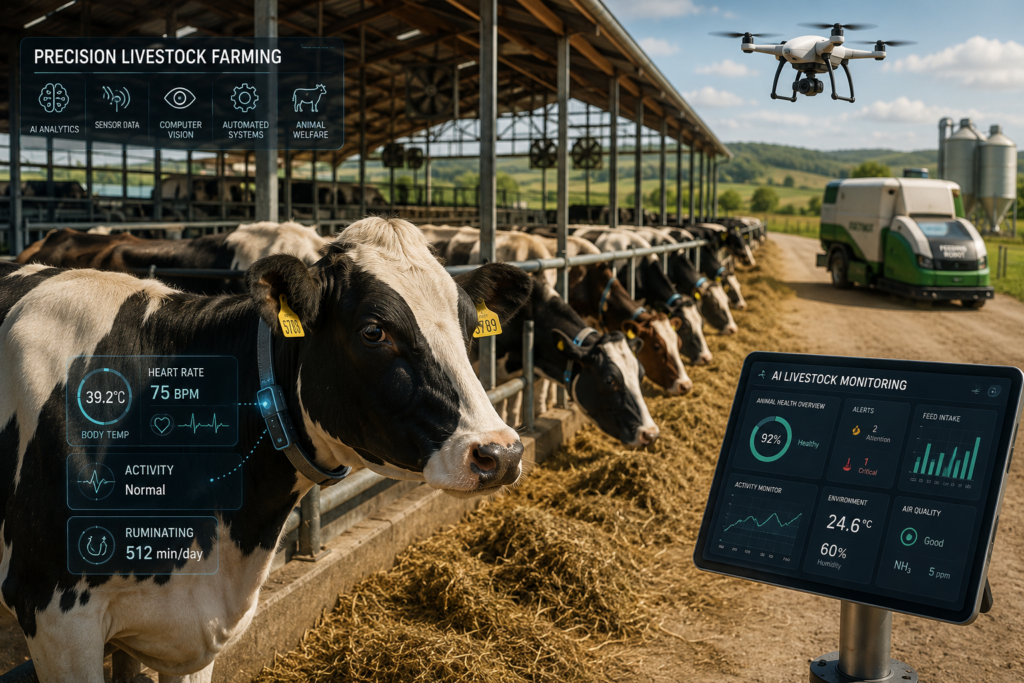
Today, livestock animals can wear sophisticated sensors that continuously collect data.
Examples include:
- Smart collars
- Ear tags
- Leg bands
- GPS trackers
- Biometric monitoring devices
These sensors track:
- Body temperature
- Heart rate
- Activity levels
- Feeding behavior
- Reproductive cycles
In dairy farming, smart collars can identify cows entering heat with remarkable accuracy.
This improves breeding efficiency while reducing stress associated with manual detection methods.
The result is more humane and productive farming.
Animal Welfare Technology Innovation #3: Livestock Monitoring Systems Using Computer Vision
Computer vision technology is transforming how farmers observe animals.
Advanced cameras powered by artificial intelligence can:
- Track animal movement
- Detect injuries
- Monitor body condition
- Identify lameness
- Analyze social behavior
Unlike human observation, these systems operate 24 hours a day.
Computer vision technology can identify subtle behavioral changes that may indicate illness long before visible symptoms emerge.
This proactive approach significantly improves welfare outcomes.
Animal Welfare Technology Innovation #4: Smart Livestock Monitoring Technology for Ethical Animal Production
Ethical animal production depends heavily on understanding how animals interact with their environment.
Modern Smart Livestock Monitoring Technology for Ethical Animal Production enables farmers to measure:
- Barn temperature
- Humidity levels
- Air quality
- Ventilation effectiveness
- Lighting conditions
- Noise levels
These environmental factors directly affect animal welfare.
For example:
Poor ventilation can increase respiratory diseases.
High temperatures can cause heat stress.
Excessive noise can create anxiety.
Smart monitoring systems continuously adjust environmental controls to maintain optimal conditions.
Comparison Table: Traditional Farming vs Smart Livestock Farming
| Factor | Traditional Farming | Smart Livestock Farming |
|---|---|---|
| Animal Monitoring | Manual Observation | Real-Time AI Monitoring |
| Disease Detection | Reactive | Predictive |
| Labor Requirements | High | Reduced |
| Welfare Assessment | Periodic | Continuous |
| Productivity Insights | Limited | Data-Driven |
| Environmental Control | Manual | Automated |
| Decision Making | Experience-Based | Data-Based |
| Animal Health Outcomes | Variable | Improved |
Animal Welfare Technology Innovation #5: Automated Feeding Systems
Nutrition is one of the most important factors affecting animal welfare.
Automated feeding systems now allow farmers to provide individualized nutrition.
Benefits include:
- Reduced competition among animals
- Improved feed efficiency
- Better growth rates
- Enhanced welfare
- Reduced waste
These systems use AI algorithms to determine optimal feeding schedules based on:
- Animal age
- Weight
- Health status
- Production goals
Animals receive exactly what they need when they need it
Animal Welfare Technology Innovation #6: Precision Livestock Farming and Predictive Health Analytics
Predictive analytics is becoming one of the most powerful tools in livestock management.
By analyzing historical and real-time data, AI systems can predict:
- Disease outbreaks
- Health deterioration
- Reproductive issues
- Stress-related conditions
This allows farmers to intervene before problems become severe.
Benefits include:
- Reduced mortality
- Lower medication usage
- Better welfare standards
- Increased profitability
Predictive health management represents a major step toward preventative animal care

Animal Welfare Technology Innovation #7: Robotic Animal Care Systems
Robotics is beginning to play a major role in commercial farming.
Examples include:
- Robotic milkers
- Automated cleaning systems
- Feed delivery robots
- Health monitoring robots
These systems improve consistency while reducing labor pressures.
For animals, this often means:
- More predictable routines
- Reduced stress
- Improved hygiene
- Better health outcomes
Robotic milking systems are particularly beneficial because cows can choose when they want to be milked rather than following rigid schedules.
Animal Welfare Technology Innovation #8: Blockchain and Welfare Transparency Systems
Consumers increasingly want proof that animal welfare claims are genuine.
Blockchain technology provides a transparent record of welfare-related data throughout the supply chain.
Information can include:
- Farm conditions
- Veterinary treatments
- Feeding practices
- Transportation records
- Welfare certifications
This transparency builds consumer trust while encouraging higher welfare standards across the industry.
The Food and Agriculture Organization (FAO) continues to highlight the importance of digital technologies and sustainable livestock systems in improving food security and animal welfare worldwide.https://www.fao.org
Best Animal Welfare Innovations Transforming Commercial Farming in 2026 and Beyond
Several trends are accelerating adoption of welfare-focused technologies:
Growing Consumer Awareness
Consumers increasingly support brands that demonstrate ethical production practices.
Regulatory Evolution
Governments worldwide continue strengthening animal welfare regulations.
Artificial Intelligence Advancements
AI capabilities improve each year, making monitoring systems more accurate and affordable.
Sustainability Goals
Welfare improvements often align with environmental sustainability objectives.
Data-Driven Agriculture
Farmers increasingly rely on analytics to optimize operations.
Challenges Facing Animal Welfare Technology Adoption
Despite enormous benefits, adoption is not without obstacles.
Common challenges include:
High Initial Investment
Advanced technologies often require significant upfront costs.
Data Management Complexity
Managing large datasets requires specialized knowledge.
Connectivity Issues
Rural areas may experience internet limitations.
Training Requirements
Farm workers need education and training to maximize benefits.
However, as technology becomes more accessible, these barriers continue to decrease.
The Future of Smart Livestock Farming Through 2027
Looking ahead, several developments are likely to reshape the industry even further.
Emerging technologies include:
- Advanced AI behavior prediction
- Autonomous livestock management systems
- Digital animal twins
- Enhanced computer vision capabilities
- Integrated welfare certification platforms
- Real-time welfare scoring systems
Future farms will likely combine multiple technologies into unified management platforms.
Rather than monitoring individual welfare indicators separately, farmers will gain comprehensive dashboards that provide a complete picture of animal well-being.
This integration will allow faster decisions, better outcomes, and greater transparency.
Animal Welfare Technology and the Rise of AI-Powered Livestock Health Monitoring
The livestock industry is undergoing a remarkable transformation, driven by advances in technology that are changing how farmers care for animals. For generations, livestock management relied heavily on visual observation, experience, and routine inspections. While these traditional methods have served farmers well, they often make it difficult to detect health issues at their earliest stages. By the time symptoms become visible, an illness may have already affected an animal’s welfare, productivity, and overall health. This challenge has paved the way for one of the most exciting developments in modern agriculture: AI-powered livestock health monitoring.
At the heart of this revolution is Animal Welfare Technology, a rapidly expanding field that combines artificial intelligence, sensors, machine learning, and data analytics to improve the lives of farm animals. These technologies are enabling farmers to monitor livestock more closely than ever before, providing real-time insights into animal health, behavior, and well-being. The result is a more proactive approach to animal care that benefits both animals and producers.
Why Traditional Monitoring Methods Are No Longer Enough
Commercial farms today often manage hundreds or even thousands of animals. Monitoring each animal individually can be a difficult and time-consuming task. Even the most experienced farmer cannot observe every movement, feeding habit, or behavioral change around the clock.
This limitation creates a significant challenge because animals frequently show subtle signs of illness before obvious symptoms appear. Reduced activity, slight changes in feeding behavior, altered movement patterns, or minor fluctuations in body temperature may all indicate an emerging health issue. Unfortunately, these early warning signs can easily go unnoticed in large-scale operations.
AI-powered monitoring systems address this problem by continuously collecting and analyzing data. Instead of relying solely on periodic human observation, farmers gain access to 24/7 surveillance and health tracking that can identify problems much earlier than traditional methods.
How AI-Powered Livestock Health Monitoring Works
Modern Livestock Monitoring Systems use a combination of technologies to gather information about animals and their environment. These systems typically include wearable devices, cameras, environmental sensors, and cloud-based software platforms.
Some of the most commonly monitored indicators include:
- Activity levels
- Feeding patterns
- Water consumption
- Body temperature
- Heart rate
- Weight changes
- Movement behavior
- Resting periods
- Social interactions
Artificial intelligence processes this information and compares it against normal behavioral patterns. When unusual activity is detected, the system generates alerts that notify farmers or farm managers.
For example, if a dairy cow suddenly reduces its feed intake or becomes less active than usual, the AI system can flag this behavior as a potential health concern. Farmers can then investigate and take action before the condition worsens.
Wearable Technology Is Revolutionizing Animal Welfare
One of the most visible aspects of Smart Livestock Farming is the growing use of wearable technology. Similar to fitness trackers used by humans, livestock wear smart devices that continuously collect health and behavioral data.
These devices may include:
- Smart collars
- Ear tags
- Leg sensors
- GPS trackers
- Biometric monitoring devices
The information gathered by these wearables provides valuable insights into animal well-being. For instance, smart collars can detect changes in rumination patterns in cattle. Since rumination is closely linked to digestive health, any unusual changes can indicate illness, stress, or nutritional problems.
In addition to health monitoring, wearable devices also assist with reproductive management. By tracking activity levels and behavior, AI systems can accurately identify breeding periods, improving reproductive success while reducing stress associated with manual monitoring methods.
Computer Vision Is Giving Farmers a New Perspective
Artificial intelligence is not limited to wearable devices. Computer vision technology is becoming a powerful tool for animal welfare monitoring.
Using strategically placed cameras, AI systems can observe animals continuously without disrupting their natural behavior. These cameras analyze images and video footage to detect changes that may indicate health or welfare issues.
Computer vision systems can identify:
- Lameness
- Injuries
- Aggressive interactions
- Feeding behavior
- Mobility issues
- Body condition changes
One of the greatest advantages of computer vision is its ability to monitor large groups of animals simultaneously. This makes it particularly valuable for commercial farms where manual observation would be difficult or impossible on a continuous basis.
By identifying problems early, farmers can provide treatment sooner, reducing suffering and improving recovery outcomes.
Early Disease Detection Saves Lives
Perhaps the most significant benefit of AI-powered monitoring is early disease detection.
Diseases often progress gradually, with subtle signs appearing before obvious symptoms develop. AI systems excel at identifying these small changes because they continuously analyze large amounts of data.
Conditions that can be detected earlier include:
- Respiratory infections
- Digestive disorders
- Mastitis in dairy cattle
- Heat stress
- Metabolic diseases
- Mobility problems
Early intervention offers several important advantages:
- Reduced animal suffering
- Lower mortality rates
- Improved treatment success
- Reduced veterinary expenses
- Decreased use of medications
- Better overall herd health
From an animal welfare perspective, preventing severe illness is far preferable to treating advanced disease after significant suffering has already occurred.
Environmental Monitoring Enhances Welfare Outcomes
Animal health is closely linked to environmental conditions. Factors such as temperature, humidity, air quality, and ventilation can significantly impact welfare and productivity.
Modern AI systems integrate environmental monitoring into their livestock management platforms. Sensors placed throughout barns and housing facilities continuously collect environmental data.
These systems can automatically identify conditions that may pose risks to animals, including:
- Excessive heat
- Poor air circulation
- High humidity
- Harmful gas concentrations
- Inadequate ventilation
When environmental issues arise, farmers receive alerts that allow them to make immediate adjustments. Some advanced systems can even automate climate control functions to maintain optimal conditions.
This proactive approach helps reduce stress and supports healthier living environments for livestock.
The Connection Between Animal Welfare and Productivity
A common misconception is that animal welfare initiatives increase costs without providing financial benefits. In reality, improving welfare often leads to higher productivity and profitability.
Healthy animals tend to:
- Eat more consistently
- Grow more efficiently
- Produce higher-quality products
- Experience fewer illnesses
- Require less medical treatment
- Reproduce more successfully
This demonstrates how precision livestock farming improves animal welfare and productivity simultaneously.
By using AI-powered systems to identify issues early and maintain optimal conditions, farmers create an environment where animals can thrive. Better welfare leads to healthier animals, and healthier animals contribute to stronger farm performance.
Looking Ahead: The Future of AI-Powered Animal Welfare Monitoring
The future of Animal Welfare Technology is incredibly promising. As artificial intelligence becomes more sophisticated, monitoring systems will continue to evolve.
Future innovations may include:
- Predictive health forecasting
- Automated welfare scoring
- Digital animal twins
- Advanced behavior recognition
- Autonomous farm management systems
- Enhanced real-time diagnostics
These technologies will provide even deeper insights into animal well-being, allowing farmers to move from reactive management to fully preventative care.
The rise of AI-powered animal welfare monitoring systems for commercial farms represents a major step forward for the livestock industry. By combining artificial intelligence, wearable technology, computer vision, and environmental monitoring, farmers can provide a higher standard of care while improving efficiency and productivity.
As the demand for ethical and sustainable farming continues to grow, AI-powered monitoring will play an increasingly important role in shaping the future of commercial animal production. It is not simply a technological advancement; it is a new way of thinking about animal welfare, one that places prevention, precision, and compassion at the center of modern agriculture.
Conclusion: Animal Welfare Technology Is Reshaping the Future of Ethical Farming
The future of commercial livestock production is no longer defined solely by productivity. It is increasingly defined by how effectively farms balance productivity with responsibility.
The rise of Animal Welfare Technology demonstrates that profitability and compassion are not opposing goals. Through Precision Livestock Farming, Smart Livestock Farming, and advanced Livestock Monitoring Systems, farmers can improve animal health, reduce suffering, increase operational efficiency, and meet growing consumer expectations.
The eight innovations discussed in this guide represent only the beginning of a much larger transformation. Artificial intelligence, predictive analytics, robotics, wearable sensors, computer vision, environmental monitoring, blockchain transparency, and automated care systems are collectively creating a future where animals receive unprecedented levels of care.
As adoption accelerates through 2027, farms that embrace these technologies will likely become leaders in both productivity and ethical animal production. The result will be a more sustainable, transparent, and humane agricultural system that benefits farmers, consumers, and, most importantly, the animals themselves.
About The Author