Agriculture Terms
Starting a farm can feel exciting.
You may already have a piece of land, a farming idea, seeds, livestock, equipment, or even a business plan. You may have watched farming videos, spoken with experienced farmers, or read several articles about crop production. Yet there is one thing that can quietly hold a beginner back: not understanding the language of agriculture.
Farmers, agricultural extension officers, researchers, agribusiness owners, suppliers, and policymakers regularly use words that may sound confusing to someone who is just entering the industry.
Words such as crop rotation, soil health, irrigation, yield, livestock, pest management, organic farming, agroforestry, precision agriculture, climate-smart agriculture, and sustainable agriculture are not simply technical expressions. They describe real practices and ideas that can influence what happens on a farm.
This is why understanding Agriculture Terms is so important.
Imagine that a farmer is told to improve soil health through crop rotation and cover crops. A beginner who does not understand those terms may have no idea what action to take. Another farmer might hear that a farm should adopt climate-smart practices but may not understand what that means in practical terms.
Learning Farming Terms gives beginners a foundation for understanding agricultural information and communicating more confidently with other people in the farming industry.
It also becomes increasingly important as agriculture changes.
Modern farming is no longer limited to a farmer, a hoe, a piece of land, and a bag of seeds. Agriculture now increasingly involves improved irrigation, digital technologies, farm machinery, soil testing, weather information, data collection, protected cultivation, improved crop varieties, conservation practices, and other technologies.
The Food and Agriculture Organization describes smart farming as an approach that can help small-scale farmers improve livelihoods through good agricultural practices, affordable technologies, and more efficient resource management.
So, whether you are planning your first vegetable garden, starting a commercial crop farm, raising livestock, studying agriculture, or simply trying to understand how food is produced, learning basic Agriculture Terms is an excellent place to begin.
In this guide, we will explore 11 powerful farming words every beginner should know in 2026, explain what each term means in simple language, and show why each concept matters in practical farming.

Agriculture Terms #1: Soil Health
One of the most important Agriculture Terms a beginner should understand is soil health.
At first glance, soil may look like nothing more than dirt. However, healthy agricultural soil is much more than a substance that holds plant roots.
Soil is a living system containing minerals, organic matter, water, air, microorganisms, fungi, insects, and other biological components. These elements interact continuously and influence how well crops can grow.
The Food and Agriculture Organization defines soil health in terms of the soil’s continuing ability to function as a living system that supports productivity, water and air quality, and plant, animal, and human health. (FAOHome)
For a beginner, the easiest way to understand soil health is this:
Healthy soil is soil that can continue supporting healthy plant growth while performing important functions such as storing water, cycling nutrients, and supporting biological activity.
Why Agriculture Terms About Soil Health Matter
A farmer can have excellent seeds and sufficient rainfall but still struggle if the soil is severely degraded.
Poor soil may have:
- Low organic matter
- Poor drainage
- Compaction
- Nutrient deficiencies
- Excessive erosion
- Low biological activity
- Poor water-holding capacity
Healthy soil, on the other hand, can create better conditions for crop roots.
This does not mean that healthy soil automatically guarantees a high yield. Farming results depend on many factors, including crop variety, weather, pests, water, nutrients, management practices, and market conditions.
However, soil remains one of the fundamental resources of crop production.
USDA conservation guidance highlights practices such as reducing soil disturbance, maintaining soil cover, increasing biodiversity, and keeping living roots in the soil as important soil-health principles. (Natural Resources Conservation Service)
Simple Example of Soil Health
Suppose two farmers grow maize.
Farmer A repeatedly grows the same crop, leaves the soil exposed after harvest, and frequently disturbs the soil.
Farmer B uses a more diverse rotation, protects the soil with plant residues or cover crops, and manages soil disturbance carefully.
Their farms may not produce identical results every season, but the second approach illustrates how a farmer can deliberately manage the soil as a productive biological resource rather than treating it simply as a growing surface.
What Beginners Should Remember About Agriculture Terms and Soil Health
When you hear soil health, think about:
Soil + roots + water + nutrients + microorganisms + organic matter + long-term productivity.
That simple mental picture will help you understand many other farming terms.
Agriculture Terms #2: Crop Rotation
Another essential entry in our list of Agriculture Terms is crop rotation.
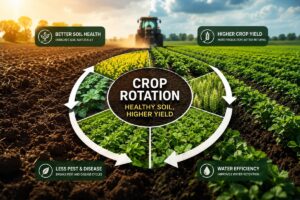
Crop rotation means growing different crops on the same piece of land in a planned sequence over time.
For example, instead of growing maize continuously on the same field, a farmer might grow maize in one season and then plant beans or another suitable crop in a subsequent season.
The exact rotation depends on the farmer’s climate, soil, market, crop choices, farm size, and production goals.
The USDA defines crop rotation as the sequencing of crops over time on a field or planting bed. It can be used by both conventional and organic farmers.
Why Is Crop Rotation Important?
Growing the same crop repeatedly can create several management challenges.
Some pests and diseases are closely associated with particular crops. Repeatedly providing the same host plant can make it easier for certain problems to persist.
Crop rotation can help break these cycles.
A diverse rotation can also influence:
- Nutrient management
- Soil structure
- Biodiversity
- Organic matter
- Weed management
- Pest pressure
- Long-term farm resilience
For example, a rotation involving legumes can be useful because certain legumes have relationships with microorganisms that help make nitrogen available within agricultural systems.
Agriculture Terms Example: Maize and Beans
Consider a farmer who grows maize followed by beans.
The farmer is not simply changing crops for variety.
The rotation can create differences in:
- Root systems
- Nutrient demands
- Crop residues
- Pest relationships
- Soil biological activity
This is one reason crop rotation appears so often in discussions about sustainable farming and soil management.
Crop Rotation Is Not a Magic Formula
Beginners should avoid assuming that any crop rotation automatically improves a farm.
The crops must be selected carefully.
A farmer needs to consider:
- Local climate
- Soil type
- Rainfall
- Market demand
- Planting seasons
- Crop diseases
- Available labor
- Machinery
- Irrigation
- Expected profitability
The goal is to create a rotation that makes sense for the particular farming system.
Agriculture Terms #3: Irrigation
If you are studying Agriculture Terms, you will almost certainly encounter the word irrigation.
Irrigation refers to the artificial application of water to agricultural land or crops when natural rainfall is insufficient or when additional water is needed.
For many farmers, irrigation can make the difference between depending entirely on rainfall and having greater control over water availability.
Common Agriculture Terms Related to Irrigation
Some irrigation-related words beginners should recognize include:
- Drip irrigation – Water is delivered slowly near the plant root zone.
- Sprinkler irrigation – Water is distributed through sprinklers over an area.
- Surface irrigation – Water moves across or through the soil surface.
- Fertigation – Fertilizer is supplied through irrigation water.
- Water efficiency – Getting useful crop production from available water while reducing unnecessary losses.
Why Irrigation Matters
Rainfall is not always distributed evenly.
A farmer may experience:
- Long dry periods
- Irregular rainfall
- Short periods of intense rain
- Unexpected dry spells
- High temperatures
- Seasonal water shortages
Irrigation can help farmers manage some of these challenges.
However, irrigation does not mean simply adding as much water as possible.
Too little water can stress crops.
Too much water can create other problems, including waterlogging, nutrient losses, root problems, and conditions favorable to certain diseases.
The goal is appropriate water management.
Agriculture Terms Beginners Should Connect With Irrigation
When learning about irrigation, connect the word with:
water source + crop needs + soil + timing + application method + efficiency.
A good irrigation decision therefore involves more than purchasing equipment.
A farmer needs to understand when the crop requires water, how much water is appropriate, how quickly the soil loses water, and which irrigation method fits the farm.
Agriculture Terms #4: Crop Yield
Crop yield is another important entry in our collection of Agriculture Terms.
Crop yield generally refers to the amount of agricultural product produced from a specified area of land.
It is commonly expressed using measurements such as:
- Kilograms per hectare
- Tonnes per hectare
- Bags per acre
- Kilograms per acre
- Tonnes per acre
The exact measurement depends on the crop, country, agricultural system, and reporting method.
Why Crop Yield Matters
Imagine two farmers each cultivate one hectare of maize.
If Farmer A harvests 2 tonnes while Farmer B harvests 4 tonnes, their land areas are the same, but their crop yields are different.
Yield therefore helps farmers evaluate production performance.
However, beginners should understand something important:
Higher yield does not automatically mean higher profit.
A farmer could achieve a very high yield but spend so much on:
- Fertilizer
- Seeds
- Irrigation
- Labor
- Pesticides
- Machinery
- Transportation
that the final profit is disappointing.
This is why successful agriculture involves both production management and financial management.
Agriculture Terms: Yield Versus Production
These two terms are related but different.
Production refers to the total amount produced.
Yield relates production to an area of land or another defined production unit.
For example, a large farm can produce more maize overall than a smaller farm while having a lower yield per hectare.
Understanding this difference is extremely useful when reading agricultural statistics.
Agriculture Terms #5: Organic Farming
Among the most recognizable Agriculture Terms is organic farming.
Organic farming is an agricultural production approach based on specific standards and practices concerning inputs, soil management, crop production, livestock, and ecological processes.
It is important to understand that the exact legal meaning of “organic” depends on the certification and regulatory system in a particular country or market.
Beginners sometimes simplify organic farming to mean “farming without chemicals.”
That description is incomplete.
Agriculture itself involves many different substances and biological processes, and organic production standards may permit some inputs while restricting or prohibiting others.
What Does Organic Farming Focus On?
Organic systems commonly emphasize areas such as:
- Soil health
- Crop diversity
- Biological processes
- Organic matter
- Ecological pest management
- Careful nutrient management
- Restrictions on certain synthetic inputs
Organic farming is therefore better understood as a production system rather than simply a decision to avoid one particular category of farm input.
Agriculture Terms: Organic Does Not Mean Effortless
Organic production can require significant planning.
Farmers may need to carefully manage:
- Weed control
- Soil fertility
- Crop rotation
- Pest pressure
- Disease
- Certification requirements
- Record keeping
- Market access
For a beginner considering organic agriculture as a business, it is important to research the relevant certification requirements in the intended market before making claims about products being certified organic.
Agriculture Terms #6: Pest Management
Pest management is one of the most practical Agriculture Terms a beginner can learn.
A pest is an organism that causes undesirable effects in agricultural production.
Depending on the farming system, pests may include:
- Insects
- Weeds
- Plant pathogens
- Rodents
- Nematodes
- Certain animals
Pest management is the process of preventing, monitoring, and controlling agricultural pests.
Why Pest Management Is Important
A pest problem can affect:
- Crop growth
- Plant health
- Yield
- Product quality
- Farm income
- Storage
- Marketability
But pest management does not simply mean spraying pesticides whenever a farmer sees an insect.
Modern pest management often emphasizes identification, monitoring, prevention, and selecting appropriate control measures.
Agriculture Terms: Integrated Pest Management
One particularly useful term is Integrated Pest Management, commonly abbreviated as IPM.
IPM brings different pest-management approaches together.
These may include:
- Crop monitoring
- Cultural practices
- Biological control
- Mechanical control
- Resistant crop varieties
- Appropriate chemical control when necessary
The important idea is that farmers should make pest-management decisions based on the actual situation rather than automatically using one control method for every problem.
Why Beginners Should Learn Pest Identification
Imagine finding an insect on a tomato plant.
A beginner may immediately assume the insect is harmful.
But not every insect found on a farm is a pest.
Some insects are beneficial predators, pollinators, decomposers, or otherwise harmless organisms.
Correct identification should therefore come before deciding how to control something.
This simple principle can prevent unnecessary treatments and help farmers make more informed decisions.
Agriculture Terms #7: Sustainable Agriculture
Sustainable agriculture is one of the most important modern Agriculture Terms because it connects farming with long-term productivity, environmental management, economic viability, and social considerations.
In simple language, sustainable agriculture asks a powerful question:
How can farmers produce food and income today without undermining their ability to keep farming in the future?
This is not merely about protecting the environment.
A farm that protects soil but consistently loses money may not be economically sustainable.
Likewise, a farm that generates short-term income while severely degrading its productive resources may struggle in the long term.
Agriculture Terms: The Three Dimensions of Sustainability
Sustainable agriculture can be viewed through several interconnected dimensions.
Environmental sustainability
This includes issues such as:
- Soil conservation
- Water management
- Biodiversity
- Erosion control
- Resource efficiency
- Pollution reduction
Economic sustainability
This involves:
- Farm profitability
- Production costs
- Market access
- Risk management
- Efficient resource use
Social sustainability
This can involve:
- Worker welfare
- Community development
- Food security
- Rural livelihoods
- Access to agricultural resources
The balance between these dimensions is what makes sustainability a complicated but valuable agricultural concept.
Agriculture Terms #8: Climate-Smart Agriculture
If you want to understand modern agriculture terms and definitions 2026, you should know climate-smart agriculture.
Climate-smart agriculture, commonly shortened to CSA, is an approach that considers food security, agricultural productivity, adaptation to climate change, resilience, and mitigation of greenhouse-gas emissions.
The FAO describes climate-smart agriculture as an approach that addresses food security and climate change while also contributing to greenhouse-gas mitigation. (FAOHome)
Why Climate-Smart Agriculture Matters
Farmers operate in an environment influenced by weather and climate.
Changes in rainfall patterns, temperatures, drought conditions, floods, and other climate-related pressures can affect agricultural production.
Climate-smart approaches seek to help agricultural systems respond to these challenges.
Depending on the location and farming system, practices may include:
- Improved water management
- Drought-tolerant crop varieties
- Soil conservation
- Crop diversification
- Agroforestry
- Improved nutrient management
- Weather information
- Efficient irrigation
- Better farm planning
Agriculture Terms: Climate-Smart Does Not Mean One Specific Farming Method
This distinction is important.
Climate-smart agriculture is not a single technique that every farmer must follow.
The most appropriate practice depends on local circumstances.
A dryland farmer may prioritize water conservation.
A flood-prone farmer may focus on drainage and resilient production systems.
A livestock farmer may concentrate on pasture management, feed efficiency, animal health, and climate risks.
The central idea is adaptation and resilience within the farming system.
Agriculture Terms #9: Precision Agriculture
Precision agriculture is one of the most interesting modern Agriculture Terms for beginners because it demonstrates how technology is changing farming.
Precision agriculture involves using information, measurements, technology, and data to manage agricultural production more precisely.
Instead of treating an entire field as though every part of it is identical, precision agriculture can help farmers recognize differences within the field.
Those differences may relate to:
- Soil conditions
- Crop growth
- Moisture
- Nutrient levels
- Pest pressure
- Topography
- Yield performance
Technologies Associated With Precision Agriculture
Modern precision farming may involve:
- GPS
- Satellite imagery
- Drones
- Sensors
- Farm-management software
- Variable-rate equipment
- Geographic information systems
- Digital maps
- Data analytics
The technology used depends on the scale and economics of the farm.
Agriculture Terms: Why Precision Agriculture Is Becoming Important
Traditional farming decisions often rely heavily on observation and experience.
Experience remains extremely valuable.
However, digital tools can add another layer of information.
For example, a farmer could potentially use soil data to identify areas of a field that have different nutrient requirements.
Instead of applying exactly the same amount of an input everywhere, a farmer may be able to make more targeted decisions where the technology and economics make this practical.
Precision Agriculture Is Not Only for Huge Farms
One misconception is that precision agriculture automatically requires expensive machinery.
Some advanced systems do involve significant investment.
But the broader principle—using better information to make better farming decisions—can apply at many scales.
A small farmer using a weather application, soil test results, a simple farm record system, or basic irrigation monitoring is already using information to improve decision-making.
Agriculture Terms #10: Agroforestry
Another important word in Agriculture Terms and Definitions is agroforestry.
Agroforestry refers broadly to agricultural systems that intentionally combine trees or other woody perennial plants with crops and/or livestock.
Instead of viewing trees and agriculture as completely separate activities, agroforestry considers how they can interact within a farming system.
Examples of Agroforestry
Depending on the location, examples can include:
- Trees integrated with crops
- Trees combined with livestock
- Fruit trees in agricultural systems
- Windbreaks
- Alley cropping
- Silvopasture
The exact design depends on the farmer’s objectives and local conditions.
Why Agroforestry Matters
Trees can provide several potential benefits within appropriate agricultural systems.
These may include:
- Shade
- Wind protection
- Habitat
- Additional products
- Soil protection
- Biodiversity
- Potential income diversification
Some agroforestry systems can also help farmers diversify production.
For example, a farmer who produces annual crops while maintaining suitable fruit or timber trees may have multiple potential sources of agricultural output.
Agriculture Terms Beginners Should Understand
Agroforestry does not mean randomly planting trees everywhere.
The choice of species, spacing, root characteristics, water availability, crop compatibility, management requirements, and market opportunities all matter.
A poorly designed tree-crop combination can create competition for light, water, or nutrients.
Therefore, agroforestry works best when the components are deliberately selected and managed.
Agriculture Terms #11: Smart Farming
The final entry in our list of Agriculture Terms is smart farming.
Smart farming refers broadly to using improved agricultural practices, information, technology, and resource-management approaches to improve farm performance.
It can overlap with concepts such as:
- Precision agriculture
- Digital agriculture
- Farm automation
- Data-driven farming
- Smart irrigation
- Remote monitoring
- Agricultural sensors
FAO’s Smart Farming approach specifically highlights affordable technologies, efficient resource management, good agricultural practices, and digital technologies as tools that can support small-scale farmers. (FAOHome)

Agriculture Terms: What Can Smart Farming Look Like?
Smart farming can be surprisingly simple.
A farmer does not necessarily need an autonomous tractor or sophisticated artificial intelligence system.
Smart farming might involve:
- Using weather information before planting
- Recording farm expenses digitally
- Monitoring irrigation
- Tracking livestock
- Using soil-test information
- Keeping electronic production records
- Monitoring crop conditions with digital tools
- Using mobile technology to access agricultural information
At a larger scale, smart farming can involve sophisticated sensors, automated equipment, satellite imagery, artificial intelligence, robotics, and data analytics.
Why Smart Farming Is Relevant in 2026
Agriculture is increasingly connected to digital technology.
The farmer of the future will not necessarily abandon traditional knowledge.
Instead, the direction of agriculture increasingly involves combining practical experience with better information and technology.
That combination is one reason smart farming deserves a place among the most useful modern agriculture terms beginners should understand.
Agriculture Terms Comparison: 11 Farming Words Every Beginner Should Know
The table below provides a quick reference for the major Agriculture Terms covered in this guide.
| Agriculture Term | Simple Definition | Why It Matters | Beginner Example |
|---|---|---|---|
| Soil Health | The ability of soil to function as a living, productive system | Supports crops, water management, and nutrient cycling | Improving organic matter |
| Crop Rotation | Growing different crops in sequence on the same land | Can improve diversity and help manage pests and nutrients | Maize followed by beans |
| Irrigation | Artificial application of water to crops | Helps manage water availability | Drip irrigation |
| Crop Yield | Production obtained per defined area or unit | Helps measure production performance | Tonnes per hectare |
| Organic Farming | A regulated production system emphasizing specified organic practices and inputs | Provides a distinct production and market system | Certified organic vegetable production |
| Pest Management | Monitoring and controlling agricultural pests | Protects crops and reduces losses | Monitoring tomato pests |
| Sustainable Agriculture | Farming designed with long-term environmental, economic, and social considerations | Supports long-term agricultural viability | Soil conservation |
| Climate-Smart Agriculture | Agriculture that considers productivity, resilience, climate adaptation, and mitigation | Helps farming systems respond to climate challenges | Drought-management practices |
| Precision Agriculture | Using data and technology to manage farming more precisely | Can improve resource targeting and decision-making | Soil mapping |
| Agroforestry | Combining trees with crops and/or livestock | Can diversify production and support ecological functions | Trees integrated with crops |
| Smart Farming | Using technology, information, and improved practices to manage farms efficiently | Connects agriculture with modern digital tools | Digital farm monitoring |
Agriculture Terms and Definitions for Beginners: How to Remember Them
Reading a list of farming vocabulary is one thing.
Actually remembering the terms is another.
The easiest approach is to connect each word with something you can see or do on a farm.
For example:
Soil health → the condition of the soil
Crop rotation → changing crops over time
Irrigation → supplying water
Yield → how much you produce from an area
Pest management → managing crop threats
Sustainable agriculture → farming for the long term
Climate-smart agriculture → farming with climate challenges in mind
Precision agriculture → using data for more precise decisions
Agroforestry → trees + agriculture
Smart farming → agriculture + information + technology
These simple associations make complicated terminology easier to remember.
Agriculture Terms Beginners Often Confuse
Learning Agriculture Terms also means learning the difference between words that appear similar.
Agriculture and farming
Agriculture is the broader field.
It includes crop production, livestock production, forestry-related systems, fisheries in broader agrifood contexts, agricultural economics, processing, technology, and many other activities.
Farming generally refers more directly to the production of crops and/or livestock.
Yield and production
Yield considers output relative to a defined production area or unit.
Production refers to the total output.
A large farm can have greater total production but lower yield per hectare than a smaller farm.
Organic and sustainable
Organic farming is a specific production system subject to particular standards.
Sustainable agriculture is a much broader concept concerning long-term environmental, economic, and social outcomes.
A farm should not automatically be described as sustainable simply because it uses one organic practice.
Precision agriculture and smart farming
These terms overlap.
Precision agriculture emphasizes precise, data-informed management of agricultural variability.
Smart farming is broader and can include digital tools, automation, data systems, improved resource management, and other technologies.
Climate-smart agriculture and sustainable agriculture
Climate-smart agriculture specifically emphasizes agricultural productivity and resilience in relation to climate change, including adaptation and mitigation considerations.
Sustainable agriculture is broader.
Understanding these distinctions helps prevent confusion when reading agricultural research or business information.
Agriculture Terms: Why Modern Farming Vocabulary Is Changing
Agriculture has always evolved.
Farmers have adopted new tools throughout history, from improved hand tools and animal traction to tractors, irrigation systems, improved seed varieties, fertilizers, pesticides, greenhouses, machinery, and digital technology.
The vocabulary changes alongside the industry.
Today, beginners may encounter terms such as:
- Digital agriculture
- Smart farming
- Precision agriculture
- Agricultural drones
- Farm sensors
- Remote sensing
- Artificial intelligence in agriculture
- Variable-rate application
- Climate-smart agriculture
- Regenerative agriculture
- Controlled-environment agriculture
Some of these concepts are highly technical, while others can be applied using relatively simple tools.
This is why learning modern agriculture terms and definitions 2026 is valuable even if you are a small-scale farmer.
You do not need to purchase advanced technology simply because a term is popular.
Instead, understanding the terminology helps you evaluate whether a technology or practice actually solves a problem on your farm.
Agriculture Terms: The Relationship Between Soil, Water, Crops and Technology
One of the biggest lessons beginners can take from these Agriculture Terms is that farming is interconnected.
Consider what happens when a farmer plants a crop.
The crop needs:
- Suitable soil
- Water
- Nutrients
- Light
- Appropriate temperature
- Protection from damaging pests and diseases
- Proper management
- Access to a market
These factors do not operate independently.
Poor soil may reduce water infiltration.
Poor water management may affect nutrient availability.
Pest damage may reduce yield.
Low yield may affect profitability.
High production costs may reduce the economic benefit of a good harvest.
This is why modern farming increasingly emphasizes systems thinking.
Instead of asking only:
“How do I grow this crop?”
a farmer may need to ask:
“How do I produce this crop efficiently, profitably, sustainably, and reliably under my local conditions?”
That is a much more powerful question.
Agriculture Terms: How Beginners Can Build Their Farming Vocabulary
You do not need to memorize hundreds of terms in one sitting.
Start with the fundamentals.
Step 1: Learn the language of soil
Begin with:
- Soil health
- Soil fertility
- Soil structure
- Organic matter
- Soil pH
- Soil erosion
- Soil compaction
These terms will help you understand the foundation of crop production.
Step 2: Learn crop-production terms
Next, understand:
- Germination
- Seedling
- Transplanting
- Planting density
- Crop rotation
- Crop yield
- Harvest
- Post-harvest handling
Step 3: Learn water-management terms
Focus on:
- Irrigation
- Drainage
- Water conservation
- Drip irrigation
- Sprinkler irrigation
- Waterlogging
Step 4: Learn pest-management terms
Understand:
- Pest
- Disease
- Weed
- Biological control
- Integrated pest management
- Pesticide
- Monitoring
Step 5: Learn modern agricultural terms
Finally, explore:
- Smart farming
- Precision agriculture
- Digital agriculture
- Climate-smart agriculture
- Agroforestry
- Regenerative agriculture
This progression makes farming vocabulary much easier to understand.
Agriculture Terms: Practical Questions Every New Farmer Should Ask
Knowing terminology is useful, but applying knowledge is even more important.
Before adopting a new agricultural practice, beginners should ask questions such as:
Is this practice appropriate for my location?
Agriculture is highly location-dependent.
A practice that works well in one climate may perform differently somewhere else.
Does my soil support this crop?
Crop selection should consider soil conditions rather than relying solely on popularity.
Where will my water come from?
Water availability can determine whether a farming plan is realistic.
What are the major pests and diseases?
Understanding potential threats before planting gives farmers more time to prepare.
How much will production cost?
A farming idea is not automatically a profitable farming business.
Who will buy the product?
Market research should happen before large-scale production whenever possible.
What happens after harvest?
Storage, transportation, processing, packaging, and marketing can determine the final value of agricultural products.
These questions turn Farming Vocabulary into practical decision-making knowledge.
Agriculture Terms: 5 Mistakes Beginners Make When Learning Farming Vocabulary
Learning new terms is useful, but beginners can still make mistakes.
1. Memorizing definitions without understanding them
Knowing that crop rotation means changing crops is useful.
Understanding why farmers rotate crops is much more useful.
Always connect the definition to a real farming situation.
2. Assuming every popular farming practice works everywhere
Agriculture is location-specific.
Climate, soil, water, markets, regulations, labor, and farm size all matter.
3. Treating technology as a replacement for agricultural knowledge
Technology can provide information and improve efficiency, but it does not eliminate the need for sound agricultural judgment.
4. Confusing productivity with profitability
Producing more does not automatically mean earning more.
A farmer must consider both output and costs.
5. Ignoring record keeping
Good records can help farmers understand what worked and what did not.
Useful records can include:
- Planting dates
- Seed varieties
- Input quantities
- Labor costs
- Fertilizer applications
- Pest-control activities
- Harvest quantities
- Sales prices
- Transportation expenses
Over time, these records can become valuable decision-making tools.
Agriculture Terms: How These 11 Words Connect to Farm Success
The 11 terms in this guide should not be viewed as isolated vocabulary.
They form a connected system.
For example:
Soil health influences crop growth.
Crop rotation can contribute to soil and pest management.
Irrigation helps manage water availability.
Pest management protects crop production.
Crop yield helps measure output.
Sustainable agriculture considers long-term farm performance.
Climate-smart agriculture considers climate risks and resilience.
Agroforestry integrates trees into agricultural systems.
Precision agriculture uses information to improve management decisions.
Smart farming brings technology and information into agricultural management.
Organic farming represents a specific production system with defined standards and practices.
Once you understand these connections, farming vocabulary stops looking like a collection of random technical words.
Instead, the terms begin to tell a story about how farms function.
Agriculture Terms: What Every Beginner Should Take Away in 2026
If you remember only a few lessons from this article, remember these.
Agriculture is a system
A farm is not simply a piece of land where crops grow.
It is a system involving:
- Soil
- Water
- Plants
- Animals
- People
- Technology
- Markets
- Weather
- Finance
- Natural resources
Soil deserves attention
Healthy soil is one of the foundations of productive agriculture.
Practices such as crop diversity, soil cover, appropriate disturbance management, and maintaining living roots can contribute to soil health. USDA conservation guidance emphasizes these principles across different farming contexts. (Natural Resources Conservation Service)
Water must be managed carefully
Irrigation can provide valuable control over water availability, but efficient water management matters.
Yield is not the whole story
A high yield is useful, but farmers must also consider production costs, product quality, market prices, and profitability.
Technology should solve real problems
Smart farming and precision agriculture can create new opportunities, but technology should be selected according to the farmer’s actual needs and resources.
Climate matters
Weather and climate influence nearly every agricultural decision.
Climate-smart agriculture provides a framework for considering productivity, resilience, adaptation, and mitigation together. (FAOHome)
Farming knowledge never stops growing
Even experienced farmers continue learning.
New varieties, technologies, markets, climate conditions, regulations, and production practices can create new challenges and opportunities.
Agriculture Terms: Frequently Asked Questions
What are Agriculture Terms?
Agriculture Terms are words and expressions used to describe farming, crop production, livestock production, soil management, agricultural technology, farm economics, natural resources, and related agricultural activities.
Examples include irrigation, crop rotation, crop yield, soil health, pest management, agroforestry, and sustainable agriculture.
What are the most important Farming Terms for beginners?
Some useful Farming Terms for beginners include:
- Soil health
- Crop rotation
- Irrigation
- Crop yield
- Pest management
- Organic farming
- Sustainable agriculture
- Climate-smart agriculture
- Precision agriculture
- Agroforestry
- Smart farming
These provide a strong starting vocabulary for understanding modern agricultural discussions.
Why should farmers learn Agricultural Terms?
Understanding Agricultural Terms makes it easier to read farming guides, communicate with agricultural professionals, understand research, evaluate technologies, follow market information, and make informed production decisions.
What is the difference between agriculture and farming?
Farming generally refers to the production of crops and livestock, while agriculture is a broader field that includes production as well as many related areas such as agricultural science, technology, economics, processing, natural-resource management, and agribusiness.
What are modern agriculture terms?
Modern agriculture terms describe newer or increasingly important concepts in agricultural production and management.
Examples include:
- Smart farming
- Precision agriculture
- Digital agriculture
- Climate-smart agriculture
- Agricultural automation
- Remote sensing
- Farm data analytics
- Variable-rate application
What is the easiest way to learn farming vocabulary?
The best approach is to learn terms in groups.
Start with soil, then crops, water, pests, livestock, farm economics, and finally modern technology.
More importantly, connect each word to a real farming example.
Is smart farming only for large commercial farms?
No.
Smart farming can include highly advanced technologies, but the basic principle is broader: using information, appropriate technology, and efficient management to improve farming decisions.
Even a small farmer can use weather information, digital records, soil-test results, mobile agricultural resources, or simple monitoring tools.
Is higher crop yield always better?
Not necessarily.
Yield is an important production measure, but profitability also depends on production costs, market prices, product quality, losses, and other factors.
A farmer should therefore consider both productivity and economic returns.
Agriculture Terms: Final Thoughts for Beginners
Learning Agriculture Terms may seem like a small step, but it can make a significant difference in how a beginner understands farming.
The more agricultural vocabulary you know, the easier it becomes to understand farming guides, communicate with experienced farmers, evaluate agricultural technologies, read research, and make better-informed decisions.
The 11 terms covered in this guide—soil health, crop rotation, irrigation, crop yield, organic farming, pest management, sustainable agriculture, climate-smart agriculture, precision agriculture, agroforestry, and smart farming—represent only a starting point.
Agriculture is far too broad to fit into a single vocabulary list.
There are hundreds of additional terms covering livestock production, horticulture, farm machinery, agricultural economics, food processing, plant pathology, genetics, irrigation engineering, agribusiness, farm finance, biotechnology, and agricultural technology.
But beginners do not need to learn everything at once.
Start with the fundamentals.
Understand your soil.
Learn how your crops grow.
Understand water management.
Learn to identify common pests and diseases.
Keep accurate farm records.
Understand your market.
Pay attention to weather and climate.
And gradually learn how technology can help you make better decisions.
The most successful farmer is not necessarily the person who knows the most complicated agricultural vocabulary. More importantly, it is the farmer who can understand useful information, apply it appropriately, observe results, learn from experience, and continually improve.
That is the real value of learning Agriculture Terms.
The words may be simple, but understanding them can open the door to a much deeper understanding of farming.
Agriculture Terms: Quick Beginner’s Reference
Before leaving this guide, here is a final memory shortcut:
Soil health = keeping the soil productive and functioning well.
Crop rotation = changing crops in a planned sequence.
Irrigation = supplying water artificially when needed.
Crop yield = production relative to a defined area or unit.
Organic farming = a regulated agricultural production system with specified practices and input requirements.
Pest management = identifying, monitoring, preventing, and controlling agricultural pests.
Sustainable agriculture = farming with long-term environmental, economic, and social considerations.
Climate-smart agriculture = farming approaches that consider productivity, resilience, climate adaptation, and mitigation.
Precision agriculture = using data and technology to manage agricultural variability more precisely.
Agroforestry = integrating trees with crops and/or livestock.
Smart farming = using information, technology, and improved management to make farming more efficient and informed.
These are more than definitions.
They are building blocks for understanding the language of modern agriculture.
About The Author