Agriculture
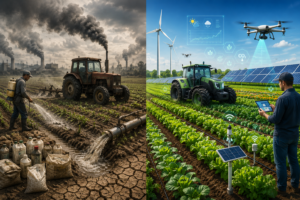
Agriculture is undergoing one of the most remarkable transformations in human history. For centuries, farming relied heavily on manual labor, experience, and unpredictable weather conditions. Today, however, the rise of AI Agriculture, Precision Farming, Smart Agriculture, and Agricultural Robotics is changing everything.
Farmers are no longer making decisions solely based on intuition. Instead, they are leveraging artificial intelligence, machine learning, drones, sensors, robotics, and predictive analytics to make smarter, faster, and more profitable decisions.
As global food demand continues to rise and climate challenges become more severe, farmers face increasing pressure to produce more food while using fewer resources. This is precisely where AI-driven technologies are proving invaluable.
According to research from the Food and Agriculture Organization (FAO) and the World Bank, technological innovation will play a critical role in ensuring global food security throughout the coming decades.
In this article, we will explore the 11 most powerful ways smart farming technologies are revolutionizing agriculture in 2026 and beyond.
Why AI Agriculture Is Becoming Essential in 2026
The agricultural industry faces several pressing challenges:
- Rising production costs
- Labor shortages
- Climate change
- Water scarcity
- Pest outbreaks
- Increasing food demand
Traditional farming methods struggle to address these challenges efficiently.
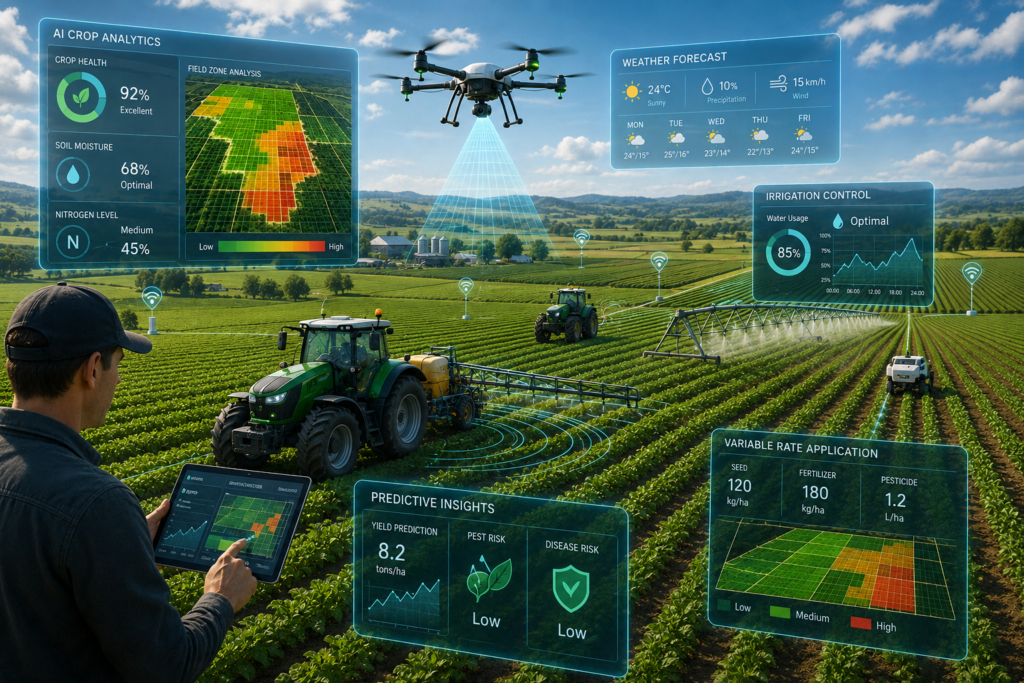
AI Agriculture introduces a new approach where data drives decision-making. Farmers can now monitor crops in real time, predict disease outbreaks, automate repetitive tasks, and optimize resource usage like never before.
The result?
- Higher yields
- Lower operational expenses
- Improved sustainability
- Better resource management
AI Agriculture and Precision Farming: Understanding the Difference
Although often used interchangeably, these concepts have unique roles.
| Technology | Primary Function | Benefits |
|---|---|---|
| AI Agriculture | Uses artificial intelligence to analyze data and make predictions | Better decisions and automation |
| Precision Farming | Applies resources precisely where needed | Reduced waste and higher efficiency |
| Smart Agriculture | Integrates digital technologies into farming | Improved productivity |
| Agricultural Robotics | Automates physical farming tasks | Labor savings and operational efficiency |
Together, these technologies form the backbone of modern agriculture.
1. AI Agriculture Improves Crop Monitoring Through Real-Time Data
One of the most significant breakthroughs in farming is continuous crop monitoring.
Modern farms now use:
- Satellite imagery
- IoT sensors
- Drone surveillance
- AI-powered analytics
These systems collect thousands of data points every day.
Farmers can instantly identify:
- Nutrient deficiencies
- Pest infestations
- Water stress
- Disease outbreaks
Instead of waiting until problems become visible, farmers can intervene early and prevent significant yield losses.
This proactive approach dramatically improves farm productivity.
2. Precision Farming Optimizes Fertilizer Application
Fertilizer costs continue to rise globally.
Traditional application methods often result in:
- Over-fertilization
- Nutrient runoff
- Environmental damage
- Unnecessary expenses
Precision Farming solves this challenge.
Using GPS-guided equipment and AI-powered soil analysis, farmers can determine exactly where fertilizer is needed.
Benefits include:
- Lower fertilizer costs
- Improved soil health
- Better nutrient absorption
- Increased crop yields
This targeted strategy reduces waste while maximizing production.
3. Smart Agriculture Enhances Irrigation Efficiency
Water management remains one of agriculture’s biggest challenges.
Smart Agriculture systems use:
- Soil moisture sensors
- Weather forecasting tools
- AI irrigation scheduling
- Automated watering systems
These technologies ensure crops receive the precise amount of water required.
Advantages include:
- Reduced water consumption
- Lower utility costs
- Healthier crops
- Greater drought resilience
In regions facing water scarcity, smart irrigation is becoming indispensable.
4. Agricultural Robotics Reduce Labor Costs
Labor shortages are affecting farms worldwide.
Finding skilled workers has become increasingly difficult and expensive.
Agricultural Robotics helps address this problem by automating repetitive tasks.
Examples include:
- Robotic harvesters
- Autonomous tractors
- Automated weeders
- Robotic fruit pickers
These machines can operate longer hours with consistent accuracy.
Benefits include:
- Reduced labor expenses
- Increased productivity
- Improved harvesting efficiency
- Reduced human error
5. AI-Powered Precision Farming Technology for Higher Crop Yields in 2026
One of the most exciting developments in modern farming is the rise of AI-powered decision support systems.
These systems analyze:
- Historical crop performance
- Weather patterns
- Soil conditions
- Market trends
AI then provides actionable recommendations.
Farmers can determine:
- Optimal planting times
- Best crop varieties
- Fertilizer requirements
- Harvest schedules
The result is more informed decision-making that directly impacts profitability.
6. How Agricultural Robots Are Transforming Modern Farming Operations
Agricultural robots are no longer experimental tools.
In 2026, they are becoming essential operational assets.
Robots now perform tasks such as:
Planting
Autonomous seeders ensure consistent spacing and depth.
Weeding
AI-powered weed detection systems target unwanted plants with remarkable precision.
Harvesting
Robotic harvesters can identify ripe produce and harvest it efficiently.
Sorting
Machine vision systems classify produce by quality and size.
These innovations reduce waste while improving output quality.
URL:
World Bank Agriculture and Food Program
7. Smart Agriculture Solutions That Reduce Farming Costs and Increase Productivity
Modern farms generate enormous amounts of data.
Smart Agriculture platforms transform that data into useful insights.
Farm management systems can track:
- Equipment performance
- Fuel consumption
- Labor efficiency
- Crop health
Farmers gain complete visibility into operations.
Benefits include:
- Better planning
- Lower operational costs
- Increased efficiency
- Stronger profitability
The ability to make data-driven decisions is becoming a major competitive advantage.
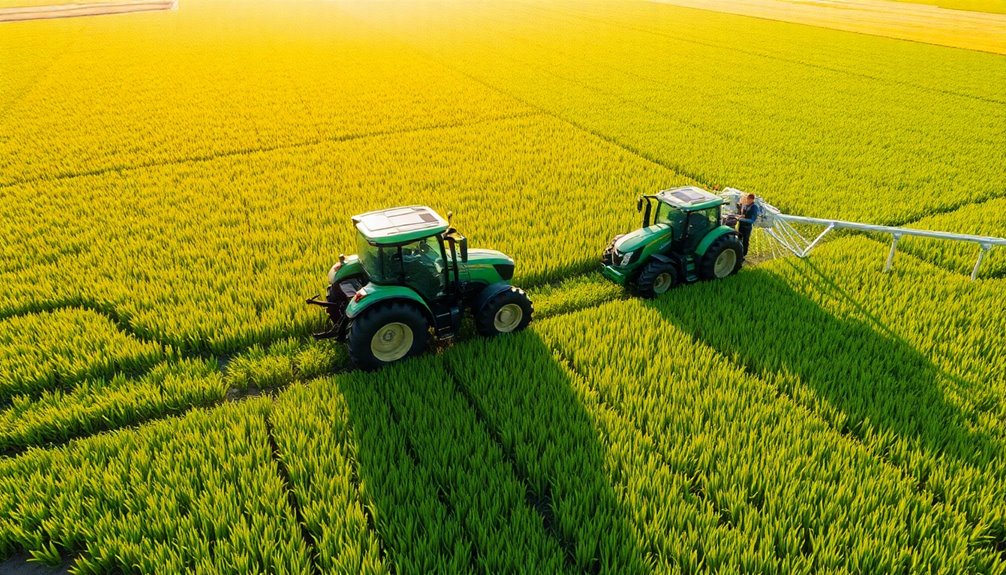
8. Autonomous Farming Systems and AI-Driven Agricultural Automation in 2026
Autonomous farming is rapidly moving from concept to reality.
Modern autonomous systems include:
- Self-driving tractors
- Automated sprayers
- Driverless harvesters
- AI-powered field monitoring vehicles
These systems work around the clock.
Advantages include:
- Continuous operation
- Reduced labor dependency
- Improved accuracy
- Faster task completion
Many experts predict that autonomous farming will become mainstream before the end of the decade.
9. AI Improves Pest and Disease Detection
Crop diseases can devastate yields if not detected early.
AI-powered image recognition systems can identify diseases long before symptoms become visible to the human eye.
Technology used includes:
- Drone imagery
- Smartphone applications
- Computer vision systems
Farmers receive early warnings and treatment recommendations.
Benefits:
- Reduced crop losses
- Lower pesticide use
- Faster intervention
- Healthier harvests
10. Precision Farming Supports Sustainable Agriculture
Consumers increasingly demand sustainable food production.
Precision Farming helps farmers achieve sustainability goals by minimizing resource waste.
Key benefits include:
- Reduced fertilizer runoff
- Lower fuel usage
- Improved soil conservation
- Better water management
Sustainability and profitability are no longer opposing goals.
Modern technology enables farmers to achieve both simultaneously.
11. Smart Agriculture Strengthens Climate Resilience
Climate uncertainty is becoming a major farming challenge.
AI systems can analyze:
- Historical weather data
- Seasonal forecasts
- Soil moisture trends
- Temperature fluctuations
This information helps farmers prepare for:
- Droughts
- Floods
- Heat waves
- Extreme weather events
Greater preparedness leads to stronger resilience and more stable production outcomes.
The Economic Impact of AI Agriculture in 2026
The financial benefits of AI Agriculture are becoming increasingly evident.
Farmers adopting smart technologies often experience:
Cost Reductions
- Lower fertilizer expenses
- Reduced water usage
- Fewer labor costs
- Reduced equipment downtime
Revenue Growth
- Increased yields
- Better crop quality
- Reduced losses
- Improved market timing
The return on investment can be substantial, especially for large-scale operations.
Food and Agriculture Organization (FAO)
Challenges Facing AI Agriculture Adoption
Despite its benefits, adoption is not without obstacles.
Some common challenges include:
Initial Investment Costs
Advanced equipment can be expensive.
Connectivity Issues
Rural internet infrastructure remains limited in some areas.
Technical Knowledge
Farmers may require training to fully utilize AI systems.
Data Security
Protecting agricultural data is becoming increasingly important.
However, as technology becomes more affordable and accessible, these barriers are gradually diminishing.
The Future of AI Beyond 2026
Looking ahead, several emerging innovations are expected to accelerate agricultural transformation:
- AI-powered breeding programs
- Fully autonomous farms
- Predictive climate adaptation systems
- Advanced agricultural robotics
- Blockchain-integrated supply chains
- Digital twins for farm management
These technologies will continue to redefine how food is produced globally.
The farms of 2030 may look dramatically different from those of today.
Key Takeaways
The future of farming is no longer a distant vision—it is happening now.
The combination of Agriculture, Precision Farming, Smart Agriculture, and Agricultural Robotics is helping farmers achieve unprecedented levels of efficiency and productivity.
The most significant benefits include:
- Higher crop yields
- Reduced operating costs
- Improved sustainability
- Better resource management
- Increased resilience to climate challenges
- Enhanced profitability
As artificial intelligence continues to evolve, its role in agriculture will only become more important.
Farmers who embrace these technologies today are positioning themselves for long-term success in an increasingly competitive and demanding agricultural landscape.
AI Agriculture and Precision Farming: The Technologies Revolutionizing Modern Crop Production
The farming industry is experiencing a major transformation as digital technologies become more integrated into everyday agricultural practices. Farmers today are under increasing pressure to produce higher yields while managing rising input costs, labor shortages, changing weather patterns, and environmental concerns. To meet these challenges, many are turning to advanced technologies that provide greater control, efficiency, and insight across their operations.
Modern farming is no longer based solely on experience and observation. Instead, it combines traditional agricultural knowledge with data-driven decision-making, allowing producers to manage crops more accurately than ever before. This shift is helping farms become more productive, sustainable, and profitable.
The Rise of Data-Driven Farming
One of the most significant developments in recent years is the ability to collect and analyze vast amounts of information from the field. Sensors, satellites, drones, and connected devices continuously gather data about soil conditions, crop growth, weather patterns, and equipment performance.
This information gives farmers a clearer picture of what is happening across their fields at any given moment. Rather than treating an entire farm as a single unit, growers can identify specific areas that require attention and respond accordingly.
The result is better resource management and more efficient production practices.
Advanced Monitoring Improves Crop Health
Monitoring crop conditions has traditionally required extensive field inspections, which can be time-consuming and sometimes ineffective when dealing with large farms. Today’s monitoring systems provide a much broader and more detailed view of crop performance.
Using aerial imagery and remote sensing technologies, farmers can detect early signs of stress caused by:
- Nutrient deficiencies
- Water shortages
- Disease outbreaks
- Pest infestations
- Environmental stress
Early detection allows for faster intervention, helping prevent small problems from becoming major threats to production.
More Efficient Use of Fertilizers and Crop Inputs
Input costs continue to represent a significant portion of farm expenses. Fertilizers, herbicides, and pesticides are essential for crop growth, but excessive use can increase costs and negatively impact the environment.
Modern field analysis tools help farmers determine exactly where treatments are needed and where they are not. This targeted approach reduces unnecessary applications while ensuring crops receive adequate nutrients and protection.
Benefits include:
- Lower operating expenses
- Reduced waste
- Improved soil quality
- Better crop performance
- Enhanced environmental stewardship
By applying resources only where they provide the greatest benefit, farmers can maximize returns while minimizing losses.
Smarter Water Management
Water is one of agriculture’s most valuable resources. In many regions, efficient irrigation is becoming increasingly important due to drought conditions and growing competition for water supplies.
Modern irrigation systems use real-time information from soil moisture sensors, weather forecasts, and field conditions to determine when and where water should be applied.
This technology helps farmers:
- Avoid overwatering
- Reduce water waste
- Improve crop development
- Lower energy costs
- Maintain healthier soil conditions
Efficient water use not only saves money but also supports long-term sustainability goals.
Drones and Remote Sensing Technologies
Drones have become valuable tools for modern crop management. Equipped with advanced cameras and imaging systems, they can survey large areas quickly and provide detailed insights that are difficult to obtain from ground-level observations.
Drone technology allows farmers to:
- Assess crop vigor
- Monitor plant growth
- Identify weed infestations
- Evaluate irrigation performance
- Detect disease hotspots
The information gathered can be converted into detailed maps and reports that support better decision-making throughout the growing season.
Predictive Technology Supports Better Planning
One of the most exciting advancements in agriculture is the ability to predict future outcomes based on current and historical data.
Modern software platforms analyze:
- Weather trends
- Soil characteristics
- Crop performance records
- Pest activity patterns
- Seasonal conditions
These insights help farmers make informed decisions regarding planting schedules, nutrient management, irrigation timing, and harvesting operations.
Rather than reacting to problems after they occur, producers can take preventative measures that reduce risk and improve overall farm performance.
Economic Benefits for Modern Farms
The adoption of advanced agricultural technologies is delivering measurable financial advantages across the industry.
Many farmers report improvements such as:
- Higher yields
- Reduced input costs
- Improved labor efficiency
- Better resource allocation
- Increased profitability
As technology becomes more affordable and accessible, farms of all sizes are finding opportunities to benefit from these innovations.
Looking Toward the Future
The future of farming will likely be shaped by even greater integration of automation, machine learning, robotics, and real-time analytics. As these technologies continue to evolve, they will provide farmers with increasingly precise tools for managing crops and resources.
The transition toward smarter farming practices represents more than a technological trend. It marks a fundamental shift in how food is produced, helping agriculture become more efficient, resilient, and capable of meeting the demands of a growing global population.
For farmers willing to embrace innovation, the opportunities ahead are substantial. The combination of intelligent systems, accurate field data, and advanced monitoring tools is creating a new era of productivity that will continue to transform crop production well beyond 2026.

Smart Solutions That Reduce Farming Costs and Increase Productivity
Smart Agriculture is helping farmers operate more efficiently by combining artificial intelligence, IoT sensors, drones, and data analytics to improve decision-making. These technologies enable farmers to monitor crops, soil conditions, weather patterns, and equipment performance in real time, reducing unnecessary expenses and maximizing output.
By automating tasks such as irrigation, fertilizer application, and pest detection, smart agriculture solutions help minimize resource waste while improving crop health and yields. Farmers can make data-driven decisions that lead to lower operational costs, increased productivity, and more sustainable farming practices.
As agricultural challenges continue to grow, Smart Agriculture is becoming an essential tool for farmers seeking to remain competitive, profitable, and environmentally responsible in 2026 and beyond.
How Agricultural Robotics Are Transforming Modern Farming Operations
Agricultural robotics is rapidly changing the way farms operate by automating labor-intensive tasks such as planting, weeding, spraying, harvesting, and crop monitoring. These advanced machines work with remarkable precision, helping farmers improve efficiency while reducing reliance on manual labor.
Robotic systems can operate for longer hours, perform repetitive tasks consistently, and minimize human error. This leads to lower operational costs, faster fieldwork, and improved crop quality. As labor shortages continue to affect the agricultural sector, robotics is becoming an increasingly valuable solution for maintaining productivity and profitability.
In 2026, agricultural robots are no longer futuristic concepts—they are practical tools helping farmers increase yields, optimize resources, and build more sustainable farming operations.
Conclusion
The agricultural industry is entering a new era driven by intelligence, automation, and data-driven decision-making. In 2026, AI Agriculture is no longer an emerging trend—it is becoming a fundamental component of successful farming operations.
From AI-powered crop monitoring and precision irrigation to autonomous tractors and agricultural robotics, modern technologies are helping farmers produce more food while spending less money. These innovations are solving some of agriculture’s most pressing challenges, including labor shortages, rising costs, resource scarcity, and climate uncertainty.
The future belongs to farms that can adapt, innovate, and leverage technology effectively. As AI-powered precision farming technology for higher crop yields in 2026 continues to mature, and as autonomous farming systems and AI-driven agricultural automation become more accessible, the opportunities for growth are enormous.
For farmers, agribusinesses, and policymakers alike, the message is clear: smart farming is not simply the future of agriculture—it is the present reality shaping the food systems of tomorrow.
About The Author