Agronomy
Agriculture has always been the backbone of human civilization, but in 2026, it is undergoing one of its most important transformations ever. At the heart of this transformation is Agronomy, the science that connects soil, crops, environment, and technology to improve farming outcomes.
So, what is agronomy in farming, and why is it important?
Agronomy is the science of managing and improving soil and crop production through research, technology, and sustainable farming methods. It focuses on maximizing yield while protecting natural resources.
Today, agronomy is no longer just about planting crops—it is about:
- Data-driven farming decisions
- Soil health optimization
- Climate-smart agriculture
- Sustainable food production systems
Modern farmers now rely heavily on farming agronomy to improve efficiency, reduce waste, and increase profitability.
According to the Food and Agriculture Organization (FAO), sustainable farming systems are essential for feeding the growing global population while protecting ecosystems.
https://www.fao.org
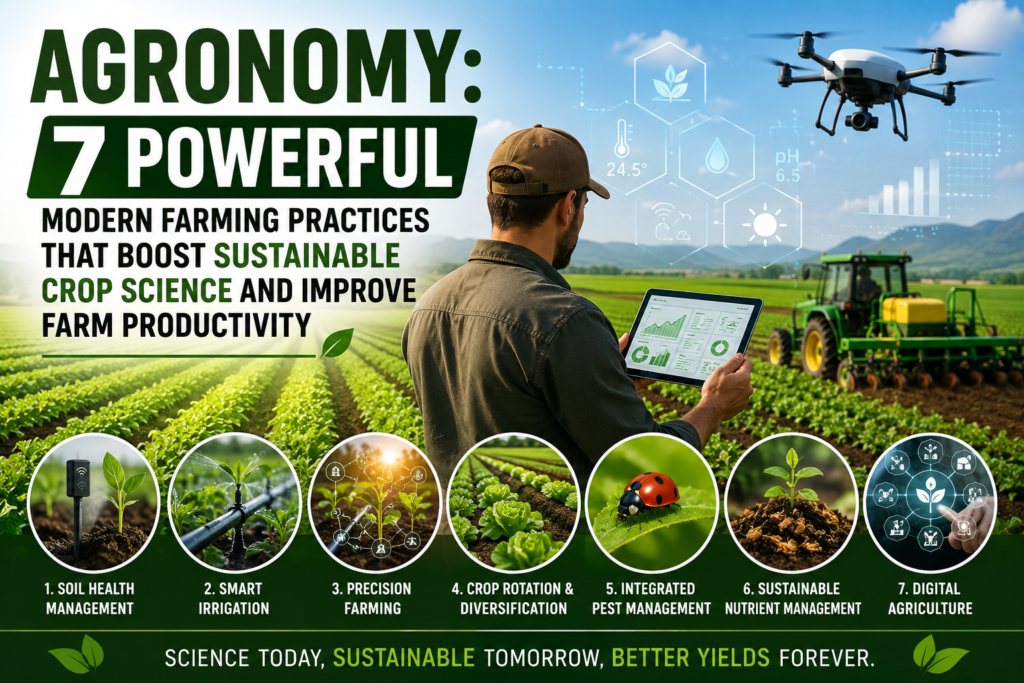
7 POWERFUL MODERN FARMING PRACTICES IN CROP SCIENCE AND SUSTAINABLE FARMING
Modern agriculture is powered by innovation. Below are 7 powerful agronomy practices reshaping farming in 2026.
1. PRECISION FARMING IN MODERN AGRONOMY PRACTICES IN SUSTAINABLE AGRICULTURE 2026
Precision farming is one of the most revolutionary developments in agronomy.
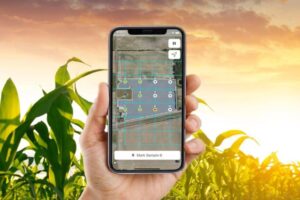
It involves using GPS, sensors, drones, and AI to monitor crop health and soil conditions in real time.
Key Features:
- Soil mapping using satellite data
- Automated irrigation systems
- Drone-based crop monitoring
- Smart fertilizer application
Why it matters:
Precision farming reduces waste and increases efficiency. Instead of treating an entire farm the same way, farmers now target specific areas based on real data.
Benefits:
- Increased crop yield
- Reduced fertilizer costs
- Improved soil conservation
- Better water management
Precision farming is a cornerstone of modern agronomy practices in sustainable agriculture 2026.
2. SOIL HEALTH MANAGEMENT IN CROP SCIENCE AND SUSTAINABLE FARMING
Healthy soil equals healthy crops. Agronomy places strong emphasis on soil science.
Soil management includes:
- Crop rotation
- Organic matter addition
- Soil pH balancing
- Erosion control
Soil is a living ecosystem, and agronomists work to keep it fertile and productive.
Benefits of agronomy in crop production and soil management:
- Long-term soil fertility
- Increased microbial activity
- Reduced soil degradation
- Improved nutrient cycling
Soil health is the foundation of sustainable farming success.
3. CLIMATE-SMART FARMING AND SUSTAINABLE AGRICULTURE 2026
Climate change has made farming more unpredictable, but agronomy provides solutions.
Climate-smart agriculture focuses on:
- Reducing greenhouse gas emissions
- Improving resilience to drought and floods
- Enhancing carbon sequestration in soil
Practical techniques:
- Drought-resistant crop varieties
- Conservation agriculture
- Agroforestry systems
The USDA emphasizes climate-smart agriculture as a key strategy for future food security.
https://www.usda.gov
4. CROP ROTATION AND DIVERSIFICATION IN FARMING AGRONOMY
Crop rotation is one of the oldest yet most effective agronomic practices.
How it works:
Farmers alternate crops each season to maintain soil nutrients and prevent pest buildup.
Example rotation system:
| Season | Crop Type | Benefit |
|---|---|---|
| Season 1 | Legumes | Fix nitrogen in soil |
| Season 2 | Cereals | High yield production |
| Season 3 | Root crops | Soil structure improvement |
Benefits:
- Natural pest control
- Improved soil fertility
- Higher long-term yield stability
- Reduced chemical fertilizer dependency
Crop diversification also increases income stability for farmers.
5. SMART IRRIGATION SYSTEMS AND HOW AGRONOMY IMPROVES FARM PRODUCTIVITY USING MODERN TECHNOLOGY
Water is one of the most critical farming resources.
Modern agronomy uses smart irrigation systems powered by:
- Soil moisture sensors
- Weather prediction tools
- Automated drip systems
Advantages:
- Reduces water waste
- Ensures optimal crop hydration
- Prevents over-irrigation damage
- Improves crop quality
Smart irrigation is a clear example of how agronomy improves farm productivity using modern technology.
6. INTEGRATED PEST MANAGEMENT IN CROP SCIENCE
Instead of relying heavily on chemical pesticides, agronomy promotes Integrated Pest Management (IPM).
IPM strategies include:
- Biological pest control (natural predators)
- Crop monitoring systems
- Resistant crop varieties
- Minimal pesticide use
Benefits:
- Safer food production
- Reduced environmental damage
- Lower farming costs
- Sustainable pest control
IPM aligns with global sustainable farming goals.
7. DIGITAL AGRICULTURE AND AI IN MODERN AGRONOMY PRACTICES IN SUSTAINABLE AGRICULTURE 2026
Technology is transforming agriculture faster than ever.
Digital farming tools include:
- AI-powered crop prediction
- Machine learning soil analysis
- Farm management software
- Blockchain food tracking systems
Why it is important:
- Increases decision-making accuracy
- Reduces human error
- Improves farm efficiency
- Enhances market transparency
Digital agronomy is the future of global food production.
COMPARISON TABLE: BENEFITS OF AGRONOMY PRACTICES IN MODERN FARMING
| Agronomy Practice | Main Benefit | Technology Used | Impact on Productivity |
|---|---|---|---|
| Precision Farming | Efficiency | GPS, AI, Drones | Very High |
| Soil Management | Fertility | Soil Sensors | High |
| Climate-Smart Farming | Resilience | Weather Models | High |
| Crop Rotation | Sustainability | Traditional + Data | Medium-High |
| Smart Irrigation | Water Saving | IoT Sensors | Very High |
| Integrated Pest Management | Eco Safety | Biological Tools | High |
| Digital Agriculture | Automation | AI & Software | Very High |
BENEFITS OF AGRONOMY IN CROP PRODUCTION AND SOIL MANAGEMENT
Agronomy plays a vital role in shaping global food systems.
Key benefits include:
- Improved crop yield and quality
- Sustainable use of natural resources
- Enhanced soil fertility
- Reduced environmental degradation
- Increased farmer profitability
Agronomy ensures that farming remains productive without destroying future resources.
HOW AGRONOMY IMPROVES FARM PRODUCTIVITY USING MODERN TECHNOLOGY
Technology is the driving force behind modern agronomy.
Key technological impacts:
- Real-time farm monitoring
- Predictive analytics for crop yield
- Automated machinery systems
- Data-based decision making
With these tools, farmers can:
- Identify problems early
- Reduce losses
- Maximize harvest output
Agronomy has transformed farming from guesswork into a science-based system.
WHAT IS AGRONOMY IN FARMING AND WHY IS IT IMPORTANT?
Agronomy is important because it:
- Ensures food security
- Supports sustainable development
- Protects natural ecosystems
- Improves farming efficiency
Without agronomy, modern agriculture would struggle to meet global food demands.

THE ROLE OF MICROORGANISMS IN SOIL AND FARMING (REWRITTEN – LOW KEYWORD DENSITY)
Beneath every healthy field of crops lies a complex and invisible world of life. This underground ecosystem is filled with tiny organisms that play a major role in keeping soil active, balanced, and capable of supporting plant growth.
Although they cannot be seen, these organisms are essential to the way farmland functions and produces food.
HOW SOIL LIFE SUPPORTS PLANT GROWTH
The soil is not just a physical base for plants—it is a living environment. Microorganisms in the soil contribute to farming in several natural ways:
- They help break down dead plant material into simpler substances
- They recycle nutrients back into the ground for plant use
- They support healthier root development
- They improve the natural condition of the soil
Through these processes, soil becomes more fertile and better suited for growing crops over time.
NATURAL PROCESSES THAT IMPROVE SOIL QUALITY
One of the most important functions of soil organisms is nutrient cycling. This means they take organic matter and convert it into forms that plants can absorb.
They also interact with plant roots in helpful ways, allowing crops to access water and nutrients more efficiently. In some cases, these organisms form close relationships with plants that improve growth and resilience.
Additionally, their activity helps maintain soil texture, allowing air and water to move more easily through the ground.
WHY SOIL HEALTH MATTERS IN FARMING
Healthy soil leads to stronger agricultural systems. When the soil is active and biologically balanced, it supports consistent crop growth and reduces the need for external inputs.
Farmers benefit from this natural system because it:
- Improves long-term productivity
- Reduces dependency on artificial fertilizers
- Supports more stable harvests
- Helps maintain land quality over time
HEALTHY SOIL VS WEAK SOIL CONDITIONS
| Feature | Active Soil Ecosystem | Poor Soil Condition |
|---|---|---|
| Nutrient Supply | Naturally balanced | Limited availability |
| Crop Growth | Strong and steady | Weak and uneven |
| Water Movement | Well regulated | Poor absorption |
| Soil Structure | Loose and healthy | Compacted and degraded |
| Long-Term Use | Sustainable | Declining quality |
THOUGHT
The living organisms beneath farmland quietly support almost every aspect of agriculture. By understanding and protecting this hidden world, farming systems can remain productive, stable, and healthier for many years to come.
Here are credible sources supporting soil microbiology in agriculture:
- FAO Soil Biodiversity Overview: https://www.fao.org/soils-portal/soil-biodiversity/en/
- USDA Soil Health and Microbiology Research: https://www.nrcs.usda.gov/conservation-basics/natural-resource-concerns/soil/soil-health
THOUGHT
Soil microbiology is the invisible engine behind modern agriculture. Without it, even the most advanced crop science systems would struggle to sustain productivity.
As agronomy continues to evolve in 2026, the integration of microbial science into farming is no longer optional—it is essential for building a resilient, productive, and sustainable agricultural future.

AGRICULTURE AND CLIMATE CHANGE ADAPTATION: SHAPING FUTURE FARMING SYSTEMS
Weather patterns around the world are becoming less predictable, and this is having a direct impact on food production. Farmers are now dealing with longer dry seasons, unexpected heavy rainfall, and shifting growing conditions that were not common in the past.
Because of these changes, farming practices are gradually evolving to help producers cope better with environmental stress and maintain stable harvests.
HOW FARMING IS RESPONDING TO A CHANGING CLIMATE
Modern farming systems are adjusting in different ways to reduce risks caused by climate shifts. These adjustments are based on research, experience, and improved agricultural planning.
Some common responses include:
- Choosing crop types that can survive harsh weather conditions
- Adjusting planting and harvesting times
- Using water more carefully and efficiently
- Improving land management practices
These changes help farmers remain productive even when conditions are uncertain.
KEY ENVIRONMENTAL CHALLENGES IN AGRICULTURE
Farming today is affected by several environmental pressures, such as:
- Irregular rainfall patterns that affect planting seasons
- Rising temperatures that stress crops
- Increased frequency of floods and droughts
- More crop pests are appearing in different regions
- Gradual decline in soil quality in some areas
These challenges require more thoughtful and flexible farming approaches.
PRACTICAL FARMING STRATEGIES FOR ADAPTATION
To handle these challenges, farmers are adopting practical methods such as:
1. Better Crop Selection
Farmers are increasingly growing varieties that can handle heat, drought, or excess moisture, depending on local conditions.
2. Improved Soil Care
Protecting soil through reduced disturbance and organic matter use helps maintain its ability to support crops over time.
3. Smarter Water Use
Techniques like drip irrigation and rainwater collection help reduce water waste and ensure crops receive enough moisture.
4. Diversified Farming Systems
Mixing different crops and integrating trees or livestock helps reduce risk and improve farm stability.
5. Balanced Pest Control
Farmers are combining natural methods with limited chemical use to manage pests more effectively and safely.
FARMING APPROACHES: OLD VS NEW
| Aspect | Traditional Approach | Modern Adaptive Approach |
|---|---|---|
| Water Management | General irrigation | Targeted water use |
| Crop Choice | Fixed seasonal crops | Flexible crop selection |
| Soil Care | Minimal attention | Active soil improvement |
| Pest Control | Chemical-heavy | Mixed control methods |
| Risk Handling | Limited | More resilient systems |
WHY ADAPTATION MATTERS IN AGRICULTURE
Adjusting farming practices is becoming increasingly important because it helps:
- Maintain food production despite weather changes
- Reduce losses caused by extreme conditions
- Protect farmland for future use
- Support long-term agricultural stability
These efforts ensure that farming remains viable in changing environmental conditions.
THOUGHT
Farming is entering a new phase where flexibility and resilience are more important than ever. By adjusting to environmental changes through smarter practices, agriculture can continue to support growing populations while adapting to a changing world.
- FAO Climate-Smart Agriculture Overview: https://www.fao.org/climate-smart-agriculture/en/
- IPCC Climate Change and Land Report: https://www.ipcc.ch/srccl/
NOTE
Climate change is one of the biggest challenges facing agriculture today, but agronomy provides the tools needed to adapt. By combining science, innovation, and sustainable practices, farmers can continue to produce food efficiently while protecting the environment.
Without agronomy, farming systems would struggle to survive increasing environmental pressure.
- FAO Climate-Smart Agriculture: https://www.fao.org/climate-smart-agriculture/en/
- IPCC Climate and Land Report: https://www.ipcc.ch/srccl/
THOUGHT
Climate change is one of the greatest challenges facing agriculture today, but it is also driving innovation. Through agronomy, farmers are no longer simply reacting to climate problems—they are actively adapting to them.
By integrating science, technology, and sustainability, agronomy ensures that farming remains productive, resilient, and environmentally responsible in the face of a rapidly changing world.
CONCLUSION: THE FUTURE OF AGRONOMY IN SUSTAINABLE FARMING
Agronomy is no longer just an academic discipline—it is the foundation of modern agriculture.
From precision farming to digital agriculture, the 7 powerful modern farming practices discussed above show how science and technology are reshaping farming in 2026.
The future of agriculture depends on:
- Sustainability
- Innovation
- Smart technology
- Soil and crop balance
As global challenges increase, agronomy will continue to be the key to feeding the world efficiently and sustainably.
About The Author