Soil Health
A productive farm does not begin with fertilizer, machinery, or even seeds. It begins beneath our feet.
The condition of the soil determines how effectively crops can access water, nutrients, air, and biological support throughout the growing season. When soil is healthy, plants generally have a stronger foundation for growth. When soil becomes degraded through repeated cropping, erosion, nutrient depletion, compaction, or declining organic matter, farmers may find themselves spending more money simply to maintain yields that once came naturally.
This is where Crop Rotation becomes one of the most practical tools in sustainable agriculture.
Instead of planting the same crop on the same land year after year, crop rotation involves changing the crops grown in a field according to a planned sequence. A farmer might grow maize one season, followed by beans, cowpea, soybean, groundnut, vegetables, or another suitable crop. The exact sequence depends on the climate, soil type, available markets, farming objectives, and crops being produced.
At first glance, changing crops may seem like a simple farming tradition. In reality, it can influence several interconnected processes underground. Different crops have different root systems, nutrient requirements, residue characteristics, and relationships with soil organisms. Some legumes can contribute nitrogen through biological fixation, while deep-rooted crops can explore different layers of soil. Different crops can also interrupt pest, disease, and weed cycles.
The result is a farming system that can be more diverse and, when properly designed, more resilient.
Research is increasingly strengthening the case for diversified rotations. A 2025 Nature Communications meta-analysis examined 3,663 paired field-trial yield observations from 1980 to 2024 and found that crop rotation increased the yield of the crop that followed compared with continuous monoculture. The average increase was about 20%, with rotations involving legumes producing particularly strong results. (Nature)
But the story goes beyond yield.
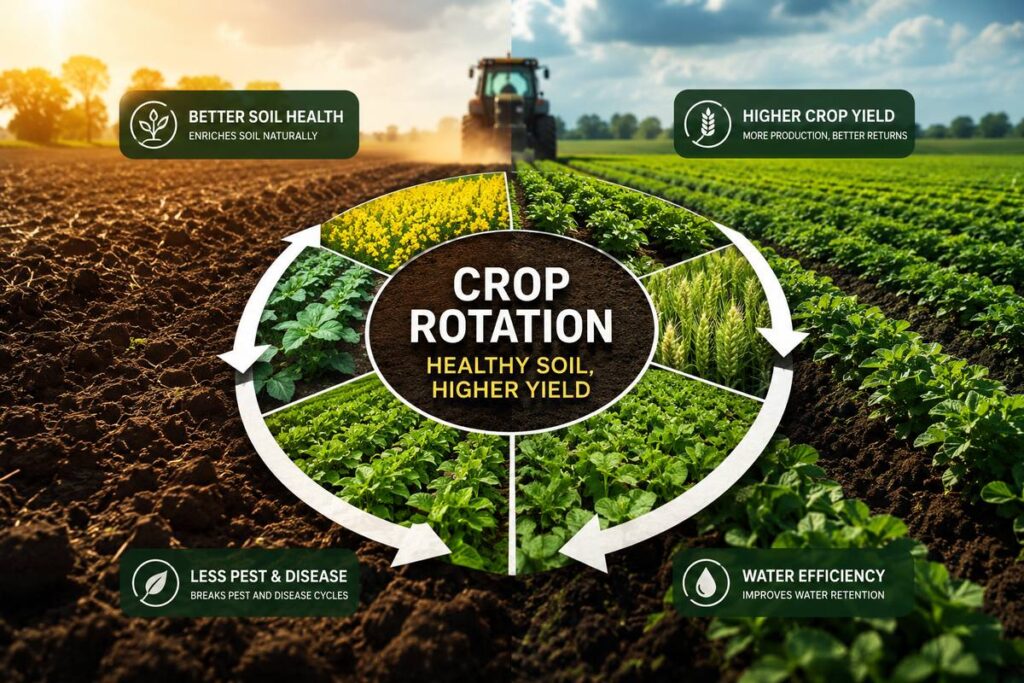
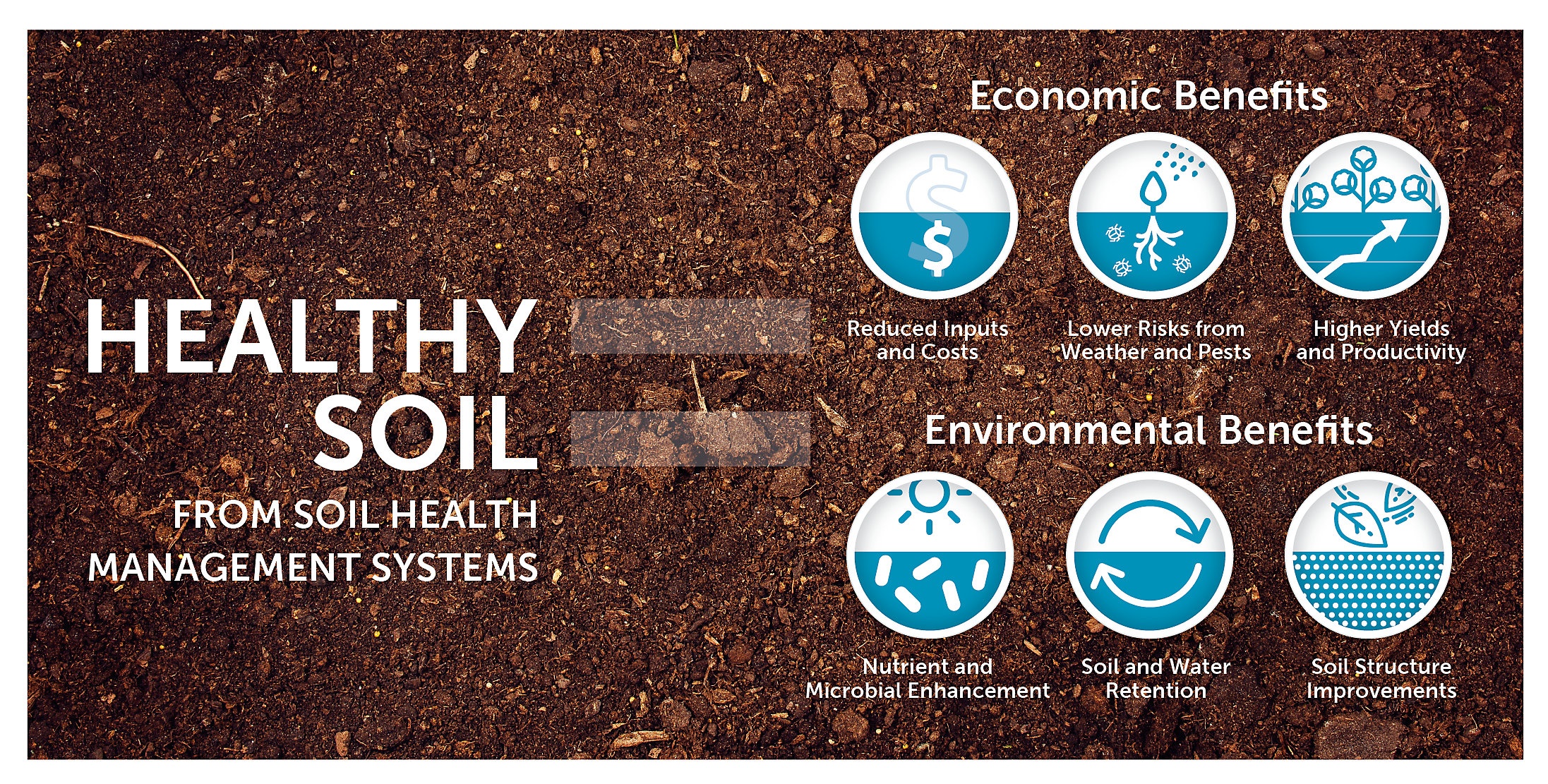
The benefits of crop rotation for soil health can include improved nutrient cycling, greater biological diversity, better soil structure, more effective use of water and nutrients, and reduced pressure from crop-specific pests and diseases.
So, what exactly makes crop rotation so valuable?
Let us take a closer look at the most important Crop Rotation Benefits, and how they can contribute to healthier soil and better farm productivity.

Soil Health and Crop Rotation: What Does Crop Rotation Actually Mean?
Before discussing the benefits, it is important to understand what crop rotation means.
Crop rotation is the planned practice of growing different crops on the same piece of land in a particular sequence over multiple growing seasons.
For example, instead of planting maize continuously:
Year 1: Maize
Year 2: Cowpea
Year 3: Maize
Year 4: Groundnut
The farmer deliberately changes the crop occupying the field.
Another farm might use:
Maize → Soybean → Wheat → Cover crop → Maize
A vegetable farmer could use a different sequence:
Tomato → Beans → Cabbage → Sweet corn → Tomato
The objective is not simply to grow different crops for variety. The objective is to make the biological and physical characteristics of one crop complement the needs of another.
A cereal crop may remove substantial quantities of particular nutrients, while a legume can contribute biologically fixed nitrogen. A crop with deep roots may explore soil layers that a shallow-rooted crop does not reach. A crop producing substantial residues can contribute organic material to the soil.
According to the Food and Agriculture Organization, crop rotation allows different root systems to explore different soil depths and can help recycle nutrients while supporting a more diverse community of soil organisms. FAO also identifies pest and disease interruption, improved water and nutrient distribution, nitrogen fixation, and increased humus formation among the effects associated with crop diversification. (FAOHome)
This explains why crop rotation should not be viewed as merely “changing crops.”
It is better understood as managing the entire farm ecosystem through crop diversity.
Soil Health and Crop Rotation: Why Does Soil Health Matter?
Soil health refers to the capacity of soil to function effectively as a living ecosystem that supports plants, regulates water, cycles nutrients, and maintains biological activity.
Healthy soil is not simply soil that contains a lot of fertilizer.
A healthy agricultural soil needs a combination of physical, chemical, and biological properties.
These include:
- Good soil structure
- Adequate organic matter
- Sufficient nutrient availability
- Good water infiltration
- Adequate water-holding capacity
- Healthy microbial activity
- Suitable root penetration
- Reduced erosion
- Balanced biological activity
- Appropriate soil pH
- Good nutrient cycling
Think of soil as a living system rather than an inert material.
Millions of organisms can live within agricultural soil. Bacteria, fungi, earthworms, insects, and other organisms interact with plant roots and decomposing organic matter. Their activities influence nutrient cycling and soil structure.
This is one reason why repeated monoculture can become problematic under some conditions.
When the same crop is grown repeatedly, the field experiences a relatively narrow pattern of root growth, residue production, nutrient removal, pest pressure, and disease exposure.
Crop rotation introduces a different biological pattern.
The roots change.
The residues change.
The nutrient demands change.
The organisms interacting with the roots change.
The timing of field operations may change.
And, importantly, pests and diseases that depend heavily on one crop may lose their continuous host.
This diversity can create a healthier and more balanced production environment.
Soil Health Benefit 1: Crop Rotation Helps Improve Soil Fertility
One of the most important Crop Rotation Benefits is its potential to improve and maintain soil fertility.
Soil fertility describes the soil’s ability to supply plants with the nutrients they need for growth.
Plants require nutrients such as nitrogen, phosphorus, potassium, sulfur, calcium, magnesium, and several micronutrients. However, simply having nutrients in the soil does not guarantee that plants can use them efficiently.
Different crops interact with soil nutrients differently.
Some crops are heavy nutrient users. Others have different nutrient requirements. Legumes such as cowpea, soybean, beans, groundnut, and some forage legumes can form relationships with nitrogen-fixing bacteria that enable atmospheric nitrogen to become part of biologically useful nitrogen pools.
This is particularly important in rotations involving cereals.
For example:
Maize → Cowpea → Maize
The cowpea phase can provide benefits that differ from those provided by continuous maize cultivation.
The exact amount of nitrogen benefit varies according to the legume, soil conditions, biological activity, residue management, climate, and other factors. Farmers should therefore avoid assuming that every legume automatically replaces a fixed quantity of fertilizer.
Nevertheless, including legumes in suitable rotations can improve nutrient cycling and reduce dependence on continuous nutrient extraction by the same crop.
FAO describes crop rotations involving legumes as a way of improving soil fertility and productivity and notes their potential to increase biological nitrogen fixation and fertilizer-use efficiency
This is one reason the phrase benefits of crop rotation for soil health is more meaningful than simply saying that rotation “adds nutrients.”
The bigger idea is nutrient cycling.
A good rotation tries to reduce the imbalance created when the same crop repeatedly takes nutrients from the same system without sufficient replenishment.
Soil Health Benefit 2: Crop Rotation Can Increase Crop Yield
Farmers ultimately need productive fields.
So while soil health is important in its own right, one of the biggest questions is:
Does crop rotation actually improve crop yield?
Evidence suggests that it can.
The 2025 meta-analysis published in Nature Communications analyzed thousands of paired field observations and found that crop rotation increased the yield of subsequent crops by about 20% compared with monoculture. Legume pre-crops produced an average subsequent-crop yield increase of approximately 23%, compared with about 16% for non-legume pre-crops.
That is significant because it demonstrates that the effects of rotation are not merely theoretical.
However, farmers should not interpret the findings as a guarantee that every rotation will increase every crop’s yield.
Agriculture is highly dependent on local conditions.
Yield responses can be influenced by:
- Rainfall
- Irrigation
- Soil type
- Fertilizer management
- Crop variety
- Planting date
- Pest pressure
- Rotation length
- Previous crop
- Residue management
- Weed control
- Temperature
- Farm management practices
The most successful rotation is therefore the one designed around the actual farm.
A farmer who understands the needs of each crop can use rotation strategically rather than randomly.
For example, if maize has been repeatedly planted on the same land and yields are declining, introducing a suitable legume may help change the nutrient and biological dynamics of the field.
This is how crop rotation improves soil fertility and yield: not through one magical mechanism, but through several processes working together.
Soil Health Benefit 3: Crop Rotation Helps Control Crop Pests
Another important benefit of crop rotation is pest management.
Many agricultural pests are closely associated with particular crops.
When the same crop is planted repeatedly, pests that depend on that crop may have an easier opportunity to survive, reproduce, and establish themselves in the production system.
Changing crops can interrupt this cycle.
Imagine a pest whose preferred host is a particular crop. If that crop is planted continuously, the pest may encounter suitable food year after year.
But if the crop is replaced with a non-host crop, the pest may face a much less favorable environment.
This does not mean crop rotation eliminates pests.
It does not.
Some pests have wide host ranges, survive in soil, move between fields, or remain present in crop residues. Others may attack multiple crops within the same rotation.
Therefore, crop rotation should be considered one component of integrated pest management, rather than a standalone pest-control solution.
FAO specifically identifies crop rotation’s phytosanitary role, noting that rotation can prevent the carry-over of crop-specific pests and diseases from one crop to the next. (FAOHome)
This can be particularly valuable when rotation is combined with:
- Resistant crop varieties
- Field sanitation
- Proper planting dates
- Biological control
- Monitoring
- Good weed management
- Appropriate pesticide use when necessary
The goal is to make the farm environment less favorable to recurring pest problems.
Soil Health Benefit 4: Crop Rotation Can Reduce Certain Plant Diseases
Disease management is another reason farmers use crop rotation.
Some plant pathogens can survive in soil or crop residues and become more problematic when the same susceptible crop is grown repeatedly.
Continuous cultivation creates a predictable host environment.
Rotation breaks that pattern.
For example, if a soil-borne pathogen is strongly associated with one crop family, planting a crop from a different family can reduce the immediate availability of a suitable host.
The effectiveness depends on the specific disease and pathogen.
A two-year rotation may be insufficient for pathogens capable of surviving for several years. Some diseases can also infect several related crops, meaning simply switching to another crop within the same botanical family may not provide enough separation.
This is why farmers should identify the disease before designing the rotation.
A useful rotation plan considers:
Which crop is affected?
What pathogen causes the disease?
How long can it survive?
Which other crops can host it?
Which crops are suitable non-host alternatives?
How long should the rotation last?
The broader principle is simple:
A crop disease is harder to maintain when its preferred host is no longer continuously available.
That makes crop rotation an important preventive strategy in many farming systems.
Soil Health Benefit 5: Crop Rotation Helps Improve Soil Structure
Soil structure refers to how individual soil particles are arranged into aggregates and pore spaces.
Good structure allows roots to grow, water to infiltrate, air to move, and organisms to function.
Poor structure can produce problems such as:
- Compaction
- Waterlogging
- Poor drainage
- Restricted root growth
- Increased runoff
- Reduced infiltration
- Greater erosion risk
Different crops develop different root systems.
Some roots are shallow.
Some penetrate deeply.
Some are fibrous.
Others are thick and strong.
Some produce extensive networks of fine roots that interact with soil particles and organisms.
When different crops are used over time, their roots can influence different parts of the soil profile.
FAO explains that diverse crops can create different biopores and improve the distribution of water and nutrients through the soil profile.
This matters because roots are not just structures that absorb water and nutrients.
They also physically interact with soil.
As roots grow and later decompose, they can leave channels behind. These channels may provide pathways for water movement and future root growth.
This is sometimes described as a form of “biological tillage.”
Deep-rooted crops can be particularly useful where compacted layers restrict root development, although the result depends heavily on the species and soil conditions.
Crop rotation therefore has the potential to influence soil structure naturally while reducing the need to rely exclusively on mechanical intervention.
Soil Health Benefit 6: Crop Rotation Improves Nutrient Cycling
Nutrients do not simply disappear after a crop uses them.
They move through a complex system involving plants, soil organisms, organic matter, water, and mineral particles.
Crop rotation can make this nutrient cycle more diverse.
Different crops absorb nutrients from different depths and in different quantities.
Some crops have shallow root systems.
Others reach deeper soil layers.
Some produce large quantities of residues.
Others leave relatively little biomass.
Some legumes interact with microorganisms capable of biological nitrogen fixation.
The result can be a more varied nutrient cycle.
FAO describes different crops as “biological pumps” because their roots can explore different soil layers and help recycle nutrients that have moved deeper into the soil profile.
This is particularly relevant for nutrients that can move below the main rooting zone of one crop.
Consider a simple example.
A shallow-rooted crop may leave some nutrients deeper in the soil.
A subsequent deep-rooted crop may access part of that nutrient supply.
When the second crop’s residues return to the soil and decompose, nutrients can eventually become available again.
This does not mean rotation eliminates the need for fertilizer.
Far from it.
Nutrient removal through harvested grain, roots, fruits, tubers, and other products still occurs.
A productive farm must replace nutrients removed from the system through appropriate fertilization, manure, compost, residue management, biological processes, or combinations of these approaches.
Rotation makes nutrient management more efficient; it does not make nutrient management unnecessary.
Soil Health Benefit 7: Crop Rotation Can Increase Soil Organic Matter
Organic matter is one of the foundations of healthy agricultural soil.
It comes from plant residues, roots, microorganisms, animal materials, and other decomposing biological materials.
Organic matter contributes to several soil functions.
It can help:
- Improve soil structure
- Support microorganisms
- Store nutrients
- Improve water retention
- Reduce erosion vulnerability
- Improve aggregation
- Support carbon storage
Different crops produce different quantities and qualities of residues.
A rotation that includes crops producing substantial root biomass and above-ground residues can contribute organic material to the soil.
Cover crops can also be incorporated into rotation systems for this purpose.
FAO notes that crop residues and cover crops can contribute organic matter, protect soil during periods without commercial crops, recycle nutrients, and improve soil structure.
This highlights an important distinction.
Growing different crops is helpful, but what happens to the crop residues matters too.
If all residues are removed from the field, burned, or otherwise lost, some potential soil benefits are also removed.
Where agronomically and economically appropriate, retaining residues can help maintain organic inputs.
The best system depends on the farm.
Livestock may need crop residues for feed.
Residues may also be needed for fuel or other household purposes.
Therefore, residue management must balance soil needs with farmers’ economic and household realities.
Soil Health Benefit 8: Crop Rotation Can Improve Water Use and Soil Moisture
Water is one of the biggest limitations to agricultural productivity.
A field may receive adequate rainfall, yet crops can still suffer because water runs off rapidly, evaporates, or moves beyond the effective root zone.
Healthy soil structure can improve the movement and storage of water.
Crop rotation can contribute indirectly by influencing:
- Root channels
- Organic matter
- Soil aggregation
- Infiltration
- Ground cover
- Soil porosity
Different root systems explore different areas of the soil profile.
This can help crops access water at different depths.
FAO notes that diverse roots can explore different soil strata and improve the distribution and use of available water and nutrients.
The relationship between crop rotation and water is particularly important in regions where rainfall is irregular.
A soil with better structure and organic matter may be better positioned to absorb rainfall rather than allowing large amounts of water to become runoff.
During dry periods, better water retention can help extend the availability of water to plants.
However, crop rotation alone cannot solve drought.
If rainfall is extremely low, the crop still needs water.
Farmers can strengthen the water-related benefits of rotation by combining it with:
- Mulching
- Cover crops
- Reduced soil disturbance where appropriate
- Contour farming
- Terracing where suitable
- Good irrigation management
- Residue retention
- Erosion control
The lesson is that soil health and water management are closely connected.
Soil Health Benefit 9: Crop Rotation Can Help Manage Weeds
Weeds compete with crops for:
- Water
- Nutrients
- Light
- Space
Some weed species become especially troublesome when the same crop and the same management practices are repeated year after year.
Continuous cropping can create predictable conditions that favor certain weeds.
Rotation changes those conditions.
Different crops may have different planting dates, canopy structures, row spacing, growth rates, and cultivation practices.
A weed that thrives in one crop environment may be less successful under another.
Rotation can therefore make weed populations more difficult to maintain.
However, farmers should not expect rotation to eliminate weeds.
Effective weed management may still require:
- Crop competition
- Mulching
- Cover crops
- Timely cultivation
- Hand weeding
- Mechanical control
- Herbicides when appropriate
- Good planting density
- Clean seed
- Preventing weeds from producing seed
One advantage of rotation is that it provides more opportunities to vary management.
Instead of fighting the same weed population under identical conditions every season, farmers can create a more diverse production environment.
This is one reason FAO lists reduction of weed and pest infestations among the potential effects of crop diversification and rotation
Soil Health Benefit 10: Crop Rotation Can Make Farms More Resilient and Profitable
Perhaps the most overlooked Crop Rotation Benefit is diversification.
Farming is inherently risky.
Weather can change.
Pests can arrive unexpectedly.
Market prices can fall.
Disease outbreaks can affect a crop.
Input prices can increase.
A farmer who depends entirely on one crop may be highly exposed to any problem affecting that crop.
Crop rotation introduces another layer of diversity.
Suppose a farmer grows maize and soybean.
If maize prices fall, soybean may provide another income opportunity.
If a pest severely affects one crop, the other crop may be less affected.
If one crop performs poorly because of unusual weather, another may perform better.
This does not guarantee profitability.
Every crop has production costs and market risks.
However, diversification can reduce dependence on a single production outcome.
The 2025 Nature Communications meta-analysis found that, across the complete crop sequences examined, rotation increased not only yields but also dietary energy, protein, several micronutrients, and revenue compared with continuous monoculture. (Nature)
This is a powerful reminder that how does crop rotation benefit farmers and soil is a bigger question than simply asking whether rotation produces more grain.
A successful rotation can potentially improve:
Soil → Crop performance → Farm resilience → Income opportunities
That connection is what makes crop rotation valuable as a long-term farming strategy.
Soil Health Comparison: Crop Rotation vs Continuous Monoculture
The difference between crop rotation and continuous monoculture becomes easier to understand when the two systems are compared directly.
| Farming Factor | Crop Rotation | Continuous Monoculture |
|---|---|---|
| Crop diversity | High | Low |
| Nutrient demand | Changes between crops | Often repetitive |
| Root systems | More diverse | More uniform |
| Pest pressure | Can be interrupted | May build up |
| Disease pressure | Can be interrupted for some diseases | May persist or increase |
| Soil biological diversity | Can increase | May be less diverse |
| Nutrient cycling | More varied | More repetitive |
| Soil structure | Can benefit from diverse roots and residues | May become vulnerable under poor management |
| Weed management | Management conditions can vary | Same conditions may favor certain weeds |
| Yield stability | Can improve in suitable systems | May be more exposed to crop-specific problems |
| Income diversification | Greater | Lower |
| Long-term soil management | Potentially stronger | Requires careful nutrient and soil management |
The table should not be interpreted as saying that monoculture is always harmful or that crop rotation is always superior.
A well-managed monoculture can be highly productive.
Likewise, a poorly designed rotation can create problems.
The important point is that crop diversity gives farmers additional biological tools for managing the production system.
Soil Health and Crop Rotation: The Role of Legumes
If there is one group of crops that deserves special attention in rotation planning, it is legumes.
Legumes include crops such as:
- Cowpea
- Soybean
- Common beans
- Groundnut
- Peas
- Lentils
- Alfalfa
- Some clovers
- Other suitable forage and grain legumes
Many legumes can form symbiotic relationships with bacteria that fix atmospheric nitrogen.
This process can contribute biologically available nitrogen to the farming system.
That is one reason rotations such as:
Maize → Cowpea → Maize
or:
Maize → Soybean → Maize
are common examples of cereal-legume rotations.
The benefits extend beyond nitrogen.
Legumes can produce residues, support different soil organisms, change rooting patterns, and interrupt some pest and disease cycles.
The 2025 global meta-analysis found particularly strong yield benefits following legume pre-crops, with a 23% average increase in the subsequent crop compared with continuous monoculture in the analyzed trials.
Still, farmers should remember that not every legume will perform equally well everywhere.
The right legume depends on:
- Climate
- Soil type
- Rainfall
- Market demand
- Seed availability
- Disease pressure
- Growing season
- Farmer objectives
- Livestock needs
The best rotation is always local.
Soil Health and Crop Rotation Examples for Farmers
The theory becomes much easier to understand when we look at practical examples.
Soil Health Example 1: Maize and Cowpea Rotation
Year 1: Maize
Year 2: Cowpea
Year 3: Maize
Year 4: Cowpea
This is a simple cereal-legume rotation.
Maize is a major cereal crop with substantial nutrient requirements.
Cowpea provides a contrasting crop type and can form nitrogen-fixing relationships with compatible bacteria.
This system can be particularly relevant in tropical and subtropical farming regions where both crops are adapted.
Soil Health Example 2: Maize and Soybean Rotation
Year 1: Maize
Year 2: Soybean
Year 3: Maize
Year 4: Soybean
Soybean provides another legume option.
The rotation may help diversify root systems, nutrient demands, pest pressures, and farm income.
However, farmers should consider soybean-specific diseases, varieties, inoculation requirements where appropriate, market prices, and soil conditions.
Soil Health Example 3: Wheat and Legume Rotation
Year 1: Wheat
Year 2: Soybean or another suitable legume
Year 3: Wheat
This system can help break continuous cereal production while providing a different crop phase.
In appropriate environments, cereal-legume rotations can improve nutrient-use efficiency and subsequent crop performance.
Soil Health Example 4: Vegetable Crop Rotation
Vegetable farmers can rotate crop families rather than repeatedly growing the same vegetable.
For example:
Tomato → Beans → Cabbage → Sweet corn → Tomato
The purpose is to avoid repeatedly exposing the soil to the same crop family and associated pests and diseases.
The exact sequence should be adapted to local conditions.
A tomato farmer dealing with a particular soil-borne disease should choose rotation crops that are appropriate non-hosts for that pathogen.
Soil Health and Crop Rotation: How to Design a Good Rotation
Designing a rotation should begin with the farm rather than with a generic formula found online.
Start by identifying the major problem.
Is the soil losing fertility?
Are pests becoming difficult to control?
Is erosion increasing?
Is water infiltration poor?
Are weeds becoming resistant to the same management practices?
Are yields declining?
Is the farm too dependent on one crop?
Once the problem is identified, choose crops that can help address it.
Consider these factors:
1. Soil type
Sandy, clayey, loamy, acidic, alkaline, shallow, and poorly drained soils behave differently.
2. Climate
Rainfall patterns and temperature determine which crops can be grown successfully.
3. Root depth
Combining crops with different rooting patterns can help diversify soil exploration.
4. Nutrient requirements
Avoid designing a rotation in which every crop has the same heavy nutrient demands.
5. Legumes
Where appropriate, include legumes to diversify nutrient cycling and potentially contribute biologically fixed nitrogen.
6. Pest and disease history
Know which pests and diseases have been affecting the farm.
7. Weed problems
Choose crops and management practices that allow weed-control strategies to vary.
8. Market demand
A crop that improves the soil but cannot be sold profitably may not be practical for a commercial farmer.
9. Labor
Some rotations require more labor than others.
10. Available machinery
Planting and harvesting equipment can influence which crops are practical.
11. Livestock integration
If a farmer keeps livestock, forage crops and crop residues may have additional value.
12. Rotation length
Some soil, pest, and disease problems require longer breaks between susceptible crops.
Soil Health and Crop Rotation: Common Mistakes Farmers Should Avoid
Crop rotation is powerful, but poor planning can reduce its effectiveness.
Mistake 1: Rotating crops without considering crop families
Tomato, pepper, eggplant, and some other vegetables belong to the same botanical family.
Simply switching from one to another may not provide the disease break a farmer expects.
Mistake 2: Choosing crops only for soil benefits
A rotation must also make economic sense.
Farmers need crops they can plant, manage, harvest, store, and sell.
Mistake 3: Assuming rotation eliminates fertilizer
Rotation can improve nutrient cycling, but harvested crops remove nutrients from fields.
Soil testing and appropriate nutrient management remain important.
Mistake 4: Ignoring residues
Removing every residue from the field can reduce organic inputs.
Where feasible, residue retention can strengthen soil-health goals.
Mistake 5: Using the same rotation everywhere
A rotation that works extremely well in one region may perform poorly somewhere else.
Climate, soil, pests, and markets matter.
Mistake 6: Expecting immediate transformation
Some soil-health changes take time.
Farmers should evaluate trends over multiple seasons rather than expecting dramatic improvement after one rotation.
Soil Health and Crop Rotation: Does Crop Rotation Replace Fertilizer?
No.
This is one of the most important points to understand.
Crop rotation should not be presented as a replacement for all fertilizers.
Plants remove nutrients when farmers harvest grain, fruits, roots, tubers, leaves, or other products.
Those nutrients must eventually be replenished.
Rotation can improve nutrient cycling and, particularly when legumes are included, can contribute to nitrogen supply. But fertilizer, manure, compost, or other nutrient sources may still be necessary.
The best approach is integrated nutrient management.
That may involve:
- Soil testing
- Organic amendments
- Mineral fertilizers
- Legumes
- Crop residues
- Compost
- Manure
- Cover crops
- Appropriate nutrient timing
- Reduced nutrient losses
The goal is not to eliminate fertilizer at all costs.
The goal is to use nutrients efficiently while maintaining long-term soil productivity.
Soil Health and Crop Rotation: What the Latest Research Says
Modern research is adding important detail to the traditional understanding of crop rotation.
The strongest recent evidence comes from large-scale analyses that combine results from many field experiments.
The 2025 Nature Communications meta-analysis analyzed 3,663 paired field-trial yield observations collected across decades and continents. It found that crop rotation increased subsequent crop yields by approximately 20% compared with monoculture. Legume pre-crops produced larger average yield gains than non-legume pre-crops.
The study also found that rotation increased total sequence-level outcomes related to yield, dietary energy, nutrients, and revenue.
Another important finding was that yield variability of the subsequent crop was lower under rotation in the analyzed data, suggesting that rotation may contribute to greater yield stability under variable conditions.
Research from the North China Plain provides another useful example. A six-year field experiment found that diversifying traditional wheat-maize production with crops including sweet potato and legumes increased equivalent yield by up to 38%, while the study reported improvements in soil-health indicators and soil organic carbon alongside other environmental benefits.
These findings do not mean every farmer should copy those exact crop sequences.
Instead, they demonstrate an important principle:
Diversification can produce measurable benefits when the rotation is appropriately designed for its environment.
Soil Health and Crop Rotation in Sustainable Agriculture
Sustainable agriculture is ultimately about maintaining the ability of farmland to produce food over the long term.
That means farmers have to think beyond a single harvest.
A system that produces a large harvest today but severely degrades the soil may create larger problems later.
Crop rotation fits into sustainable agriculture because it addresses several dimensions simultaneously.
It can contribute to:
- Soil fertility
- Biodiversity
- Pest management
- Disease management
- Water management
- Soil structure
- Nutrient cycling
- Crop diversification
- Farm resilience
FAO identifies crop diversity as one of the important principles within conservation agriculture and highlights rotation’s role in productivity, soil management, pest and disease control, and resource use. (FAOHome)
But sustainable farming should never be reduced to one practice.
Crop rotation works best when combined with other appropriate practices.
These may include:
- Reduced soil disturbance
- Soil cover
- Cover cropping
- Integrated pest management
- Appropriate irrigation
- Erosion control
- Balanced fertilization
- Organic matter management
- Good seed selection
The strength comes from combining complementary practices.
Soil Health and Crop Rotation: What Are the Main Benefits in One View?
For farmers who want a quick summary, the major Crop Rotation Benefits can be grouped into ten areas:
- Improved soil fertility through more diverse nutrient cycling and appropriate inclusion of legumes.
- Higher crop yield where rotation improves growing conditions and reduces limiting factors.
- Better pest management by interrupting the continuous presence of suitable host crops.
- Disease reduction for some crop-specific and soil-associated diseases.
- Improved soil structure through diverse root systems and residue inputs.
- Better nutrient cycling as different crops explore and use soil resources differently.
- More organic matter when suitable crops and residues contribute biological material.
- Improved water management through effects on soil structure, infiltration, roots, and organic matter.
- Better weed management by changing crop environments and management patterns.
- Greater farm resilience through crop and income diversification.
These benefits are connected.
Improved soil structure can support water infiltration.
Better water availability can support plant growth.
Healthy roots can support soil biological activity.
More diverse biological activity can influence nutrient cycling.
Better nutrient cycling can contribute to crop productivity.
That is why the benefits of crop rotation for soil health should be viewed as a network of relationships rather than ten completely separate advantages.
Soil Health and Crop Rotation: How Long Does It Take to See Results?
There is no universal answer.
Some effects may become visible relatively quickly.
For example, changing crops can immediately change pest-host availability and crop residue characteristics.
Other changes, such as improvements in soil organic matter or long-term soil structure, may take considerably longer.
Farmers should therefore avoid judging a rotation after only one season.
Instead, monitor:
- Crop yield
- Soil organic matter
- Soil nutrient levels
- Soil pH
- Weed populations
- Pest incidence
- Disease incidence
- Water infiltration
- Soil moisture
- Erosion
- Production costs
- Farm income
Keeping records makes rotation decisions much more objective.
A farmer may discover that one crop sequence produces slightly less yield in the short term but significantly reduces input costs or improves the following crop.
Another rotation may improve soil fertility but perform poorly economically because the alternative crop has no reliable market.
Good agricultural decisions consider both.

Soil Health and Crop Rotation: Is Crop Rotation Suitable for Small Farms?
Yes.
Crop rotation is not only for large commercial farms.
Smallholder farmers can use rotation principles on relatively small plots.
In fact, diversification may be especially valuable where farmers face limited access to expensive external inputs.
A smallholder farmer might rotate:
Maize → Cowpea → Maize
or:
Cassava → Legume → Maize
or another sequence appropriate to the local farming system.
The farmer can also integrate livestock where suitable.
Crop residues may feed animals, while manure can return nutrients to fields.
This creates a more circular farming system.
However, small farmers often face practical constraints.
These include:
- Limited land
- Limited seed access
- Labor shortages
- Market constraints
- Food-security requirements
- Livestock-feed needs
- Limited access to fertilizers
- Weather uncertainty
Therefore, crop rotation should be designed around what the farmer can realistically manage.
Soil Health and Crop Rotation: The Difference Between Rotation and Random Crop Changes
There is an important distinction between crop rotation and simply changing crops whenever convenient.
Rotation is planned.
A farmer should know what was planted previously, what is being planted now, and what will follow.
For example:
Maize → Cowpea → Maize
is a rotation.
But:
Maize → Whatever seed is available → Whatever crop survives
is not necessarily a well-designed rotation.
Planning matters because the previous crop can affect the next crop.
A farmer should ask:
What does this crop take from the soil?
What does it leave behind?
Which pests does it encourage?
Which diseases could carry over?
How much residue does it produce?
What crop will benefit from following it?
This way, every crop becomes part of a larger strategy.
Soil Health and Crop Rotation: Can Crop Rotation Increase Farm Income?
Potentially, yes.
But profitability depends on the economics of the entire rotation.
A rotation can improve income through several pathways.
Higher yields
If rotation improves the performance of a following crop, farmers may harvest more.
Lower pest-management costs
If crop rotation reduces certain pest pressures, farmers may spend less on control.
Reduced nutrient losses
Better nutrient cycling can improve the efficiency of fertilizer and other inputs.
Multiple markets
Growing different crops creates access to different markets.
Reduced risk
Dependence on a single commodity is reduced.
Improved long-term productivity
Maintaining healthier soil can protect the productive capacity of farmland.
However, a rotation can also introduce costs.
A new crop may require:
- New seed
- New equipment
- New knowledge
- Different pesticides
- Different harvesting methods
- Additional labor
- Different storage
- New market arrangements
Therefore, farmers should calculate the economics before adopting a rotation.
Soil Health and Crop Rotation: A Practical Step-by-Step Plan
Farmers who want to introduce crop rotation can begin with a simple process.
Step 1: Identify the current problem
Is it declining yield, pests, disease, poor soil structure, nutrient depletion, erosion, or excessive input costs?
Step 2: Record the current crop sequence
Write down what has been planted on each field during previous seasons.
Step 3: Test the soil
Where possible, use soil testing to understand nutrient levels, pH, and other important properties.
Step 4: Identify suitable crops
Choose crops that are adapted to the local climate and soil.
Step 5: Include a suitable legume
Where agronomically appropriate, consider cowpea, soybean, beans, groundnut, or another suitable legume.
Step 6: Consider pest and disease cycles
Do not rotate into another crop that carries the same major disease problem.
Step 7: Consider market demand
Make sure the alternative crop has a realistic use or market.
Step 8: Plan residue management
Decide which residues should remain on the field and which can be removed for livestock or other needs without undermining soil-management goals.
Step 9: Monitor results
Track yield, costs, soil conditions, pests, diseases, and income.
Step 10: Adjust the rotation
A rotation is a management tool, not a rigid rule.
Farmers should improve it as they learn what works on their land.
Soil Health and Crop Rotation: Important Limitations to Understand
Despite its many advantages, crop rotation is not a miracle solution.
Its effects vary.
A poorly designed rotation can fail to improve soil health.
A crop may be unsuitable for local climate conditions.
A legume may perform poorly because of drought, disease, poor establishment, or unsuitable soil conditions.
A pest may attack several crops within the rotation.
A pathogen may survive long enough to cross the rotation period.
A profitable crop may require more labor than the farmer can provide.
This is why scientific evidence should be used as a guide rather than a guarantee.
The 2025 meta-analysis itself found that rotation effects varied across conditions and crop types. It also reported that the benefits tended to decline with higher nitrogen fertilization rates over time, illustrating that rotation interacts with other management practices rather than operating independently. (Nature)
The right question is therefore not:
“Does crop rotation always work?”
A better question is:
“Which crop rotation works best under my farm’s conditions?”
That shift in thinking can lead to better decisions.
Frequently Asked Questions
Soil Health FAQ: What is crop rotation?
Crop rotation is the planned practice of growing different crops on the same field in a sequence over multiple growing seasons. The objective is to diversify nutrient use, rooting patterns, residues, pest and disease exposure, and other biological processes.
Soil Health FAQ: What are the biggest benefits of crop rotation?
The major benefits include improved nutrient cycling, better soil structure, pest and disease management, weed management, greater crop diversity, improved soil fertility, potential yield increases, and greater farm resilience.
Soil Health FAQ: Does crop rotation improve soil fertility?
It can. Rotations can diversify nutrient demand and cycling, while suitable legumes can contribute biologically fixed nitrogen. However, nutrient removal through harvested crops still needs to be addressed.
Soil Health FAQ: Does crop rotation increase crop yield?
Research indicates that it can. A 2025 meta-analysis found an average increase in subsequent crop yield of about 20% under rotation compared with monoculture across the analyzed field observations.
Soil Health FAQ: Which crops are best for crop rotation?
There is no universal list. Suitable crops depend on local soil, climate, pests, markets, rainfall, and farm objectives. Legumes such as cowpea, soybean, beans, and groundnut can be valuable components of many rotations.
Soil Health FAQ: Can crop rotation control pests?
It can reduce pressure from some crop-specific pests by interrupting their host crop. However, it should be combined with broader integrated pest-management practices.
Soil Health FAQ: Can crop rotation reduce plant diseases?
It can help reduce some crop-specific and soil-associated diseases by removing susceptible host crops from the field for a period of time. The effectiveness depends on the pathogen and rotation length.
Soil Health FAQ: How often should crops be rotated?
There is no single ideal rotation length. Some problems can be managed with short rotations, while diseases and other issues may require longer breaks between susceptible crops.
Soil Health FAQ: Does crop rotation replace fertilizer?
No. Crop rotation can improve nutrient cycling and may reduce some nutrient requirements under suitable conditions, but farmers still need to replace nutrients removed through harvest.
Soil Health FAQ: Is crop rotation good for small-scale farmers?
Yes. Small-scale farmers can use simple rotations such as maize-cowpea or other locally appropriate crop sequences. The rotation should fit available land, labor, markets, food needs, and climate.
Soil Health FAQ: Does crop rotation improve soil organic matter?
It can contribute to organic matter when rotation crops provide substantial roots and residues and those residues are retained or managed appropriately.
Soil Health FAQ: What is the best crop rotation for maize?
There is no universal best sequence. Maize-legume rotations such as maize-cowpea or maize-soybean can be useful where those crops are adapted, but local agronomic and economic conditions should determine the final rotation.
Soil Health and Crop Rotation: The Bigger Lesson for Modern Agriculture
Agriculture often focuses heavily on what happens above the ground.
Farmers watch the leaves.
They monitor flowers.
They inspect fruits.
They estimate yields.
But much of a crop’s success is determined beneath the surface.
The soil is a living environment.
Roots interact with microorganisms.
Water moves through pores.
Nutrients cycle through organic and mineral forms.
Residues decompose.
Pests and pathogens survive.
Carbon accumulates or is lost.
When farmers repeatedly grow the same crop, they repeatedly impose the same biological pattern on that environment.
Crop rotation changes the pattern.
It introduces diversity.
That diversity can influence soil structure, nutrient cycling, water use, pest pressure, disease pressure, weed management, and crop performance.
This is why the benefits of crop rotation for soil health are so important in modern agriculture.
The objective is not simply to grow a different crop every year.
The objective is to create a farming system in which crops work together across time.
One crop may prepare the soil environment for another.
One may contribute residues.
Another may explore deeper soil layers.
A legume may contribute biologically fixed nitrogen.
A different crop may interrupt a pest or disease cycle.
The next crop may then benefit from those changes.
That is the real power of rotation.
Soil Health and Crop Rotation: Final Thoughts
Healthy soil is one of the most valuable assets a farmer can have.
Unlike machinery, it cannot simply be replaced when it becomes degraded. Soil develops over long periods, and rebuilding its productive capacity can take time.
This makes soil management a long-term investment.
Crop Rotation is one of the oldest agricultural practices that continues to have relevance in modern farming because it works with biological diversity rather than depending entirely on repeated chemical or mechanical interventions.
The evidence is increasingly compelling.
Recent research shows that crop rotation can improve subsequent crop yields, while studies of diversified rotations have also reported improvements in soil-health indicators, organic carbon, resource use, and broader agricultural outcomes.
But the most important lesson is not that every farmer should follow one specific rotation.
It is that farmers should stop thinking of each harvest as an isolated event.
Today’s crop affects tomorrow’s soil.
Today’s soil affects tomorrow’s crop.
And today’s management decisions can influence the farm’s productivity for years to come.
A well-designed rotation can help break pest and disease cycles, diversify nutrient use, improve soil structure, support biological activity, and potentially increase crop yield and farm resilience.
For farmers looking toward the future, that is more than an old farming tradition.
It is a practical strategy for protecting one of agriculture’s most important resources: healthy soil.
When the soil is managed well, the benefits do not end with one harvest.
They can continue from one crop to the next, from one season to the next, and potentially from one generation of farmers to the next.
- FAO — Crop Rotation and Species Diversification: use the contextual anchor “crop rotation and species diversification”. It provides authoritative information on nutrient cycling, roots, pests, diseases, water, and soil biology. FAO: Crop Rotation and Species Diversification
- Nature Communications — Crop Rotations Synergize Yield, Nutrition, and Revenue: use the contextual anchor “recent research on crop rotation and crop yield”. It supports the article’s current evidence on yield, legumes, nutrition, and revenue. Nature Communications: Crop Rotations Synergize Yield, Nutrition, and Revenue
About The Author