Crop Yield Per Acre
Imagine standing in the middle of a one-acre farm.
At first glance, one acre may not seem particularly large. Depending on where you live, you may picture a small family farm, a vegetable garden, a maize field, a cassava plot, or perhaps a piece of land waiting to be developed.
But here is the fascinating part: one acre can produce an enormous amount of food when the right crop is selected and the land is managed properly.
That simple fact makes Crop Yield Per Acre one of the most useful measurements in agriculture.
Farmers, investors, agricultural planners, food businesses and even people interested in starting small farms often ask the same question:
How much food can 1 acre produce?
There is no single answer.
An acre planted with potatoes can produce a very different harvest from an acre planted with wheat. An irrigated tomato farm can produce something completely different from a rain-fed maize field. A well-managed farm with fertile soil, improved seed, adequate water and good pest management can also outperform a poorly managed farm using the same crop.
This is why understanding Food Production Per Acre requires more than simply asking which crop has the biggest number.
According to the Food and Agriculture Organization of the United Nations, crop yield is essentially the amount harvested from a given area. FAO’s crop statistics cover cereals, roots and tubers, vegetables, fruits, pulses, oil crops and many other agricultural products.
That gives us a useful foundation.
In this guide, we will examine 10 important High Yield Crops, explain their potential, compare their production characteristics, and explore what actually determines Farm Yield Per Acre.
We will also answer a question that sounds simple but has a surprisingly complicated answer:
What crops produce the most food per acre?
The answer depends on whether you measure food by fresh weight, dry weight, calories, protein, market value or another measure.
So, rather than presenting one misleading “winner,” this article takes a broader look at Crop Yield Per Acre and what it really means for farmers in 2026 and beyond.

Crop Yield Per Acre: What Does It Actually Mean?
Before comparing crops, it is important to understand what Crop Yield Per Acre means.
Crop yield is generally a measurement of how much agricultural product is harvested from a specific area of land.
For example, if a farmer harvests 5 tonnes of maize from one hectare, the crop yield is 5 tonnes per hectare.
Because an acre is smaller than a hectare, farmers working with acres often convert production figures into pounds, kilograms or tonnes per acre.
Crop Yield Per Acre and the Difference Between Acre and Hectare
This distinction matters because agricultural statistics around the world are frequently reported in hectares.
One hectare is approximately 2.47 acres.
One acre is approximately 0.405 hectares.
Therefore, if a crop produces 10 tonnes per hectare, a rough conversion would be:
10 tonnes × 0.405 = about 4.05 tonnes per acre.
This is only a conversion of area. It does not mean that every farmer will actually harvest 4.05 tonnes from an acre.
Actual production depends on many conditions.
Crop Yield Per Acre Is Not the Same Everywhere
A crop does not have one universal yield.
For example, maize yields can differ dramatically between countries and even between farms in the same region.
The latest available datasets demonstrate these differences. For 2025 maize data, for example, reported yields ranged from relatively modest levels in some countries to more than 10 tonnes per hectare in several high-performing agricultural systems.
Potatoes show an even more striking example.
The latest available FAO-based data shows potato yields above 50 tonnes per hectare in New Zealand and the United States, while yields in other countries are much lower
This tells us something important:
Crop Yield Per Acre is influenced by both the crop and the farming system.
Crop Yield Per Acre: How Much Food Can 1 Acre Produce?
So, how much food can one acre actually produce?
The honest answer is:
It depends.
An acre can produce hundreds or thousands of kilograms of agricultural products, depending on the crop, variety, soil, climate, water supply, planting density, pest pressure and farming practices.
A productive potato field, for example, can generate many tonnes of fresh tubers per hectare. Converted to an acre, a high-performing production system can therefore produce several tonnes from a single acre.
Rice and maize can also produce substantial quantities, although their harvested weight is generally different from that of root and tuber crops.
Vegetables can be particularly interesting because some crops can be harvested repeatedly or intensively managed over relatively small areas.
The most important factors affecting Food Production Per Acre include:
- Crop variety
- Soil fertility
- Rainfall
- Irrigation
- Temperature
- Planting date
- Plant population
- Seed quality
- Fertilizer management
- Weed control
- Pest management
- Disease management
- Farm mechanization
- Harvesting practices
- Post-harvest losses
- Farmer experience
This means that comparing crops solely by their potential yield can be misleading.
A crop that produces 30 tonnes per hectare under ideal conditions may perform poorly in a region where water is limited.
Likewise, a crop producing 5 tonnes per hectare may be highly profitable if it requires fewer inputs and has a strong local market.
Crop Yield Per Acre: 10 High Yield Crops Worth Knowing in 2026
There is no universal list of the “10 highest-yielding crops” because yield depends on location and production conditions.
However, several crops consistently stand out when discussing Food Production Per Acre, agricultural productivity and intensive farming.
The following crops are particularly important:
- Potatoes
- Sweet potatoes
- Cassava
- Sugarcane
- Maize
- Rice
- Tomatoes
- Onions
- Carrots
- Bananas
Each crop tells a different story about agricultural productivity.
Let’s examine them more closely.
Crop Yield Per Acre: 1. Potatoes Can Produce Huge Harvests
Potatoes are among the most interesting crops when discussing Crop Yield Per Acre.
Why?
Because potatoes are a root crop that produces substantial fresh weight from relatively limited land.
Under favorable production conditions, potato yields can exceed those of many major cereal crops by weight.
Recent FAO-based data illustrates just how productive potatoes can be. In 2024, reported potato yields reached more than 50 tonnes per hectare in New Zealand and about 50.9 tonnes per hectare in the United States.
Converted approximately to acres, that is more than 20 tonnes per acre in those exceptionally productive systems.
However, it is important not to interpret that figure as a guarantee.
A farmer should never assume that planting one acre of potatoes automatically means harvesting 20 tonnes.
Actual results can be much lower because of:
- Poor seed quality
- Drought
- Excessive rainfall
- Potato diseases
- Poor soil drainage
- Inadequate fertilization
- Pest damage
- Poor planting density
- Improper harvesting
Potatoes also demonstrate why yield by weight does not automatically equal nutritional productivity.
Fresh potatoes contain significant water, while dried grains have much lower moisture content.
So a comparison based purely on tonnes does not tell the whole story.
Why Potatoes Are Important for Food Production Per Acre
Potatoes can be attractive because they:
- Produce substantial fresh weight
- Can provide carbohydrates
- Are widely consumed
- Have multiple culinary uses
- Can be stored under suitable conditions
- Can generate income for commercial farmers
- Fit into many intensive farming systems
For farmers with suitable climates, soil and markets, potatoes can therefore be an important component of high-output agriculture.
Crop Yield Per Acre: 2. Sweet Potatoes Offer Strong Food Production
Sweet potatoes are another crop worth serious attention.
They are particularly valuable in tropical and subtropical farming systems because they can provide both food and income.
Like Irish potatoes, sweet potatoes are root crops capable of producing significant quantities of edible material.
But sweet potatoes offer another advantage: their leaves can also be consumed in some food systems.
This makes the crop interesting from a whole-plant utilization perspective.
Crop Yield Per Acre and Sweet Potato Farming
Sweet potato productivity depends on:
- Variety
- Soil structure
- Rainfall
- Irrigation
- Plant spacing
- Planting material
- Weed management
- Pest management
- Harvest timing
Good-quality planting material can establish a strong crop, while poor planting material can reduce production.
Farmers should also consider whether their target market prefers large roots, smaller roots, processing varieties or particular colors.
This is an important lesson:
The highest Crop Yield Per Acre is not always the highest farm income.
A farmer producing 10 tonnes of a crop with weak market demand may earn less than a farmer producing 5 tonnes of a highly valuable crop.
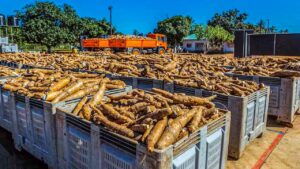
Crop Yield Per Acre: 3. Cassava Is a Powerful Tropical Food Crop
Cassava deserves a prominent place in any discussion about What Crops Produce the Most Food Per Acre, especially in tropical agriculture.
It is widely grown across Africa, Asia and Latin America and is valued for its ability to produce carbohydrate-rich roots under conditions where some other crops may struggle.
Cassava can be processed into many products, including:
- Garri
- Fufu
- High-quality cassava flour
- Starch
- Chips
- Industrial products
- Animal feed ingredients
This versatility makes cassava much more than a simple food crop.
Crop Yield Per Acre and Cassava’s Agricultural Importance
Cassava can perform well in environments where water availability and soil conditions may limit some other crops.
However, “hardy” does not mean “needs no management.”
Farmers still need to pay attention to:
- Quality planting stems
- Variety selection
- Plant spacing
- Weed control
- Soil fertility
- Pest pressure
- Disease management
- Harvest timing
Cassava also takes longer to mature than some vegetables.
Therefore, when calculating Farm Yield Per Acre, farmers should consider not only the amount produced but also how long the land remains occupied.
That is an important economic measurement.
Crop Yield Per Acre: 4. Sugarcane Can Produce Extraordinary Biomass
Sugarcane is one of the world’s major biomass-producing crops.
It can generate enormous quantities of plant material per unit of land, particularly under suitable tropical and subtropical conditions.
But sugarcane introduces another important concept into our discussion:
Biomass yield is not the same thing as food yield.
A sugarcane field may produce a huge mass of stalks, but only part of that harvested material ultimately becomes sugar or food products.
Therefore, if someone asks, “What crops produce the most food per acre?” sugarcane should be discussed carefully.
It is a high-biomass crop, but biomass alone should not be confused with edible food.
Crop Yield Per Acre and Sugarcane Production
Sugarcane performance depends on:
- Rainfall
- Irrigation
- Soil fertility
- Variety
- Temperature
- Crop age
- Fertilizer management
- Weed control
- Harvesting system
It is also a crop where production cycles matter.
Farmers must think beyond one harvest and understand how the crop fits into the longer-term farming system.
Crop Yield Per Acre: 5. Maize Remains a Major High-Yield Crop
Maize, also known as corn, is one of the world’s most important cereal crops.
It is used for:
- Human food
- Animal feed
- Flour
- Cornmeal
- Industrial products
- Starch
- Biofuel
- Processed foods
Because maize is grown on a huge global scale, its yield is closely monitored.
The latest available data shows that maize productivity varies enormously across countries. Some highly productive systems recorded yields above 10 tonnes per hectare in 2025, while other production systems recorded much lower levels.
This difference is crucial for understanding Crop Yield Per Acre.
Crop Yield Per Acre and Maize Management
High maize yields generally require careful management of:
- Seed genetics
- Planting date
- Plant spacing
- Soil fertility
- Nitrogen availability
- Water
- Weed competition
- Insect control
- Disease management
A farmer cannot simply buy a high-yielding seed variety and expect maximum production.
The genetics provide potential.
The farm environment determines how much of that potential is achieved.
Crop Yield Per Acre: 6. Rice Can Deliver Strong Food Production
Rice is one of the world’s most important staple foods.
It feeds billions of people and is grown across a wide range of environments.
Rice productivity can be especially high in systems with:
- Reliable irrigation
- Improved varieties
- Good nutrient management
- Effective weed control
- Good water management
- Timely planting
- Proper harvesting
According to FAO-based data, rice yields vary significantly around the world. For 2024, some countries recorded yields above 10 tonnes per hectare, while others were considerably lower. (Our World in Data)
This variation reinforces the idea that Crop Yield Per Acre is a measurement of actual performance rather than a permanent characteristic of a crop.
Crop Yield Per Acre and Rice’s Food Value
Rice is especially important because the harvested grain is a major staple.
However, yield comparisons should take processing into account.
Rice statistics are commonly reported as paddy rice, meaning the harvested crop before milling.
The amount of edible rice obtained after processing will therefore be lower than the original harvested paddy weight.
That distinction is important when calculating actual Food Production Per Acre.
Crop Yield Per Acre: 7. Tomatoes Can Produce High Value From Small Land
Tomatoes are different from maize, rice and wheat because farmers often focus on both yield and market value.
Tomatoes can produce substantial quantities from relatively small areas under intensive production.
They are commonly grown for:
- Fresh markets
- Restaurants
- Processing
- Sauces
- Paste
- Household consumption
With irrigation and proper management, tomato production can become highly intensive.
But tomatoes also demonstrate the risks of chasing yield.
Crop Yield Per Acre and Tomato Production Challenges
Tomatoes can be affected by:
- Tuta absoluta
- Aphids
- Whiteflies
- Caterpillars
- Fungal diseases
- Bacterial diseases
- Viral diseases
- Heat stress
- Water stress
This means that a farmer’s theoretical yield can be very different from actual harvested yield.
Strong pest management and disease prevention are therefore essential.
The lesson is simple:
A high-yield crop is only high-yielding when the farmer can successfully protect and harvest it.
Crop Yield Per Acre: 8. Onions Can Deliver Strong Production and Market Value
Onions are another crop where yield and market economics intersect.
They are widely consumed and can be sold through local, regional and commercial markets.
An onion farmer is interested in:
- Bulb size
- Total weight
- Quality
- Storage life
- Market price
- Production cost
- Harvest timing
This means that Farm Yield Per Acre should never be considered independently from profitability.
For example, an acre producing a large quantity of poor-quality onions may be less profitable than an acre producing a smaller quantity of premium-quality bulbs.
Crop Yield Per Acre and Onion Management
Important factors include:
- Variety selection
- Soil drainage
- Irrigation
- Nutrient management
- Weed control
- Pest management
- Disease control
- Harvest timing
- Curing
- Storage
The final point is particularly important.
Producing food is only half the challenge.
Farmers also need to protect what they produce after harvest.
Crop Yield Per Acre: 9. Carrots Can Produce Substantial Root Weight
Carrots are another root crop that can deliver strong production from well-managed land.
They prefer loose, well-prepared soil because the roots need room to develop properly.
Compacted or poorly drained soils can result in:
- Misshapen roots
- Poor root expansion
- Reduced marketability
- Difficult harvesting
- Lower yields
This illustrates how soil management affects Crop Yield Per Acre.
A farmer can have good seed, adequate fertilizer and enough water, yet still receive disappointing results if the soil physically prevents the crop from developing.
Crop Yield Per Acre and Intensive Vegetable Production
Vegetables such as carrots can be attractive for small-scale farmers because their value per unit of land can be greater than that of some bulk grains.
However, vegetables often require more labor and closer management.
Farmers should therefore consider:
- Yield
- Selling price
- Labor
- Irrigation
- Inputs
- Transportation
- Storage
- Market losses
A high physical yield does not automatically mean high profit.
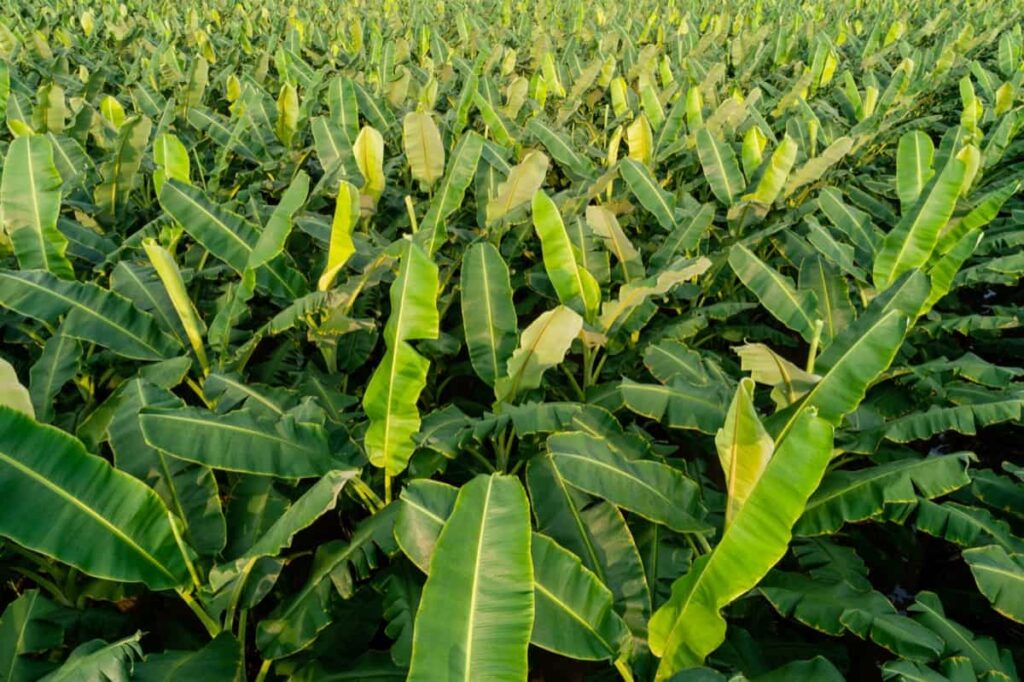
Crop Yield Per Acre: 10. Bananas Can Produce Food Over Extended Production Cycles
Bananas are another important food crop, particularly in tropical regions.
Unlike annual cereals such as maize and rice, bananas have a different production system.
They are perennial or long-lived plants that can continue producing through successive cycles when properly managed.
Bananas provide:
- Carbohydrates
- Fresh fruit
- Processing opportunities
- Local market income
- Export opportunities in some regions
Their productivity depends heavily on:
- Variety
- Soil fertility
- Water availability
- Wind protection
- Disease management
- Plant density
- Weed control
This makes banana production an interesting example of why How Much Food Can One Acre of Farmland Produce cannot be answered with one number.
The production cycle itself matters.
Crop Yield Per Acre: Comparing 10 High-Yield Crops
The table below provides a practical comparison.
Important: The figures and rankings should not be interpreted as guaranteed farm yields. Actual yields vary by country, variety, climate, soil, management and farming system. FAO’s global crop database reports production and yield by country and crop, while recent 2025 maize data illustrates how strongly yields can vary between production systems. (FAO Data)
| Crop | Crop Type | Typical Yield Potential | Food/Production Advantage | Major Limitation |
|---|---|---|---|---|
| Potato | Root/tuber | Very high fresh-weight potential | Large harvest from limited land | Disease, water and soil requirements |
| Sweet potato | Root/tuber | High | Food, leaves and income potential | Pests, storage and market issues |
| Cassava | Root/tuber | High | Strong tropical food-security crop | Long production cycle |
| Sugarcane | Sugar/biomass | Extremely high biomass | Large biomass and sugar production | Not equivalent to edible food weight |
| Maize | Cereal | Moderate to high | Staple food, feed and industrial uses | Strongly affected by water and nutrients |
| Rice | Cereal | Moderate to high | Major global staple | Water and management requirements |
| Tomato | Vegetable | High under intensive systems | High value per unit area | Disease and pest pressure |
| Onion | Vegetable/bulb | High | Strong food and market demand | Storage and disease challenges |
| Carrot | Root vegetable | High | High fresh-weight production | Requires suitable soil |
| Banana | Fruit | High | Continuous/extended production potential | Disease and climate sensitivity |
Crop Yield Per Acre: Why Fresh Weight Can Be Misleading
Here is where agricultural comparisons become really interesting.
Suppose Crop A produces 20 tonnes per acre while Crop B produces 5 tonnes per acre.
It would be tempting to say Crop A produces four times as much food.
But that conclusion may be wrong.
Why?
Because the crops may contain different amounts of:
- Water
- Carbohydrates
- Protein
- Fat
- Fiber
- Minerals
- Vitamins
A tonne of fresh vegetables is not nutritionally equivalent to a tonne of dry grain.
Therefore, when comparing Food Production Per Acre, farmers, researchers and policymakers may use different measurements depending on the question.
Crop Yield Per Acre by Fresh Weight
This is the easiest measurement.
It asks:
How many kilograms or tonnes were harvested?
This measurement is useful for:
- Marketing
- Transport
- Storage
- Farm production records
- Comparing physical harvest volumes
But it can be misleading nutritionally.
Crop Yield Per Acre by Calories
Calories provide another perspective.
A crop with high carbohydrate content can provide substantial energy even if its fresh weight is lower.
This is especially relevant when discussing food security.
Crop Yield Per Acre by Protein
Protein production per acre is another useful measurement.
Legumes and certain crops can become particularly important when the question changes from:
“How many tonnes can I harvest?”
to:
“How much protein can this land produce?”
Crop Yield Per Acre by Economic Value
Farmers often care about another number:
How much money can this acre generate?
This can completely change the ranking.
A low-volume specialty vegetable may generate more revenue per acre than a high-volume cereal.
That is why farmers should distinguish between:
- Physical yield
- Nutritional yield
- Economic yield
- Marketable yield
Crop Yield Per Acre: What Determines Farm Yield?
A crop’s genetic potential is only the starting point.
The final Farm Yield Per Acre is influenced by the entire production system.
Crop Yield Per Acre and Soil Quality
Soil is the foundation of agricultural production.
Important soil characteristics include:
- Organic matter
- Nutrient availability
- Soil structure
- Drainage
- pH
- Water-holding capacity
- Biological activity
Healthy soil can support stronger root development and better nutrient availability.
Poor soil can limit yield even when other inputs are adequate.
Crop Yield Per Acre and Water
Water is one of the biggest factors affecting yield.
Too little water can cause:
- Wilting
- Poor flowering
- Poor fruit development
- Reduced grain filling
- Small roots
- Lower final yield
Too much water can also be harmful.
Waterlogged soils can reduce oxygen around roots and increase disease problems.
The goal is not simply “more water.”
The goal is the right amount of water at the right time.
Crop Yield Per Acre and Seed Quality
Good seed can make a significant difference.
Improved varieties may offer:
- Higher yield potential
- Better disease resistance
- Improved drought tolerance
- Better maturity characteristics
- Improved market quality
- Better adaptation to local conditions
However, improved genetics cannot overcome every environmental problem.
Crop Yield Per Acre and Fertilizer
Plants need nutrients to grow.
Major nutrients include:
- Nitrogen
- Phosphorus
- Potassium
There are also several secondary and micronutrients.
But more fertilizer does not automatically mean more yield.
Excessive fertilizer can:
- Waste money
- Damage crops
- Increase environmental pollution
- Cause nutrient imbalances
- Reduce farm profitability
The best approach is balanced nutrient management based on the crop and soil.
Crop Yield Per Acre and Pest Control
Pests can dramatically reduce production.
Depending on the crop and location, farmers may face:
- Insects
- Mites
- Nematodes
- Rodents
- Birds
- Fungal pathogens
- Bacteria
- Viruses
- Weeds
Integrated pest management can help farmers combine monitoring, cultural practices, biological control and carefully selected pesticides where necessary.
Crop Yield Per Acre: Why Climate Changes the Numbers
Two farmers can plant the same seed on one acre and harvest completely different quantities.
One may have:
- Reliable rainfall
- Fertile soil
- Good seed
- Moderate temperatures
- Effective pest management
The other may face:
- Drought
- Flooding
- Heat
- Poor soil
- Pest outbreaks
- Disease
The difference can be enormous.
This is why global yield statistics should be interpreted carefully.
FAO’s crop database covers hundreds of agricultural products and countries, but its metadata also notes that data sources and reporting methods can differ between countries. (FAO Data)
So when looking at Highest Yielding Crops Per Acre in 2026, the correct question is often:
Highest yielding where, under what conditions, using which variety and measured in what way?
Crop Yield Per Acre: Irrigation Can Transform Production
Water availability is one of the most important differences between low-input and intensive agriculture.
Rain-fed farming depends largely on rainfall patterns.
Irrigated agriculture gives farmers greater control over water availability.
That can allow:
- More consistent production
- Better planting schedules
- Multiple cropping opportunities
- Reduced drought risk
- Improved crop establishment
- Better fruit and grain development
However, irrigation is not free.
Farmers must consider:
- Pumping costs
- Equipment
- Energy
- Water availability
- Maintenance
- Labor
- Drainage
A farmer should therefore evaluate irrigation as an investment rather than simply an expense.
Crop Yield Per Acre: Multiple Cropping Can Increase Annual Food Production
Here is another factor that can completely change the answer to How Much Food Can 1 Acre Produce?
The question should sometimes be:
How much food can one acre produce in an entire year?
A farmer who harvests one crop once a year may produce less annual food than a farmer who can successfully grow two or three crops on the same land over different seasons.
This is known as multiple cropping or sequential cropping.
For example, depending on the climate and farming system, land may support:
- A cereal crop followed by a vegetable crop
- A short-duration legume followed by another crop
- Multiple vegetable cycles
- Intercropping systems
Therefore, annual land productivity can be much higher than the yield from a single harvest.
Crop Yield Per Acre: Intercropping Can Change Food Production
Intercropping means growing more than one crop in the same field during part or all of the production cycle.
Examples can include:
- Maize and beans
- Cassava and legumes
- Cereals and vegetables
- Fruit crops with compatible understory crops
Intercropping can help farmers use:
- Vertical space
- Light
- Soil nutrients
- Growing time
more efficiently.
However, it is not automatically better.
Competition between crops can reduce the yield of individual crops.
The correct comparison is therefore the productivity of the entire system.
Yield Does Not Always Mean Profit
This may be the most important lesson in this entire article.
The crop with the highest yield is not necessarily the crop that makes the farmer the most money.
Imagine two farms.
Farm A produces 15 tonnes of Crop A per acre.
Farm B produces 5 tonnes of Crop B per acre.
Crop A sounds better.
But suppose:
- Crop A sells for a low price.
- Crop A requires expensive fertilizer.
- Crop A requires expensive harvesting.
- Crop B sells at a much higher price.
- Crop B has strong local demand.
- Crop B has lower transportation costs.
Farm B could make more profit.
Therefore, a farmer considering Farm Yield Per Acre should also calculate:
Revenue − Production Cost = Gross Margin
Depending on the farm’s accounting system, the farmer may then need to consider additional costs before determining final profit.
Market Demand Matters
A farmer should never select a crop based only on yield.
Before planting, ask:
- Who will buy the crop?
- How much will they pay?
- When will they buy?
- How far is the market?
- What quality do they require?
- Can the crop be stored?
- How quickly does the crop spoil?
- Are there processors nearby?
- Are prices seasonal?
This is particularly important for tomatoes, vegetables and fruits.
A farmer can produce an excellent harvest and still lose money if prices collapse at harvest time.
Post-Harvest Losses Can Destroy Production Gains
Imagine producing 10 tonnes of food.
If 20% is lost before it reaches consumers, only about 8 tonnes remain available.
That means improving farm yield is only one part of the food-production challenge.
Farmers also need to reduce losses caused by:
- Poor harvesting
- Mechanical damage
- Insects
- Rodents
- Moisture
- Fungal contamination
- Poor packaging
- Poor storage
- Transportation problems
- Market delays
For perishable crops such as tomatoes, fruits and leafy vegetables, post-harvest management can be especially important.
In other words:
Producing more food is valuable, but preserving what you produce is equally important.
Which Crops Produce the Most Food Per Acre?
So we can finally return to the big question.
What crops produce the most food per acre?
There is no single universal winner.
If you measure fresh harvested weight, some root and tuber crops can produce extremely large quantities.
If you measure dry matter, the ranking changes.
If you measure calories, it changes again.
If you measure protein, another group of crops becomes more interesting.
If you measure revenue, high-value vegetables and specialty crops can become extremely competitive.
This is why agricultural scientists and farmers should avoid simplistic rankings.
The better question is:
Which crop produces the most useful output from my acre under my specific conditions?
That is a much more practical question.
Crop Yield Per Acre: The Difference Between Potential Yield and Actual Yield
Another common mistake is confusing potential yield with actual farm yield.
Seed companies and agricultural research institutions may report impressive yields under controlled or well-managed conditions.
A farmer’s field is different.
Real farms experience:
- Weather changes
- Pest outbreaks
- Equipment breakdowns
- Labor shortages
- Input shortages
- Soil variation
- Market pressure
- Water shortages
Therefore, a farmer should create realistic yield expectations.
For example:
Potential yield: What the crop can produce under excellent conditions.
Expected yield: What the farmer reasonably expects under local conditions.
Actual yield: What is ultimately harvested.
The gap between these three numbers is often where farm improvement opportunities exist.
How Farmers Can Increase Production in 2026
Farmers looking to improve Crop Yield Per Acre do not necessarily need to double their fertilizer use or buy expensive machinery.
Sometimes the biggest improvements come from better management.
1. Choose the Right Crop Variety
Select varieties adapted to:
- Local climate
- Soil
- Disease pressure
- Market demand
- Production season
2. Improve Soil Health
Use practices such as:
- Crop rotation
- Organic matter management
- Cover crops
- Reduced soil degradation
- Appropriate fertilizer application
3. Improve Water Management
Use irrigation efficiently where appropriate.
Avoid both drought stress and unnecessary overwatering.
4. Improve Plant Population
Plant spacing matters.
Too few plants may waste land.
Too many may create excessive competition.
The ideal population depends on the crop and production system.
5. Control Weeds Early
Weeds compete with crops for:
- Water
- Nutrients
- Light
- Space
Early weed management can therefore have a significant effect on final production.
6. Monitor Pests
Do not wait until an infestation becomes severe.
Regular field scouting can help identify problems early.
7. Harvest at the Right Time
Harvest timing can affect:
- Quantity
- Quality
- Shelf life
- Market price
8. Keep Farm Records
Record:
- Seed quantity
- Fertilizer use
- Labor
- Irrigation
- Pest-control costs
- Harvest weight
- Selling price
Without records, it is difficult to know whether Farm Yield Per Acre is actually improving.
How Technology Is Changing Farm Productivity
Agriculture is becoming increasingly data-driven.
Farmers can now use technologies such as:
- Soil sensors
- Weather stations
- Satellite imagery
- GPS equipment
- Mobile farm-management applications
- Drones
- Automated irrigation
- Precision fertilizer systems
- Artificial intelligence
These tools can help farmers identify differences across a field rather than treating every part of an acre exactly the same.
For example, satellite imagery may reveal areas experiencing water stress.
A soil test may reveal nutrient deficiencies.
Weather data can help farmers plan irrigation.
Digital records can help compare yields across seasons.
Technology does not replace good farming knowledge.
Instead, it can help farmers make better decisions.
What 2026 Farmers Should Really Measure
If your goal is to improve farm performance, don’t measure only tonnes per acre.
Track several indicators.
Crop Yield Per Acre
How much was harvested?
Food Production Per Acre
How much usable food did the land generate?
Marketable Yield Per Acre
How much of the harvest met the buyer’s quality requirements?
Revenue Per Acre
How much money did the harvest generate?
Profit Per Acre
How much remained after production expenses?
Water Productivity
How much production was obtained for the water used?
Labor Productivity
How much output was produced relative to labor invested?
These measurements provide a much clearer picture of agricultural performance.
Why the “Highest Yielding Crop” Can Be the Wrong Choice
Suppose a farmer has one acre.
They might be tempted to select whichever crop has the largest reported yield.
But the best crop could actually be a lower-yielding crop.
Why?
Because farming is a business as well as a biological activity.
The farmer needs to consider:
- Production cost
- Market price
- Time to harvest
- Risk
- Labor requirements
- Water requirements
- Storage
- Transportation
- Local demand
- Price volatility
A crop with lower physical yield but higher profit may be the smarter choice.
How Long Does the Crop Take to Produce?
Time is another factor that is often ignored.
Consider two crops.
Crop A produces 10 tonnes per acre after 12 months.
Crop B produces 5 tonnes per acre after three months.
If Crop B can be grown four times successfully within a year, the annual production potential becomes very different.
This is why How Much Food Can One Acre of Farmland Produce should sometimes be considered over an entire year rather than a single crop cycle.
The annualized productivity of land can be much more informative.

Crop Yield Per Acre: Can One Acre Feed a Family?
This is one of the most interesting questions surrounding small-scale agriculture.
Can one acre feed a family?
Potentially, yes.
But there is no universal answer.
It depends on:
- Family size
- Crop selection
- Dietary requirements
- Climate
- Farming intensity
- Irrigation
- Soil fertility
- Storage
- Multiple cropping
- Livestock integration
- Food waste
A one-acre farm producing mostly vegetables will provide a different diet from an acre producing maize.
A diversified farm may produce:
- Carbohydrates
- Vegetables
- Fruits
- Legumes
- Herbs
- Animal feed
This can potentially provide a more diverse food supply than a monoculture.
However, households also require fats, proteins and other nutrients that may not be supplied adequately by a single crop.
Crop Yield Per Acre: Why Diversification Can Be Better Than Monocropping
Growing one crop across an entire acre can simplify management.
But diversification can spread risk.
For example, a farmer could potentially combine different crops based on local conditions.
Benefits may include:
- Reduced dependence on one market
- Greater dietary diversity
- Better use of growing seasons
- Potentially improved soil management
- Multiple income streams
- Reduced exposure to one crop’s failure
However, diversification also creates management complexity.
Farmers must determine which combinations actually work in their environment.
What the Latest Global Data Tells Us
The latest FAOSTAT crop dataset provides a useful reminder that agriculture is incredibly diverse.
FAO tracks production, harvested area and yield for a wide range of crops across more than 245 countries and territories. The dataset includes cereals, fruits, vegetables, roots and tubers, pulses, oil crops, sugar crops and other agricultural products. (FAO Data)
The global picture shows that yields have generally improved over the long term, but productivity remains highly uneven between countries and farming systems.
For example, recent data show:
- Very high potato yields in some highly productive agricultural systems.
- Major differences in rice yield between countries.
- Large variation in maize productivity.
- Significant differences in cereal yields across regions.
The FAOSTAT crop production and yield data is therefore a valuable reference for farmers, researchers and agricultural writers who want to compare production data responsibly.
For broader visual comparisons, the global crop yield data also provides a useful way to examine long-term changes in crop productivity using FAO-based data. (Our World in Data)
Crop Yield Per Acre: What the Future Could Look Like Beyond 2026
The pressure to produce more food from limited land is unlikely to disappear.
Population growth, urbanization, climate pressures, changing diets and competition for land all make agricultural productivity increasingly important.
This does not necessarily mean farmers should simply maximize yield at any cost.
The future of agriculture will increasingly involve balancing:
- Yield
- Profitability
- Water use
- Soil health
- Biodiversity
- Climate resilience
- Food quality
- Resource efficiency
That means the best farm of the future may not be the farm that produces the most tonnes.
It may be the farm that produces the greatest useful output while using resources efficiently and maintaining the productive capacity of its land.
Crop Yield Per Acre: Key Lessons Farmers Should Remember
After examining these crops and production factors, several important lessons stand out.
Lesson 1: One Acre Can Produce a Lot of Food
A single acre can produce substantial food under the right conditions.
But the exact amount varies greatly.
Lesson 2: There Is No Universal Highest-Yield Crop
The “winner” changes depending on how yield is measured.
Lesson 3: Potatoes and Other Root Crops Can Produce Very High Fresh Weight
Recent data demonstrates the impressive physical yields possible from potatoes in some production systems. (Our World in Data)
Lesson 4: Maize and Rice Remain Critical Staple Crops
Their importance is not simply about yield.
They are major sources of food and play central roles in global food systems.
Lesson 5: High Yield Does Not Equal High Profit
Market price and production cost matter.
Lesson 6: Water Is Critical
Irrigation can significantly influence production where rainfall is unreliable.
Lesson 7: Soil Health Matters
Healthy soil provides the foundation for sustainable productivity.
Lesson 8: Pest Management Protects Yield
A crop cannot reach its potential if pests and diseases destroy it.
Lesson 9: Post-Harvest Management Matters
Food that is produced but lost after harvest does not contribute fully to food availability.
Lesson 10: Farmers Should Measure More Than Yield
Revenue, profit, marketable yield, water productivity and long-term soil health are equally important.
Crop Yield Per Acre: Frequently Asked Questions
How much food can 1 acre produce?
There is no single answer. Production depends on the crop, climate, soil, variety, water, fertilizer, pest management, planting density, growing season and harvesting system.
An acre of a high-yield root crop can produce several tonnes of fresh produce under favorable conditions, while cereal yields are generally measured differently.
Which crop has the highest yield?
There is no universal highest-yielding crop.
Some root and tuber crops can produce very high fresh-weight yields, while other crops may produce more calories, protein or economic value per acre.
What are high-yield crops?
High-yield crops are crops capable of producing substantial output from a given amount of land under suitable conditions.
Examples include potatoes, sweet potatoes, cassava, sugarcane, maize, rice and intensively managed vegetables.
Can one acre feed a family?
It can contribute substantially to household food needs, but whether it can fully feed a family depends on family size, diet, crop selection, productivity, climate, farming intensity and food storage.
Is high yield the same as high profit?
No.
A high physical yield can still produce poor financial results if input costs are high or market prices are low.
Does irrigation increase yield?
Irrigation can improve production where water is a limiting factor, especially when it allows crops to receive water at critical growth stages.
However, irrigation also creates costs and must be properly managed.
What is the best crop for one acre?
There is no universal answer.
The best crop depends on:
- Climate
- Soil
- Water
- Market
- Production costs
- Farmer experience
- Crop duration
- Risk tolerance
A farmer should choose the crop that provides the best combination of yield, profitability, resilience and market demand.
Final Thoughts
The question “How much food can 1 acre produce?” sounds simple.
In reality, it opens the door to one of the most fascinating questions in agriculture:
How efficiently can humans turn a limited piece of land into food?
The answer is influenced by biology, climate, technology, soil, water, markets and human decisions.
Potatoes can produce enormous fresh-weight harvests under high-performing conditions. Cassava can provide an important source of food in tropical regions. Maize and rice remain essential global staples. Tomatoes, onions and carrots can generate significant production from intensively managed land. Sugarcane can produce extraordinary biomass, while bananas offer a very different long-term production system.
But the biggest lesson is not that one crop is the absolute winner.
It is that Crop Yield Per Acre is only the beginning of the story.
A truly productive farm must produce food consistently, use resources wisely, manage costs, reduce losses and maintain the land for future seasons.
For farmers in 2026, the goal should not simply be to ask:
“Which crop gives me the biggest harvest?”
A better question is:
“Which crop can give me the best useful, marketable and sustainable output from my acre under my actual farming conditions?”
That question leads to better farm decisions.
And as pressure on agricultural land continues to grow, understanding Food Production Per Acre will become even more important.
One acre may look small on a map.
But managed intelligently, it can become an extraordinarily productive piece of land.
About The Author