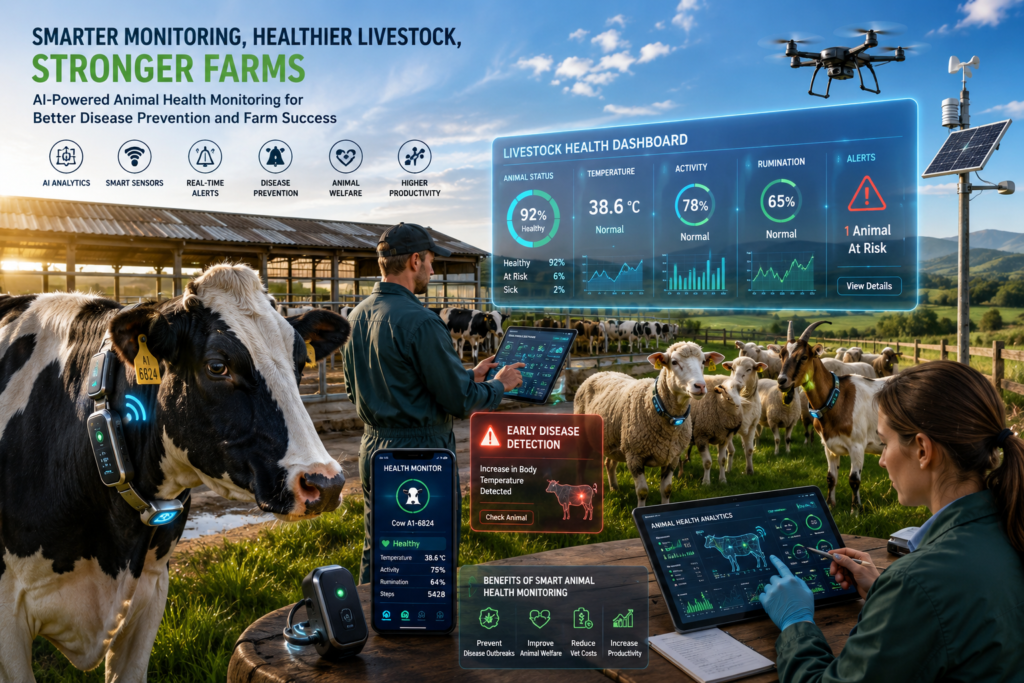
Animal Health Monitoring
The livestock industry is undergoing one of the most significant transformations in its history. Gone are the days when farmers relied solely on visual observation and experience to identify health problems in their animals. While traditional knowledge remains invaluable, modern technology is providing unprecedented opportunities to detect diseases earlier, improve animal welfare, and increase farm profitability.
Today, animal health monitoring has evolved from a reactive practice into a proactive strategy. Farmers can now monitor livestock health around the clock using wearable devices, artificial intelligence, smart sensors, and data analytics. These innovations are helping producers identify health concerns before symptoms become visible, dramatically improving livestock disease prevention efforts.
As global demand for animal products continues to grow and disease outbreaks become increasingly costly, the adoption of smart livestock farming technologies is no longer optional for many producers. It is becoming an essential component of successful farm management.
In this guide, we’ll explore nine powerful trends that are transforming the future of livestock health management and helping farmers build healthier, more productive herds.
Why Health Monitoring Matters More Than Ever
Animal health is directly connected to farm profitability. A single disease outbreak can result in:
- Reduced milk production
- Lower weight gain
- Increased mortality rates
- Higher veterinary expenses
- Production disruptions
- Trade restrictions
- Reduced consumer confidence
Effective animal health monitoring enables farmers to identify potential threats before they escalate into major problems.
Modern livestock disease prevention is no longer just about vaccinations and treatments. It involves continuous monitoring, predictive analysis, and real-time decision-making that can significantly reduce disease risks.

The Evolution of Animal Health Monitoring in Modern Agriculture
For generations, livestock farmers relied primarily on visual inspections. Animals were checked for obvious signs of illness such as:
- Reduced appetite
- Lethargy
- Limping
- Weight loss
- Abnormal behavior
While these methods remain important, many diseases begin developing long before visible symptoms appear.
This is where precision livestock farming is changing the game.
Precision livestock farming uses advanced technologies to monitor individual animals continuously, allowing farmers to make data-driven decisions that improve health and productivity.
Table: Traditional Livestock Monitoring vs Modern Animal Health Monitoring
| Feature | Traditional Monitoring | Modern Animal Health Monitoring |
|---|---|---|
| Observation Frequency | Periodic | 24/7 Continuous |
| Disease Detection | After Symptoms Appear | Before Symptoms Appear |
| Labor Requirement | High | Reduced |
| Data Collection | Manual | Automated |
| Accuracy | Variable | Highly Precise |
| Animal Welfare | Reactive | Proactive |
| Decision Making | Experience-Based | Data-Driven |
| Outbreak Prevention | Limited | Enhanced |
| Farm Efficiency | Moderate | High |
Animal Health Monitoring: 9 Powerful Trends That Are Revolutionizing Livestock Disease Prevention and Farm Success
1: Animal Health Monitoring Through Wearable Technology
Wearable devices are rapidly becoming one of the most influential tools in livestock management.
Just as humans use fitness trackers, livestock can now wear smart collars, ear tags, and leg sensors that continuously collect health data.
These devices monitor:
- Body temperature
- Heart rate
- Movement patterns
- Feeding behavior
- Rumination activity
- Sleep cycles
The data is transmitted in real time to farm management platforms where farmers can identify abnormalities immediately.
Benefits of Wearable Animal Health Monitoring
- Earlier disease detection
- Reduced veterinary costs
- Improved reproductive management
- Better productivity tracking
- Enhanced animal welfare
Wearables are particularly valuable for detecting subtle behavioral changes that may indicate illness before visible symptoms develop.
2: How AI-Powered Livestock Health Monitoring Prevents Disease Outbreaks in 2026
Artificial intelligence is becoming the brain behind modern livestock operations.
AI systems can analyze enormous amounts of data generated by livestock monitoring devices and identify patterns humans might miss.
How AI Detects Disease Early
AI algorithms analyze:
- Feeding patterns
- Water intake
- Movement behavior
- Temperature fluctuations
- Historical health records
When abnormalities appear, the system alerts farmers immediately.
For example, a cow that reduces feed intake by a small percentage may appear healthy to the naked eye. However, AI can recognize this subtle deviation as an early warning sign of disease.
Key Benefits of AI-Powered Livestock Health Monitoring
- Faster disease detection
- Reduced mortality rates
- Lower treatment costs
- Improved herd management
- Better farm profitability
AI transforms livestock disease prevention from a reactive process into a predictive one.
3: Best Smart Sensors for Early Disease Detection in Farm Animals
The rise of smart sensors has revolutionized farm management.
These devices provide continuous insight into animal health and environmental conditions.
Common Smart Sensors Used in Livestock Farming
Temperature Sensors
Monitor body temperature changes that often occur before clinical symptoms appear.
Activity Sensors
Track movement patterns and identify unusual behavior.
Rumination Sensors
Measure chewing activity and digestive health.
Environmental Sensors
Monitor:
- Air quality
- Humidity
- Ventilation
- Temperature
Poor environmental conditions often contribute to disease outbreaks.
Why Smart Sensors Matter
Early disease detection allows farmers to:
- Isolate affected animals quickly
- Prevent disease spread
- Reduce treatment costs
- Improve recovery rates
This makes smart sensors one of the most effective livestock disease prevention tools available today.
4: Precision Livestock Farming Technologies for Improving Animal Welfare
Animal welfare is becoming increasingly important to consumers, regulators, and producers alike.
Precision livestock farming technologies help farmers ensure that animals remain healthy, comfortable, and productive.
Examples of Precision Livestock Farming Technologies
- Automated feeding systems
- Smart water management systems
- Environmental monitoring platforms
- Video-based behavior analysis
- Automated health tracking systems
These technologies create healthier living environments and reduce stress-related health issues.
Impact on Animal Welfare
Benefits include:
- Reduced disease incidence
- Lower stress levels
- Better growth performance
- Improved reproduction rates
- Higher product quality
Healthier animals are happier animals, and happier animals contribute to stronger farm performance.
for more details:
5: Real-Time Animal Health Monitoring Systems
Real-time monitoring allows farmers to respond instantly to emerging health concerns.
Instead of waiting for daily inspections, alerts are generated automatically whenever unusual activity is detected.
What Real-Time Monitoring Tracks
- Feeding behavior
- Water consumption
- Body temperature
- Weight fluctuations
- Activity levels
Immediate alerts enable rapid intervention.
This dramatically reduces the risk of widespread disease outbreaks within herds and flocks.
6: Predictive Analytics and Livestock Disease Prevention
Predictive analytics is helping farmers anticipate problems before they occur.
By analyzing historical and real-time data, predictive systems estimate future disease risks.
How Predictive Analytics Works
The system evaluates:
- Weather conditions
- Disease history
- Animal performance data
- Environmental factors
- Biosecurity records
It then predicts which animals may be at greater risk of illness.
Benefits
- Improved planning
- Reduced losses
- Better resource allocation
- Enhanced disease control
Predictive analytics is becoming a cornerstone of smart livestock farming strategies.
7: Automated Biosecurity Monitoring for Livestock Disease Prevention
Biosecurity remains one of the most effective defenses against disease outbreaks.
Technology is now strengthening biosecurity efforts through automation.
Automated Biosecurity Tools
- Visitor tracking systems
- Vehicle monitoring systems
- Digital access controls
- Automated sanitation checkpoints
- Environmental contamination sensors
These systems reduce human error and improve compliance with disease prevention protocols.
Why Biosecurity Matters
Strong biosecurity helps prevent:
- Disease introduction
- Cross-contamination
- Herd-wide infections
- Economic losses
Automation ensures biosecurity measures remain consistent and effective.
8: Computer Vision Systems in Smart Livestock Farming
Computer vision is another rapidly growing area within animal health monitoring.
Using cameras and AI, computer vision systems continuously observe livestock behavior.
What Computer Vision Can Detect
- Lameness
- Aggression
- Feeding changes
- Social interaction patterns
- Injury risks
Unlike manual observation, these systems operate continuously without fatigue.
Advantages
- Early detection of health problems
- Reduced labor requirements
- Improved welfare monitoring
- Greater management efficiency
Computer vision is becoming a powerful tool for large-scale livestock operations.
9: Livestock Disease Prevention Strategies Using AI and Real-Time Health Monitoring
Combining AI with real-time monitoring creates one of the most effective disease prevention systems available today.
Rather than relying on a single technology, integrated platforms bring together data from multiple sources.
Data Sources Include
- Wearable sensors
- Environmental sensors
- Feeding systems
- Veterinary records
- Production records
AI analyzes this information to provide actionable recommendations.
Integrated Disease Prevention Strategies
Successful farms are increasingly implementing:
- Continuous health monitoring
- Predictive disease modeling
- Automated alerts
- Smart biosecurity protocols
- Data-driven treatment plans
These strategies significantly reduce disease risks while improving overall productivity.
Challenges Facing Animal Health Monitoring Adoption
Although the benefits are substantial, adoption still faces several challenges.
Common Barriers
Initial Investment Costs
Advanced monitoring systems can require significant upfront investment.
Data Management
Large volumes of data must be properly organized and interpreted.
Connectivity Limitations
Some rural areas still experience internet connectivity challenges.
Training Requirements
Farmers may require training to maximize the value of these technologies.
Despite these obstacles, the long-term benefits often outweigh the initial costs.
The Future of Precision Livestock Farming
The future looks incredibly promising.
Emerging innovations are expected to further improve:
- Disease detection accuracy
- Automation capabilities
- Predictive analytics
- Animal welfare outcomes
- Sustainability efforts
As technologies become more affordable, adoption rates are likely to increase across farms of all sizes.
The next generation of animal health monitoring systems may even identify diseases days or weeks before symptoms emerge.
This level of predictive capability could transform livestock disease prevention worldwide.
Practical Steps Farmers Can Take Today
Farmers interested in adopting modern monitoring technologies do not need to overhaul their operations overnight.
A gradual approach often works best.
Step 1: Assess Current Health Management Practices
Identify gaps in disease detection and monitoring.
Step 2: Start with Smart Sensors
Implement basic monitoring devices before investing in larger systems.
Step 3: Improve Biosecurity
Strengthen disease prevention protocols.
Step 4: Use Data Effectively
Track health trends and production performance.
Step 5: Explore AI Solutions
Consider platforms that integrate monitoring and predictive analytics.
Small improvements can lead to significant long-term gains.
Animal Health Monitoring and Livestock Disease Prevention: Why Early Detection Matters More Than Ever
The success of any livestock operation depends heavily on the health of its animals. Whether managing cattle, poultry, sheep, goats, or pigs, healthy animals are more productive, more profitable, and less likely to create costly challenges for farmers. This is why Animal Health Monitoring has become one of the most important aspects of modern livestock management. As disease threats continue to evolve and farming operations become larger and more complex, early detection is emerging as the cornerstone of effective Livestock Disease Prevention.
For many years, farmers relied on routine observation to identify health issues. While experience and daily inspections remain valuable, many diseases begin silently. An animal may appear healthy while experiencing internal health problems that are not immediately visible. By the time obvious symptoms such as weight loss, fever, coughing, reduced feed intake, or abnormal behavior appear, the disease may have already spread to other animals.
This reality highlights the growing importance of advanced Animal Health Monitoring systems. Modern monitoring tools provide farmers with the ability to detect subtle changes in behavior, activity, and physical condition long before serious illness develops. As a result, farmers can take action sooner, reducing the impact of disease and strengthening their overall Livestock Disease Prevention efforts.
The Growing Need for Better Animal Health Monitoring
The livestock industry is facing increasing pressure from multiple directions. Disease outbreaks can spread rapidly, consumer expectations for animal welfare are rising, and production costs continue to increase. In this environment, farmers can no longer afford to rely solely on reactive health management strategies.
Effective Animal Health Monitoring allows producers to move from reacting to disease toward preventing it altogether. Instead of waiting until animals become visibly sick, farmers can identify early warning signs and intervene before a minor issue turns into a major outbreak.
Some of the most common challenges that improved monitoring helps address include:
- Infectious disease outbreaks
- Respiratory illnesses
- Digestive disorders
- Reproductive health problems
- Heat stress
- Nutritional deficiencies
- Animal welfare concerns
Addressing these challenges early not only supports Livestock Disease Prevention but also improves overall farm efficiency and profitability.
Why Early Detection Is Critical for Livestock Disease Prevention
Disease prevention becomes much easier when health issues are identified during their earliest stages. Many illnesses follow a progression that begins with small physiological or behavioral changes. These changes are often too subtle to detect through occasional visual inspections.
This is where modern Animal Health Monitoring makes a significant difference. Continuous monitoring systems can detect:
- Slight decreases in feed consumption
- Reduced movement or activity
- Changes in rumination patterns
- Elevated body temperatures
- Variations in water intake
- Unusual social behavior
Each of these indicators may serve as an early warning signal that an animal requires attention.
When farmers identify these signs quickly, they can:
- Isolate affected animals
- Consult veterinarians sooner
- Begin treatment earlier
- Reduce disease transmission
- Protect the rest of the herd or flock
The result is a more effective and sustainable approach to Livestock Disease Prevention.
The Link Between Animal Welfare and Disease Prevention
Animal welfare and disease prevention are closely connected. Animals that experience stress, poor nutrition, overcrowding, or inadequate environmental conditions are generally more vulnerable to illness.
Modern Animal Health Monitoring provides valuable insights into factors that influence animal welfare. By tracking animal behavior and environmental conditions, farmers can identify issues before they negatively impact health and productivity.
For example, monitoring systems may reveal:
- Heat stress during hot weather
- Poor ventilation inside livestock housing
- Inadequate access to feed or water
- Changes in resting behavior
- Increased signs of discomfort
Addressing these issues promptly contributes to stronger Livestock Disease Prevention programs while improving animal welfare and performance.
How Smart Livestock Farming Supports Early Disease Detection
The rise of Smart Livestock Farming is transforming how producers manage animal health. Rather than relying solely on periodic observations, smart farming technologies provide real-time information about livestock conditions.
Through the use of sensors, wearable devices, and automated monitoring platforms, farmers can gain continuous insights into the health status of individual animals.
Some common technologies used in Smart Livestock Farming include:
- Smart ear tags
- GPS tracking collars
- Activity monitors
- Temperature sensors
- Automated feeding systems
- Environmental monitoring equipment
These technologies work together to strengthen Animal Health Monitoring and improve decision-making across the farm.
By collecting accurate data around the clock, smart systems help farmers recognize potential health issues earlier, making Livestock Disease Prevention more effective and less costly.
Precision Livestock Farming Is Changing the Future of Animal Health
One of the most significant developments in modern agriculture is the growth of Precision Livestock Farming. This approach focuses on monitoring individual animals rather than managing entire groups based on averages.
Every animal is unique. Some animals may show signs of illness sooner than others, while certain individuals may require specialized care. Precision Livestock Farming helps farmers understand these differences and respond accordingly.
Benefits of Precision Livestock Farming include:
- Earlier disease detection
- Improved treatment accuracy
- Better reproductive performance
- Enhanced feed efficiency
- Reduced medication usage
- Stronger disease prevention outcomes
When combined with advanced Animal Health Monitoring, precision management allows farmers to provide more targeted care while supporting long-term Livestock Disease Prevention goals.
Building a More Resilient Farm Through Early Detection
Perhaps the greatest advantage of modern monitoring technologies is their ability to improve farm resilience. Disease outbreaks can be financially devastating, particularly when they affect large numbers of animals.
Investing in reliable Animal Health Monitoring systems helps create a stronger defense against unexpected health challenges. Farmers gain access to timely information, better decision-making tools, and greater confidence in their management practices.
As technology continues to evolve, the future of Livestock Disease Prevention will increasingly depend on data-driven insights, predictive analytics, and real-time monitoring systems. Farms that embrace these innovations today will be better prepared to meet the challenges of tomorrow.
Thoughts
Early detection has become one of the most valuable tools available to livestock producers. By investing in effective Animal Health Monitoring, farmers can identify health concerns sooner, improve animal welfare, reduce treatment costs, and strengthen their overall Livestock Disease Prevention strategy.
The combination of modern monitoring tools, Smart Livestock Farming, and Precision Livestock Farming is helping producers shift from reactive disease management to proactive health protection. In an industry where prevention is always more affordable than treatment, early detection is no longer just an advantage—it is a necessity for long-term farm success.

Conclusion
Animal health monitoring is rapidly becoming the foundation of successful livestock production. As disease threats become more complex and consumer expectations continue to rise, farmers need smarter tools to protect their animals and their livelihoods.
The emergence of wearable technology, AI-powered analytics, smart sensors, predictive modeling, computer vision, and precision livestock farming technologies is fundamentally changing how livestock disease prevention is approached. Instead of reacting to illness after it appears, farmers can now identify risks early, intervene quickly, and prevent outbreaks before they spread.
The farms that embrace these innovations today will be better positioned to improve animal welfare, reduce costs, increase productivity, and remain competitive well into 2027 and beyond. In a world where every animal matters and every decision counts, investing in modern animal health monitoring is no longer just a technological upgrade—it is a strategic advantage that can determine the future success of a livestock operation.
About The Author