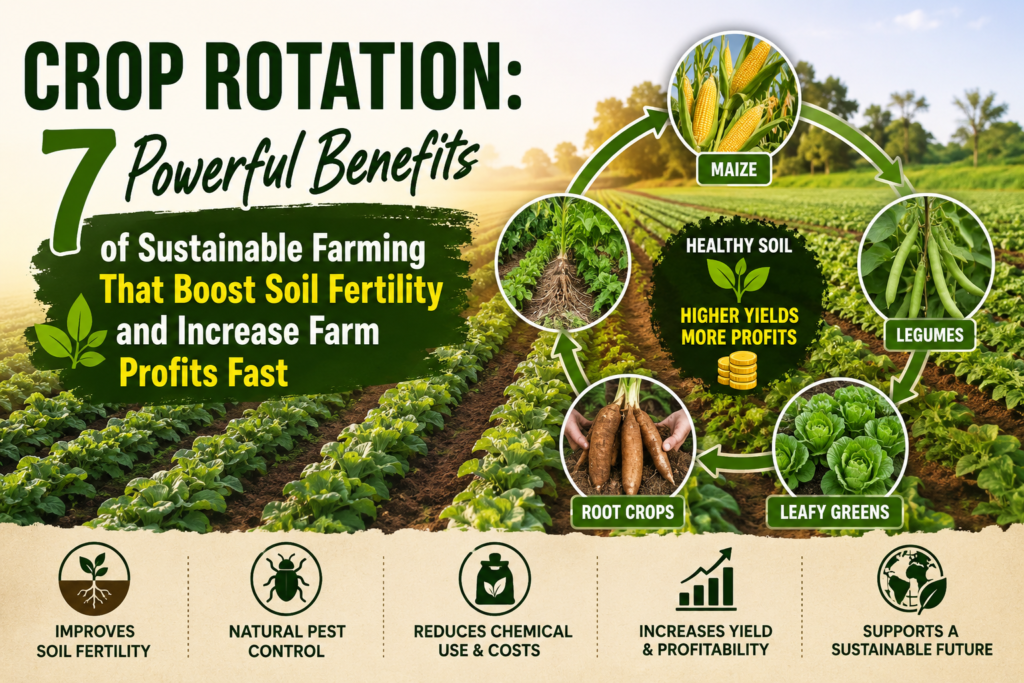
Crop rotation
In today’s rapidly changing agricultural landscape, farmers are under more pressure than ever before. Rising fertilizer costs, unpredictable weather patterns, soil degradation, and pest resistance have made traditional farming methods less reliable. This is where crop rotation emerges as a timeless yet powerful solution.
At its core, crop rotation is the practice of growing different types of crops on the same land in sequential seasons. While it sounds simple, its impact on sustainable farming, soil fertility, and farm profitability is profound.
Modern agricultural research continues to confirm what traditional farmers have known for centuries: rotating crops is one of the most .
According to the Food and Agriculture Organization (FAO), sustainable land management practices like crop rotation significantly improve soil health and reduce dependency on chemical inputs over time.
Read more: Crop Rotation Sustainable Farming – FAO Guide
This article explores 7 powerful benefits of crop rotation, backed by agricultural science and real-world farming practices, and explains why it remains essential for future food security.

Understanding Sustainable Farming and Soil Fertility Basics
Before diving into the benefits, it is important to understand the relationship between sustainable farming and soil fertility.
Soil is not just “dirt”—it is a living ecosystem filled with nutrients, microorganisms, organic matter, and minerals. Continuous planting of the same crop (monocropping) drains specific nutrients from the soil, leaving it weak and less productive.
Crop rotation restores balance by:
- Replenishing soil nutrients naturally
- Breaking pest and disease cycles
- Improving water retention
- Enhancing microbial diversity
This is why experts consider it one of the most reliable soil fertility improvement strategies in agriculture today.
7 Powerful Benefits of Sustainable Farming Explained
Sustainable farming is more than just a modern agricultural idea—it is a practical way of producing food while protecting the land for future use. Instead of relying heavily on chemicals or exhausting the soil, it focuses on working with natural processes to keep farms productive over time.
Below are seven important ways this approach supports healthier farming systems and more reliable harvests.
1. Improved soil health over time
One of the most noticeable advantages is the gradual improvement of soil quality. When farming practices support natural recovery, the soil becomes richer, more balanced, and better at supporting plant growth.
This leads to:
- Stronger plant development
- Better nutrient availability
- Reduced soil exhaustion
2. Fewer pest problems naturally
Changing farming patterns and reducing reliance on single crops makes it harder for pests to build up. This helps lower the frequency of infestations without depending too much on chemical control.
As a result:
- Pest populations are easier to manage
- Crop damage is reduced
- The farm becomes more self-regulating
3. Lower production costs
Over time, farmers often spend less on fertilizers, pesticides, and soil treatments when natural systems are working effectively. This helps reduce overall farming expenses.
Common savings include:
- Reduced chemical usage
- Fewer corrective treatments
- Lower input dependency
4. More stable harvests
Instead of unpredictable yields, farms tend to produce more consistent results when soil and crop conditions are well balanced.
This improves:
- Planning for market sales
- Income stability
- Reduced risk of total crop failure
5. Better soil structure
Healthy farming practices also improve how soil is physically formed. Good structure allows water and air to move more freely, supporting stronger root systems.
Benefits include:
- Improved drainage
- Better moisture retention
- Reduced soil compaction
6. Support for environmental balance
This approach reduces harm to the surrounding environment by limiting chemical runoff and encouraging natural biological activity in the soil.
It helps:
- Protect nearby water sources
- Support beneficial organisms
- Maintain ecological balance
7. Long-term farm resilience
Perhaps the most important benefit is the ability to keep farms productive over many years. By maintaining soil health and reducing external dependence, farms become more resilient to climate changes and market pressures.
This means:
- Stronger adaptation to changing conditions
- More reliable production cycles
- Improved long-term sustainability
These benefits show that working with natural systems rather than against them creates a more stable and efficient farming environment. Over time, this approach helps farmers maintain productivity while protecting their land for the future.
Best methods for natural pest control in agriculture
Different crop rotation systems exist, but the most effective include:
1. Legume-based rotation
- Beans → Maize → Vegetables
- Improves nitrogen levels and reduces pests
2. Root-to-leaf rotation
- Carrots → Lettuce → Corn
- Balances soil nutrient usage
3. Three-year rotation cycle
- Year 1: Heavy feeder crops
- Year 2: Legumes
- Year 3: Rest or cover crops
These systems are widely used in pest control farming strategies globally.
Crop rotation and sustainable farming comparison insights
Crop rotation stands out because it combines multiple benefits:
- Economic sustainability
- Environmental protection
- Soil regeneration
- Pest management
Unlike chemical-heavy farming, it builds long-term resilience rather than short-term gains.
How Different Crops Work Together to Improve Soil Health Naturally
Soil is not just a growing surface—it is a living system that responds differently depending on what is planted in it. When the same type of crop is grown repeatedly, the soil gradually becomes unbalanced. However, when different crops are grown in sequence, the soil has a chance to recover and function more efficiently.
Different plants affect soil in different ways
Every plant interacts with the soil uniquely. Some crops consume large amounts of nutrients, while others contribute to restoring them. This natural variation is what makes changing crops over time so beneficial.
For example:
- Some plants draw heavily from surface nutrients
- Others reach deeper layers of the soil for nourishment
- Certain plants return nutrients to the soil after harvesting
This variety helps prevent long-term depletion.
Supporting the living organisms in the soil
Healthy soil contains billions of microorganisms that play an important role in plant growth. These tiny organisms help break down organic matter and make nutrients available to plants.
When different crops are grown over time:
- Soil organisms remain more active
- Harmful organisms are less likely to dominate
- The underground ecosystem becomes more balanced
This creates a stronger foundation for future planting.
Improving soil structure over time
Plant roots also influence how soil is shaped. Some roots are deep and strong, while others are shallow and spreading. By alternating between different plant types, the soil gradually becomes better structured.
This leads to:
- Better water movement through the ground
- Improved air circulation around roots
- Reduced soil compaction
Why does continuous planting of the same crop cause problems
When only one type of crop is grown repeatedly, the soil is placed under constant pressure. It loses certain nutrients faster, becomes more vulnerable to imbalance, and may gradually produce weaker harvests.
Changing crops helps avoid this pattern by giving the soil time and variation to recover naturally.
Key idea
In simple terms, alternating crops works because it brings diversity back into the soil system. This diversity helps the land stay healthier, more balanced, and more productive over time without relying heavily on external inputs.
In essence, crop rotation does not fight nature—it works with it.
How Changing Crops Helps Naturally Manage Pests and Reduce Chemical Use
One of the most practical advantages of changing what is grown on a piece of land over time is its effect on pests and plant diseases. Instead of relying heavily on chemical treatments, farmers can use simple planting patterns to make the environment less favorable for harmful insects and pathogens.
Breaking the cycle of pests and diseases
Many agricultural pests survive by depending on a specific crop. When that same crop is planted repeatedly, it gives pests a continuous food source and allows their population to grow quickly.
When crops are changed regularly:
- Pest life cycles are interrupted
- Disease organisms struggle to survive between seasons
- Soil-borne threats lose their host environment
This natural disruption reduces the chance of repeated infestations.
Reducing reliance on chemical treatments
In many farming systems, pesticides are used as a first response to pest problems. However, frequent chemical use can become expensive and may also lead to resistant pests over time.
By varying crops, farmers can:
- Lower the frequency of pest outbreaks
- Reduce the need for repeated spraying
- Avoid the buildup of resistant pest populations
This leads to a more balanced and cost-efficient farming approach.
Encouraging a healthier farm ecosystem
A changing planting pattern does more than control pests—it also supports a more balanced environment on the farm. Beneficial insects and soil organisms are more likely to thrive when conditions are less predictable for harmful species.
Over time, this helps to:
- Strengthen natural pest, predators
- Improve soil biological activity
- Create a more stable growing environment
A preventive rather than reactive approach
Instead of reacting to pest problems after they appear, this method focuses on preventing them from becoming severe in the first place. By disrupting pest patterns early, farmers reduce the need for emergency interventions during the growing season.
This makes farming more manageable, less costly, and more environmentally balanced in the long run.
How Crop Rotation Supports Better Farm Income and Lower Production Costs
One of the most important reasons farmers adopt crop rotation is not just for soil improvement, but for its clear financial advantages. Over time, changing what is grown on the same land can help reduce expenses, stabilize yields, and create a more reliable source of income for small farms.
Lower spending on farm inputs
When the same crop is planted repeatedly, the soil gradually becomes weaker and more dependent on external inputs. This often forces farmers to spend more on fertilizers, pesticides, and soil treatments.
With rotation, the situation improves naturally because:
- Soil nutrients are restored through plant diversity
- Pest pressure is reduced without heavy chemical use
- Fewer corrective treatments are needed each season
As a result, overall production costs tend to decrease over time.
More stable harvests across seasons
Another major advantage is improved consistency in harvest results. Instead of experiencing sharp fluctuations in yield, farmers often see more predictable outcomes when they rotate crops properly.
This happens because:
- Soil quality remains more balanced
- Crop stress is reduced
- Pest and disease outbreaks are less frequent
With more stable production, farmers can plan better and reduce the risk of financial loss.
Reduced risk and improved financial planning
Farming always carries uncertainty, but diversification through rotation helps spread that risk. When different crops are grown in sequence, income is not tied to a single crop performance.
This provides:
- Multiple harvest opportunities throughout the year
- Reduced reliance on one market price
- Better resilience during poor seasons
In practical terms, this makes farm income less unpredictable.
Long-term economic stability for small farms
Over time, rotating crops can help build a more self-sustaining farming system. Instead of constantly reacting to soil problems or pest damage, farmers gradually create a system that requires fewer external inputs and delivers more consistent returns.
This shift supports long-term financial stability and helps small farms remain productive even under changing environmental and market conditions.

Practical Crop Rotation Methods for Healthier and More Productive Farms
Crop rotation is most effective when it is applied with a clear, practical structure that fits the needs of the farm. Rather than focusing on theory, this section looks at simple, real-world approaches farmers can use to improve soil condition, reduce pest problems, and maintain steady production over time.
Building a simple and workable rotation plan
A good rotation system does not need to be complicated. In fact, the best results often come from straightforward planning that farmers can follow season after season.
Key principles include:
- Avoid planting the same crop in the same field repeatedly
- Alternate crops that use different types of nutrients
- Include soil-restoring plants in the cycle
- Give the soil time to recover between heavy harvests
This kind of structure helps maintain balance in the soil without requiring expensive inputs or advanced equipment.
Common rotation patterns used on small farms
Farmers around the world often rely on a few reliable rotation patterns that can be adapted to different climates and soil types.
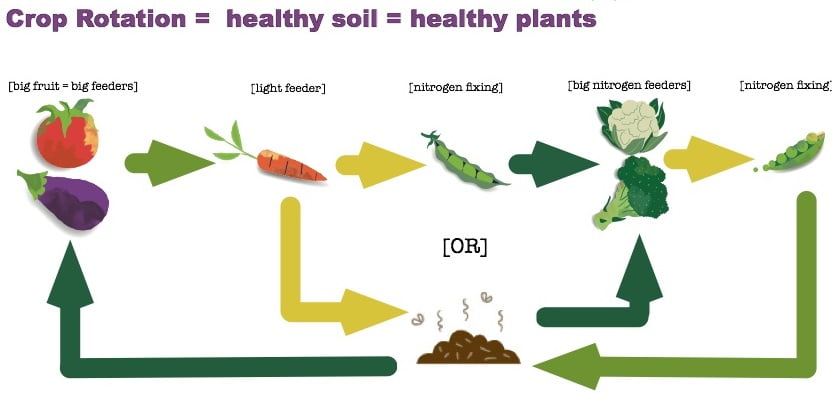
1. Nutrient balance rotation
- Heavy nutrient-demanding crops → followed by restorative crops → then lighter crops
This helps prevent soil exhaustion and maintains steady productivity.
2. Root and leafy plant alternation
- Deep-rooted crops → shallow leafy crops → legumes
This pattern improves soil structure and reduces strain on specific nutrient layers.
3. Seasonal cycling approach
- Warm-season crops → cool-season crops → soil-covering plants
This ensures the land remains productive and protected throughout the year.
Natural pest reduction through planting diversity
Changing what grows in a field from season to season makes it harder for pests and diseases to establish themselves. Many harmful insects and soil pathogens depend on a consistent food source. When that source changes, their population naturally declines.
This leads to:
- Fewer recurring pest outbreaks
- Reduced need for chemical sprays
- Healthier long-term soil conditions
It is a preventative approach rather than a reactive one.
Keeping soil active and productive over time
Soil is healthiest when it is continuously stimulated by different types of plants. Some crops loosen the soil, others add organic matter, and others help protect the surface from erosion.
By varying plant types over time, farmers encourage:
- Better water movement through the soil
- Improved air circulation around roots
- More stable soil structure
This creates a more resilient growing environment for future planting seasons.
Key takeaway
A well-planned rotation system is less about strict rules and more about consistency and diversity. When farmers vary their crops thoughtfully, they support healthier soil conditions, reduce recurring pest problems, and maintain steady farm productivity without depending heavily on external inputs.
Conclusion: The Future of Crop Rotation and Sustainable Farming for Long-Term Success
In conclusion, the growing importance of sustainable farming shows that agriculture is shifting toward smarter, more balanced, and more environmentally responsible practices. Among these practices, crop rotation remains one of the most reliable and practical methods for improving long-term farm performance, especially for small-scale farmers who need affordable and effective solutions.
What makes crop rotation so powerful is its ability to naturally restore soil fertility without relying heavily on synthetic inputs. Instead of exhausting the land through continuous planting of the same crops, rotation allows the soil to recover, rebuild nutrients, and maintain its natural balance. Over time, this leads to healthier soil conditions, stronger plant growth, and more stable agricultural output.
Another major advantage of crop rotation in sustainable farming is its role in reducing farming challenges such as pest outbreaks and plant diseases. By changing what is grown on the same land, farmers disrupt the life cycle of harmful organisms, making pest control farming more natural and less dependent on chemical pesticides. This not only lowers production costs but also supports a cleaner and safer farming environment.
From an economic perspective, benefits of crop rotation for small-scale farming profitability are becoming more evident. Farmers experience reduced spending on fertilizers and chemicals, while also enjoying more consistent yields. This combination of lower costs and stable production directly improves farm income and long-term financial security.
In addition, understanding how crop rotation improves soil fertility and reduces chemical use is essential for modern agriculture. Healthier soil means better water retention, improved nutrient cycling, and stronger resistance to environmental stress. These factors contribute to more resilient farming systems that can better withstand climate change and unpredictable weather conditions.
When looking at cost-effective sustainable farming techniques for smallholder farmers, crop rotation stands out as one of the simplest yet most impactful strategies. It does not require expensive technology or complex systems—only careful planning and consistent application. Even small adjustments in crop sequencing can lead to significant improvements in soil quality and productivity.
Furthermore, using the best crop rotation methods for natural pest control in agriculture ensures that farms remain productive without damaging the surrounding ecosystem. This approach supports biodiversity, encourages beneficial soil organisms, and strengthens the overall health of the farm environment.
Ultimately, the direction of modern agriculture is clear: the future belongs to systems that combine productivity with sustainability. Crop rotation and sustainable farming practices offer a proven pathway toward this balance. They help farmers protect their soil, reduce costs, increase yields, and build more resilient agricultural systems that can last for generations.
In the long run, adopting crop rotation is not just an agricultural choice—it is a strategic investment in the future of farming, ensuring that land remains fertile, productive, and capable of supporting food production for years to come.
About The Author